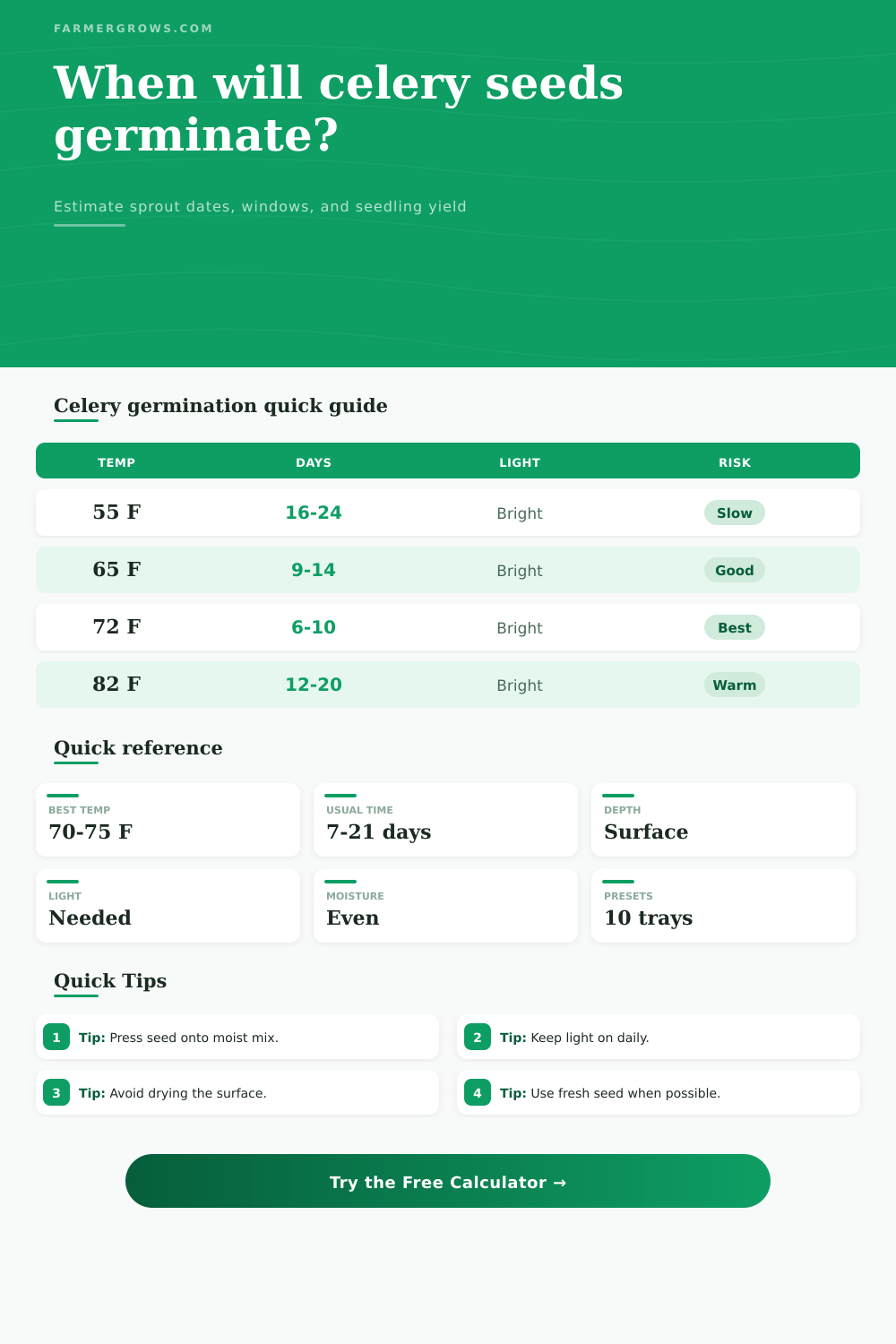
Celery Seed Germination Time Calculator
Estimate celery sprout dates, main emergence windows, likely usable seedlings, and germination risk from temperature, seed freshness, light, depth, moisture, and tray conditions.
📋Celery germination presets
Choose a realistic celery seed-starting scenario, then fine tune the temperature, light, depth, moisture, and seed age for your tray.
🌱Celery seed tray inputs
Celery seed is small, light-sensitive, and slow compared with many vegetables. Use tray-level averages, especially the actual mix temperature.
Estimated celery germination schedule
Calculated from your celery tray conditions.
Full germination breakdown
📊Condition score grid
These four live indicators explain why the celery estimate moves faster or slower than the usual 7 to 21 day range.
⚖Temperature comparison grid
Compare the same celery tray at cooler, current, ideal, and warmer mix temperatures while keeping the other inputs unchanged.
Press seed onto pre-moistened mix and cover with a humidity dome or clear cover, but leave light available. A heavy layer of mix delays or prevents celery sprouting.
Do not discard a celery tray too early. At cool temperatures or with older seed, healthy emergence can still arrive near the end of the 14 to 21 day window.
📚Celery germination reference tables
| Mix temp | Expected days | Celery response | Use note |
|---|---|---|---|
| 50-54 F / 10-12 C | 21-30 | Very slow | Use only if no warmer space is available. |
| 55-59 F / 13-15 C | 16-24 | Slow | Expect uneven emergence and a longer wait. |
| 60-64 F / 16-18 C | 12-18 | Fair | Usable, but slower than a warm tray. |
| 65-69 F / 18-21 C | 9-14 | Good | Reliable for most home seed-starting rooms. |
| 70-75 F / 21-24 C | 6-10 | Best | Ideal range for fast celery emergence. |
| 76-80 F / 24-27 C | 8-13 | Warm | Still workable if moisture remains even. |
| 81-85 F / 27-29 C | 12-20 | Stress | Too warm for consistent celery starts. |
| Seed age | Viability factor | Timing effect | Tray action |
|---|---|---|---|
| Fresh | 1.00 | Baseline | Sow normal cell count. |
| 1 year | 0.92 | +1 day | Usually dependable when stored cool. |
| 2 years | 0.80 | +2 days | Sow a few extra cells or seeds. |
| 3 years | 0.62 | +4 days | Run a small test if space is tight. |
| 4+ years | 0.42 | +7 days | Overseed heavily or replace seed. |
| Depth | Light reach | Timing effect | Best use |
|---|---|---|---|
| Surface | Excellent | Fastest | Press seed onto moist mix. |
| 1/32 in / 1 mm | Good | Minimal | Fine vermiculite dusting only. |
| 1/16 in / 2 mm | Fair | +2 days | Acceptable if cover is very light. |
| 1/8 in / 3 mm | Reduced | +5 days | Often too deep for celery seed. |
| 1/4 in / 6 mm | Poor | +9 days | High failure risk for celery. |
| Condition | Speed effect | Success effect | Celery note |
|---|---|---|---|
| Primed seed | -2 days | Higher | Very even if not allowed to dry. |
| 12 hour soak | -1 day | Slight boost | Drain well before sowing tiny seed. |
| Pelleted seed | +1 day | Good | Pellet must soften with steady moisture. |
| Surface dries | +4 days | Lower | Mist gently or bottom-water early. |
| Waterlogged mix | +3 days | Lower | Airless mix weakens tiny seedlings. |
Reference values are practical seed-starting estimates for celery. Actual results shift with cultivar, seed lot, storage history, tray depth, and daily temperature swings.
Growing celery from seed test your patience. Be gentle with those tiny seeds; take care and get condition right. Celery’s a slow grower, and most gardeners wants instant gratification, which isn’t what will happen. In fact, it may be two or three weeks before anything happen, and then it’ll go slow again. Use germination calculator to monitor things along the way.
That way, did that empty tray fail or is it simply slow? Heat are the main thing that controls speed. And while air may be warm on your windowsill, soil beneath can be cold enough to halt growth. Seventyish degrees F is considered prime territory, just warm enough to trigger plant activity but not hot enough to stress seedling. Drop below sixty and things slows down (essentially putting the plant in suspended animation). Push it up to eightyish and you risk damping off or simply cooking tiny embryos before they can establish roots. This is why gardeners don’t merely crank up room’s thermostat; they employ heat mats.
How to Grow Celery Seeds
Light is another factor that frequently trips people up. Contrary to most veggies, celery seeds requires light to begin germination. Don’t bury them heavily; typically they won’t even germinate. Simply press the seed lightly on top of damp soil (dusting it with a bit of fine vermiculite will help retain moisture and still allow the early cells to recieve light). Again, don’t cover it all the way, that heavy soil will block out the light cue. Remember, you’re trying to set things up for it to get light exposure, not dig deep carrot-like roots.
The biggest mistake in week two is moisture management. You need a moist top layer without a soggy bottom. That’s tricky; when the top is too dry, those hair-thin seedlings snaps off or shrivel before they even emerge. If you soak them again, you’ll wash out all that air space in the potting mix and they’ll rot. Use a humidity dome (which helps with the balance) but open it each day to prevent fungi.
Older seeds needs ideal conditions; newer ones has a bit more leeway. After two years, viability rate plummets, so check package date. But how do they all interconnect? Those are in reference tables, which also indicate at what point you’re adding time different than the optimum range. Two days for a few more degrees of cool is nothing. But add that to dry soil and less-than-ideal light conditions and things can quickly be delayed. This makes chasing the moving target even harder.
Enter your variables to have the tool adjust the emergence window and provide a realistic range of dates, not just a “hope. Growing celery is a lesson in learning to go with nature’s schedule. To coax along the seeds, there are things we can do: provide optimal conditions of light, heat and moisture. But biologically, things will happen when they happen. The best thing here is consistency. Maintain conditions and let them be. If it’s quiet in the tray, that doesn’t necessarily mean something went wrong. Maybe they’re simply waiting patienty to come up.