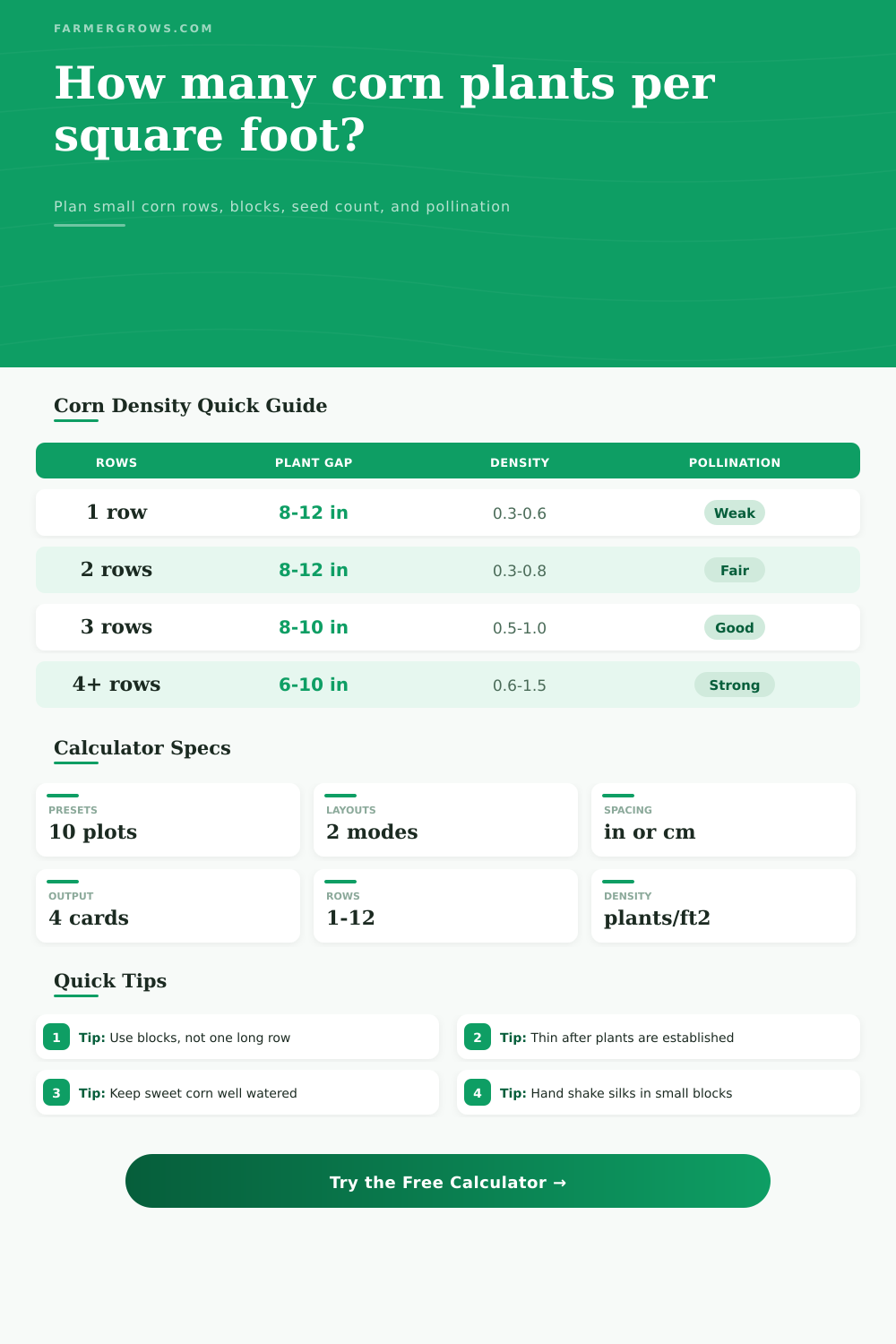
Corn Plants Per Square Foot Calculator
Plan a small corn patch from bed width, row length, row spacing, plant spacing, seed stand loss, corn type, and row-block pollination strength.
Choose a real backyard or market-garden layout, then tune spacing and stand assumptions. These presets focus on square-foot density and row-block geometry, not acre-scale population.
Small-Plot Corn Density Results
Your corn stand estimate will appear here.
Lowest pollen capture. Use only with hand help or where missed kernels are acceptable.
Better than one row, but edge plants still dominate the patch.
Useful small-garden compromise when row length is limited.
Best backyard layout for wind-pollinated sweet corn and popcorn.
Reference densities use the standard row-crop spacing formula: plants per square foot = 144 divided by row spacing in inches divided by in-row plant spacing in inches.
| Row spacing | Plant spacing | Plants per ft² | Best small-plot use |
|---|---|---|---|
| 36 in | 12 in | 0.33 | Wide traditional garden row |
| 30 in | 12 in | 0.40 | Standard sweet corn spacing |
| 30 in | 8 in | 0.60 | Tighter sweet corn or popcorn |
| 24 in | 8 in | 0.75 | Compact block with good fertility |
| 18 in | 8 in | 1.00 | Dense small bed, high water demand |
| 12 in | 8 in | 1.50 | Raised-bed sweet corn block |
| Rows in patch | Pollination strength | What it means | Practical adjustment |
|---|---|---|---|
| 1 row | Weak | Pollen often misses silks | Hand pollinate or plant a block |
| 2 rows | Fair | Some cross-row pollen movement | Keep rows short and close |
| 3 rows | Good | Better pollen cloud in the patch | Works for many small gardens |
| 4+ rows | Strong | Best small-plot ear fill pattern | Plant blocks rather than long rows |
| Germination x survival | Final plants wanted | Minimum seed drop | Planning note |
|---|---|---|---|
| 95% x 95% | 50 plants | 56 seeds | High-quality fresh seed |
| 90% x 95% | 50 plants | 59 seeds | Typical good garden seed |
| 85% x 90% | 50 plants | 66 seeds | Older seed or cooler soil |
| 75% x 85% | 50 plants | 79 seeds | Expect replant or thinning |
| Small plot layout | Typical area | Good target stand | Pollination outlook |
|---|---|---|---|
| 4 ft x 8 ft raised bed | 32 ft² | 32-48 plants | Good if 4 rows fit |
| 10 ft x 10 ft garden block | 100 ft² | 60-100 plants | Strong with 4+ rows |
| Two 20 ft rows | 80-100 ft² | 40-60 plants | Fair, hand help useful |
| Baby corn bed | 24-60 ft² | 50-120 plants | Ear fill less important |
Favor row blocks over long single rows. Corn is wind pollinated, so a short square or rectangular block usually fills ears better than one long row with the same plant count.
Density only works with water and nitrogen. Close rows raise plants per square foot, but the patch must have steady moisture, fertility, and sunlight or ear size drops quickly.
To harvest a good crop of corn, you must first know how corn differ from most any other crop grown in the garden. If you’re used to sowing one long row of sweet corn, as most people do, you’ll likely be frustrated because the ears will be half-filled or the kernels stunted-looking. More often than not, the cause has nothing to do with seed, but rather way it was planted.
Corn depend on wind to carry its pollen, so it requires a crowd. It needs neighbors nearby to catch its pollen. That’s where the calculator comes into play: It tells you how many plant to grow in your own garden (and what to expect from how closely packed those plants are). But it also teaches you something that most people don’t think about when beginning there planning: density versus spread.
How to Plant Corn in a Block
Don’t think in terms of a long row. Think in blocks. A four-foot by eight-foot block will do better then a thirty-two-foot line using the same number of plants. Why? Because pollen is heavy; it drop fast. Pollen from your block gets blown around to all nearby silks within a few inches. Too much blows way past the plant in one long row. The silks go unfertilized.
Another thing: Keep in mind the rate of germination when doing your planning. Don’t think “I want 50 plants, so I’ll plant 50 seeds.” Germination may be reduced if the weather is cool and/or damp at sowing time, as with old seed. Half don’t sprout? Then spacing will be wider, and too much space means a pollen cloud that’s thinner, and bare spots in block.
Better to sow a little more than needed, and thin them later after they’re up and growing. Yes, thinning’s involved, and nobody likes it, but crowded seedling compete for their food and for light, resulting in weakened stalks that will be unable to hold up those heavy ears down the road.
Don’t make things so roomy that the plants isolate each other. There should be plenty of room for roots to spread out and for air to move. But don’t leave it too sparse either. Eight to twelve inches between plant is a good compromise for general sweet corn, leaving enough distance for each plant to breathe, yet close enough that its tassels can reach into neighboring ones to swap pollen. The calculator will help you figure out how many seeds to sow so you don’t have to guess.
The other variable here is water. Planting densely does not work well without good irrigation. In a dense planting, the roots of each plant fights for moisture. One dry week, and whole block stunts out.
Another feature of tool is that you can account for the condition of soil: Is it fertile? Strong plants growing in a bed with lots of fertility can be planted more tightly than in a bed where the soil is dry and rocky. Match the planting density with how well you can take care of plants.
Corn growing’s all about the social dynamics: those sociable plant want to be together. Isolated? Bad idea for them. Use the density guide and reference tables to understand how much space each plant need around it. How wide the rows must be.
Two works better than one; four (a block) is best. Why? Because it makes a microclimate, keeping pollen concentrated. That turns a gamble into a reliable harvest.
Do some math: measure your bed, test your soil, and then recall that corn like company. Offer it a block, not a line, and it’ll repay you with full, sweet ears.