
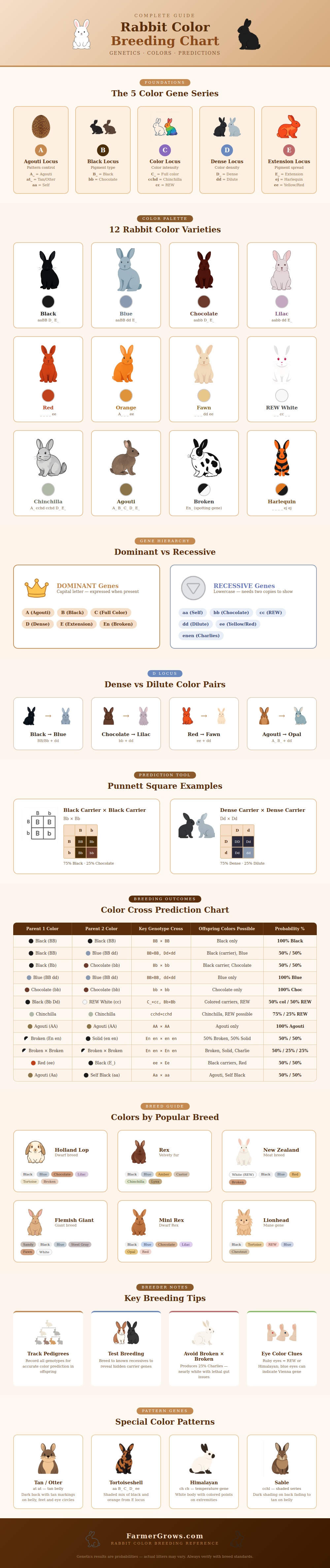
Rabbit color are the result of five main gene series that determine how the rabbit’s colors appears. By understanding these five gene series, a rabbit breeder can accurately predict the color of the litter that will be born from a pair of rabbit. The five main gene series is the Agouti gene series, the Black locus gene series, the Color locus gene series, the Dense locus gene series, and the Extension series gene.
Each of these five gene series interact with each of the other gene series, so altering the features of one gene series will alter the appearance of the entire coat of the rabbit. The Agouti gene series determine whether the rabbit has bands of color throughout the coat like a wild rabbit or if the rabbit’s fur is a solid color. The Black locus gene series determine the type of eumelanin in the rabbits’ coat and allow the rabbit to be black or chocolate colored.
How Rabbits Get Their Fur Color
The Color locus gene series determine the intensity of the color of the rabbit’s fur, ranging from full vibrancy to chinchilla silvering or ruby eyed white rabbits. The Dense locus gene series determine the saturation of the color of the rabbits fur; the presence of the dilute gene in a rabbit will change bold colors like black to a blue color. Finally, the Extension series gene control how the pigment spread over the coat and allows the rabbit to produce red or orange color fur.
A recessive gene in the rabbit’s coat causes the dilution of a rabbit’s color; the rabbit will only display the diluted color of its fur if it have two copies of the dilute gene. For instance, if one breed a black rabbit with a blue rabbit that has two copies of the dilute gene, and if the black rabbit is also a carrier of the dilute gene, then half of the kits will be blue and half will be black. This is because the dilute gene is recessive and the black rabbit will show black color but will pass along the dilute gene for its offsprings.
The dominance of each gene series for the rabbits determine which traits will be visible on the rabbits. Capital letter represent the dominant gene for a specific trait and lowercase letters represent the recessive gene. The dominant gene will hide the recessive gene in the rabbits coat color.
For instance, if a rabbit has a black gene that is dominant to a chocolate gene, the color of the rabbits’ coat will be black. In order to calculate the probabilities of each color of the rabbits’ kits, you can use Punnett squares. However, the probabilities are only an estimate of what the color of the kits will be.
Rabbit pattern are also determined by genes; these pattern genes can also be layered over the base colors of the rabbits’ fur. For instance, the En gene will result in broken spotting in the rabbit’s fur; the color will be scattered over a white base color. However, you should take care when breeding for these genes, as breeding two rabbits with broken fur will result in what are known as charlie rabbit.
Charlie rabbits have faint spot of color in their coats and are mostly white in color. In addition, these rabbits tend to have gut defect that make them unable to survive long period of time. Breeds of rabbits has different color varieties.
For instance, breeders breed Holland Lop rabbits for blacks, blues, chocolates, tortoiseshell, and broken fur pattern. Rex rabbits are bred for castor agouti or lynx dilute colors. New Zealand rabbits are bred for whites, reds, or blacks.
Flemish Giants have sandy or steel gray fur and Mini Rex rabbits has opal blue fur. To ensure that the kits have the proper color varieties, the breeding rabbits should match the characteristic of the breed to which you intend to contribute. The best way to simplify the breeding of rabbits is to utilize a breeding prediction chart.
Breeding a pure black rabbit with another pure black rabbit will result in black kits only. However, breeding a black carrier rabbit with a chocolate rabbit will result in half black kits and half chocolate kit. Breeding an Agouti carrier with a self color rabbit will result in half of the kits having the broken fur pattern and half having solid color fur.
Additionally, tracking the pedigree of rabbits being bred will provide information about the color of the kits. Furthermore, the color of the rabbits’ eye will indicate some of the gene that the rabbit carries.