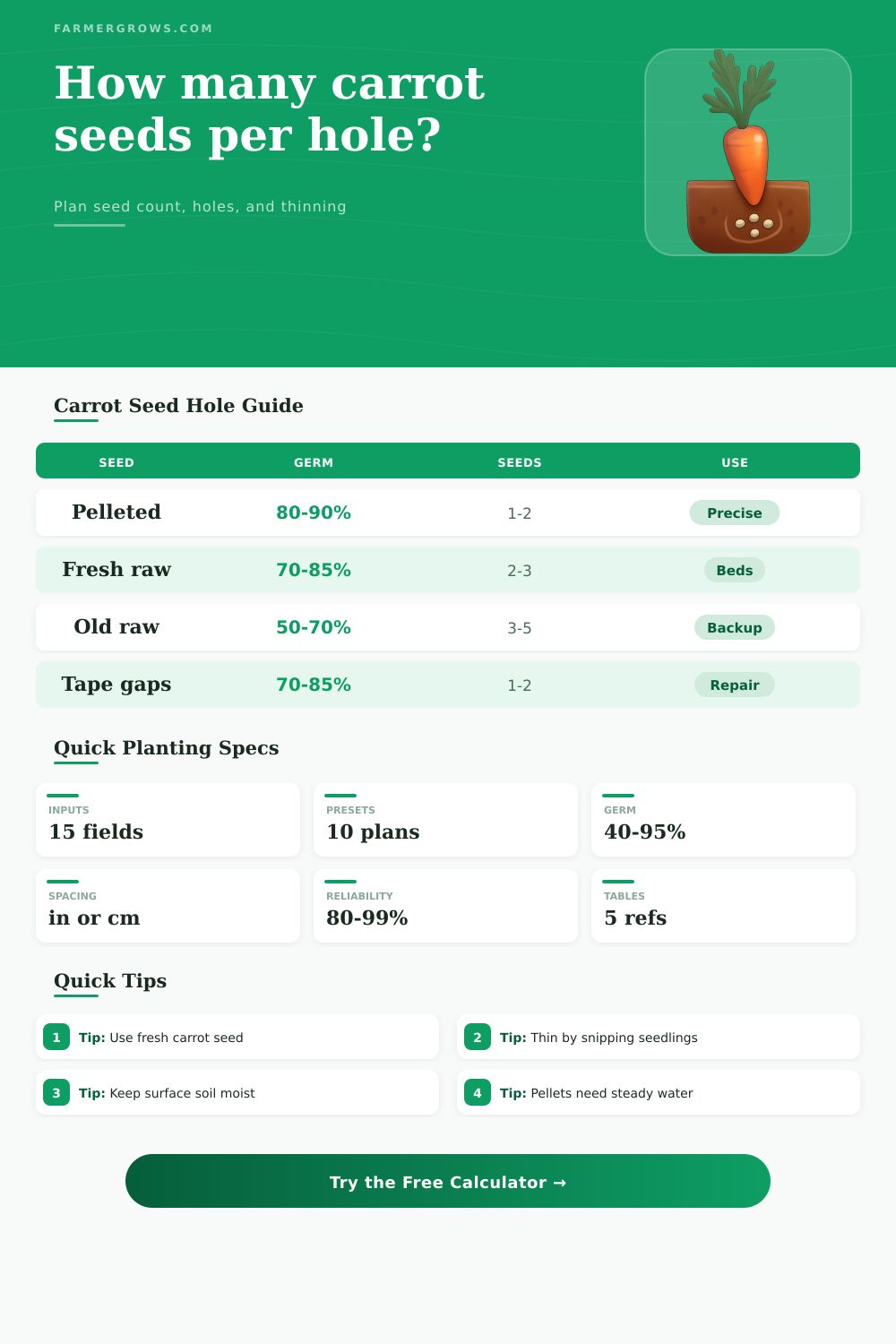
Carrot Seeds Per Hole Calculator
Estimate how many carrot seeds to place in each shallow hole, dibble, plug, or repair spot using germination, field emergence, reliability, spacing, thinning goals, and packet size.
Carrots are often sprinkled in furrows, but many gardeners plant them in tiny stations, seed-tape gaps, plug trays, paper pots, and dibbled grid beds. This calculator treats each station as a shallow hole and finds the smallest seed count that meets your stand reliability target.
Your Carrot Seed Plan
Enter planting details to calculate carrot seeds per hole.
| Carrot type | Final in-row spacing | Row spacing | Seeds per hole starting point | Best use |
|---|---|---|---|---|
| Baby or mini carrots | 1 to 1.5 in | 3 to 5 in | 2 to 3 raw seeds | Dense early harvests |
| Nantes fresh carrots | 1.5 to 2.5 in | 5 to 8 in | 2 to 3 raw seeds | Fresh eating and bunching |
| Danvers storage carrots | 2.5 to 3.5 in | 8 to 12 in | 2 to 4 raw seeds | Fall storage roots |
| Imperator long carrots | 2.5 to 4 in | 8 to 12 in | 2 to 3 raw seeds | Deep, loose beds |
| Chantenay carrots | 3 to 4 in | 9 to 12 in | 2 to 4 raw seeds | Heavier soil and broad roots |
| Live emergence per seed | 1 seed succeeds | 2 seeds succeeds | 3 seeds succeeds | 4 seeds succeeds |
|---|---|---|---|---|
| 85% | 85.0% | 97.8% | 99.7% | 99.9%+ |
| 75% | 75.0% | 93.8% | 98.4% | 99.6% |
| 65% | 65.0% | 87.8% | 95.7% | 98.5% |
| 55% | 55.0% | 79.8% | 90.9% | 95.9% |
| 45% | 45.0% | 69.8% | 83.4% | 90.8% |
| Planting layout | Length | Rows | Final hole spacing | Approx holes |
|---|---|---|---|---|
| 4 x 8 ft raised bed | 8 ft | 7 rows | 2 in | 336 holes |
| Baby carrot square | 4 ft | 12 rows | 1.25 in | 456 holes |
| Storage carrot rows | 20 ft | 4 rows | 3 in | 320 holes |
| Seed tape repairs | Manual | Manual | Gap only | 25 holes |
| Metric allotment bed | 3 m | 8 rows | 5 cm | 480 holes |
| Result from calculator | Likely field situation | What to do | Why it matters |
|---|---|---|---|
| 1 seed per hole | Fresh pellet or high germination | Check moisture twice daily | One miss creates a gap |
| 2 seeds per hole | Fresh raw seed or pellets | Thin to one at first true leaves | Good balance of gaps and thinning |
| 3 to 4 seeds per hole | Older seed or tougher seedbed | Snip extras early | Protects the chosen root |
| Many expected gap holes | Low live emergence | Re-sow quickly or use fresher seed | Carrots are slow to catch up |
Use shallow holes. Carrot seed is usually covered only lightly. Treat each hole as a tiny station, not a deep pocket that traps the seed below its preferred depth.
Thin by cutting. When more than one carrot emerges in a hole, snip the extras at soil level. Pulling can disturb the root you want to keep.
Carrots: When you plant a row of carrot seeds, you space them at a distance that allows each root enough room to grow. Too little space between them, and they becomes thinned-out forked straws. Too much space wastes precious garden real estate while you harvest less food.
How do you get the tiny, dust-like seeds into their holes individually? Not easily! Usually you drop zero seeds, or three. By doing the reverse math, the number of seeds you’ll have to sow to yield how many plants, you can plan your rows more better.
How to Plant Carrots Correctly
It’s all about the numbers, or at least some math: There is the number of seeds that will actualy grow (germination). Then there are the ones that will survive in the ground (field emergence). This can be impacted by uneven moisture, pests, soil drying out, or soil crust. Estimating each value matter; it impacts what you plant where.
For instance, maybe the seed says it has an eighty percent germination rate…but what happens if the ground dries out fast? Your rate may go down. With this tool, you can enters a lower germination rate as a way to account for possible bad luck. If you decrease emergence expectation, the tool will adjust number of recommended seeds to make sure you get the number of plants you want.
Some seeds come pelleted (coated in material that makes them bigger and less fiddly), others are raw. If it’s pellets, you can sow one or two per hole with confidence. If they are raw, which is smaller and harder to place accurately, you’ll need to plant extra to account for mis-placing some when sowing and for those lost naturaly. After you choose seed type, the calculator will adjust number accordingly. Since pellets are already larger than raw seed, the calculator use a smaller buffer for them.
Seeds get older and die off fast, faster then you think. If they haven’t been stored perfectly, they’re likely gone in a year or two. Don’t assume the number printed on the bottom of an out-of-date seed packet mean anything, test a sample yourself. Then enter that more-reasonable-percentage figure into the tool so it recommends planting more seeds per hole.
No point having holes in your row where nothing ever happens. It is better to thin three seedlings now than to wait six weeks for bare ground and watch the growing season slip away. Carrots sown too thickly stunt; they’ll fight each other for space and nutrition, so thinning matter. To figure out how much excess to discard (based off germination rate and how thickly you sow), use this calculator.
Don’t pull the extras, snip them off instead. Why? If pulled, you disturb the roots of the surviving plant, which can lead it to fork or be stunted while it heals itself. Snipping preserves soil structure, leaving a clean path for selected carrot to follow.
Some varieties grow wider than others. Danvers types are chunkier, while Nantes ones is long and narrow. They require more or less space to fill out, respectively. To avoid having to remember all that information, the tool’s reference tables includes spacing instructions. Just input your bed measurements, and it figures out how many holes will fit inside those limits. It also factors row spacing into its calculations. People frequently forget this when they only think about how much space to leave between items planted end-to-end.
The end result is knowing how many packets you need. And how much seed will you use (with some cushion in case you have to reseed things, or miscount)? No more overspending on seed; no more hoarding packets that go bad. No advanced math about probabilities required; just the numbers that make sense for making your garden happen.
You get properly spaced rows of carrots, not wasted seed in open ground. Practical without sacrificing precision: That’s what planning should of been good for.