Greenhouse Plastic Calculator
Estimate greenhouse cover area, roll width, overlap, film layers, and total roll length for hoop houses, gable bays, lean-tos, and multi-span film structures.
Choose a familiar greenhouse footprint to seed the calculator. Each preset sets the style, dimensions, roll width, overlap, end allowance, layers, and waste so you can compare jobs quickly.
Film Output
Live results update from the greenhouse shape, roll width, overlap allowance, layers, and waste buffer.
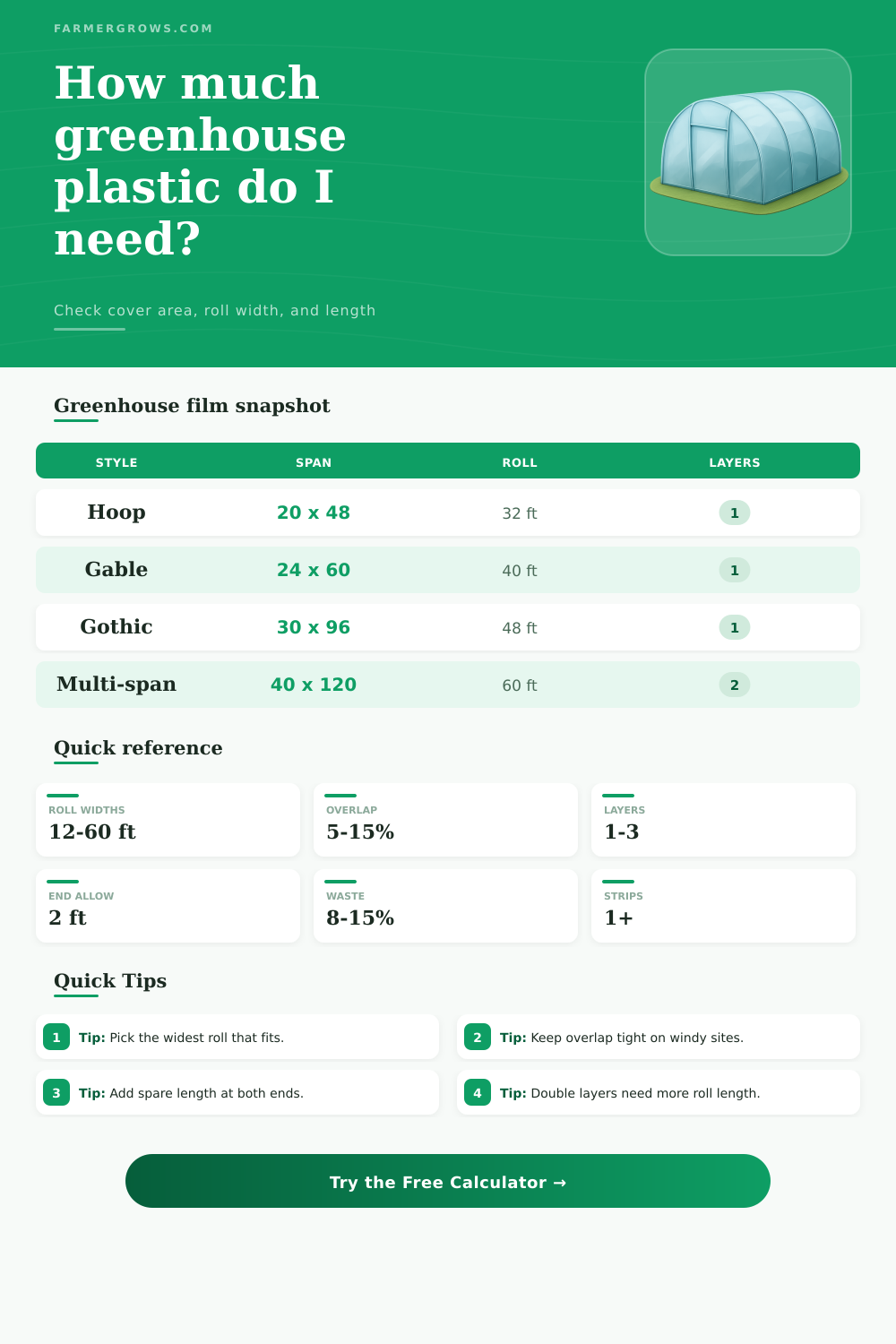
| Roll width | Span fit | Good for | Note |
|---|---|---|---|
| 12 ft | Small tunnels | Starter beds | Easy to handle |
| 16 ft | Compact houses | Low hoop bays | Good for short runs |
| 24 ft | Mid spans | Propagation | Common farm choice |
| 32 ft | Wide spans | High tunnels | Fewer seams to tape |
| 40 ft | Large spans | Gable bays | Better for fuller roofs |
| 48 ft | Deep shells | Gothic houses | More material, fewer joins |
| 60 ft | Commercial | Multi-span bays | Fastest wide cover option |
| Style | Cross-section idea | End area idea | Use case |
|---|---|---|---|
| Hoop house | Half ellipse arc | Rect + arch | Fast season extension |
| Gable roof | 2 x slope length | Rect + triangle | Simple framed house |
| Gothic arch | Longer arch arc | Rect + arch | Better snow shedding |
| Lean-to | One slope + wall | Reduced end face | Attached side house |
| Multi-span | Gable plus gutter | Wider end face | Connected commercial bays |
| Site | Overlap | Waste | Planning hint |
|---|---|---|---|
| Sheltered yard | 5% | 5-8% | Best for tidy installs |
| Average farm | 8% | 8-10% | Safe middle ground |
| Windy ridge | 12% | 10-12% | Add more seam grip |
| Cold winter bay | 15% | 12-15% | Use extra trim margin |
| Layers | Use | Order effect | Planning note |
|---|---|---|---|
| 1 layer | Spring work | Lowest film need | Fastest and lightest |
| 2 layers | Winter cover | Double length need | Common for cold nights |
| 3 layers | Special builds | Triple length need | Rare but useful for trials |
| Repair strip | Patch work | Small spare roll | Keep on hand for tears |
Wide single roll
- One pass across the shell.
- Fastest setup and least handling.
- Best when the chosen width fits well.
Narrow roll seam
- More strips but easier to source.
- Useful for small or awkward spans.
- Expect a little more overlap waste.
Double layer winter
- More film, more insulation help.
- Good for cold nights and wind.
- Roll length rises quickly.
Commercial wide bay
- Large roll widths cut seam count.
- Best for multi-span structures.
- Needs more total film on hand.
Calculating the correct amount of greenhouse plastic is an essential task in establishing the required plastic for a greenhouse. If the calculation is incorrect, it will lead to either shortages in the plastic supply or excess plastic that can be wasted. Greenhouse plastic are sold in large rolls.
The price for greenhouse plastic is priced by the square feet. If a person underestimates greenhouse plastic requirement, it will result in a delay of the project. However, if a person overestimates the amount of greenhouse plastic require, it will result in purchasing plastic that will go unused.
How to Work Out How Much Greenhouse Plastic You Need
The greenhouse’s geometric structure will determine the amount of greenhouse plastic required. The dimensions of the greenhouse must be accounted for, including the span width, sidewall height, and peak height. A person cannot measure the greenhouse by measuring only the flat dimension.
The arc length of the arches must be calculated because it is a longer measurement than the straight length between the two points. If the width of the plastic roll does not match the cross-sectional greenhouse dimensions, a person will have to seam greenhouse plastic strip together. Seaming greenhouse plastic strips will lead to an overlaps in the plastic.
Overlapping greenhouse plastic sheets is necessary to secure the plastic to the greenhouse frames. However, the overlap percentage depend on the sites environment conditions. A five percent overlap is used for calm sites.
However, a twelve or fifteen percent overlap is necessary on a ridge top to balance the wind force. Using a larger percentage to overlap the greenhouse plastic will require more greenhouse plastic. The additional amount of greenhouse plastic will require more seam in the plastic sheets.
More seams will require more labor to tape each seam. Additionally, more seams will result in greenhouse plastic being wasted during the trimming of the plastic sheets to the greenhouse dimensions. The roll width of the greenhouse plastic must be carefully choose.
Using a roll that is too wide will result in greenhouse plastic that is not used. Using a roll that is too narrow will result in many seams to the greenhouse plastic sheets. Greenhouses can use a single, double, or triple layer of greenhouse plastic.
A single layer of plastic is used for spring tunnel. A double layer of plastic is used for winter greenhouses for the insulation provided by the air layer in between the two sheet of plastic. A triple layer of plastic is used for cold frames to gather as much heat as possible.
An additional length of plastic is required for each layer of greenhouse plastic to provide the needed coverage to the greenhouse. The end plastic allowance are used for burying the plastic in the soil or for tucking it under greenhouse door. A person should always order a batch of greenhouse plastic that includes a waste buffer.
The waste buffer is used for the greenhouse plastic that is wasted during the greenhouse plastic cutting process. An eight to fifteen percent waste buffer is recommended. A larger waste buffer will be required in an exposed greenhouse site; however, a smaller percentage is use in a greenhouse located in a sheltered area.
The dimensions of the greenhouses can vary, and each style require different calculations for greenhouse plastic. Hoop houses have half-ellipse dimensions that require more greenhouse plastic than a straight line measurement. Greenhouses with gothic arches have sharper curves to allow snow to run off the greenhouse roofs.
These roofs require more greenhouse plastic than hoop farm. Greenhouses with gable roofs have straight slope and are easy to frame but require more greenhouse plastic. Lean-tos use one of the existing greenhouse walls and require less plastic on one side.
However, they are more difficultly to manage regarding drainage. Multi-span greenhouses use gutters to connect the greenhouses. The dimensions of these greenhouses require wider roll of greenhouse plastic.
The rolls of greenhouse plastic come in various sizes. Twelve-foot rolls of greenhouse plastic are suitable for small greenhouses. However, thirty-two or forty-foot rolls are better for high tunnel.
Sixty-foot rolls are used for multi-span greenhouses. The roll dimensions must match the size of the greenhouse cross-section to avoid wasting plastic or using too much seams in the plastic sheets. Some of the most common mistakes when calculating the amount of greenhouse plastic needed include forgetting the rise in the greenhouse height and assuming the length of the flat side of the greenhouse is the same than the length of greenhouse plastic needed.
People must remember to order a repair roll of greenhouse plastic as it can tear during the greenhouse setup. Following these steps will ensure that the greenhouse plastic provide the coverage required for the greenhouse’s plants.