🌱 Greenhouse Bow Length Calculator
Estimate circular bow length, radius, arc gain, bow count, and a practical material takeoff for greenhouse frames. The takeoff includes bows, purlins, base rails, endwall framing, stock length, and waste.
Pick a common greenhouse layout to seed the calculator. Each preset sets unit system, bow style, span, rise, length, spacing, pipe size, purlin rows, ridge rows, stock length, and waste.
Bow Geometry Output
Enter dimensions to see bow arc length, radius, bow count, total takeoff, and estimated weight.
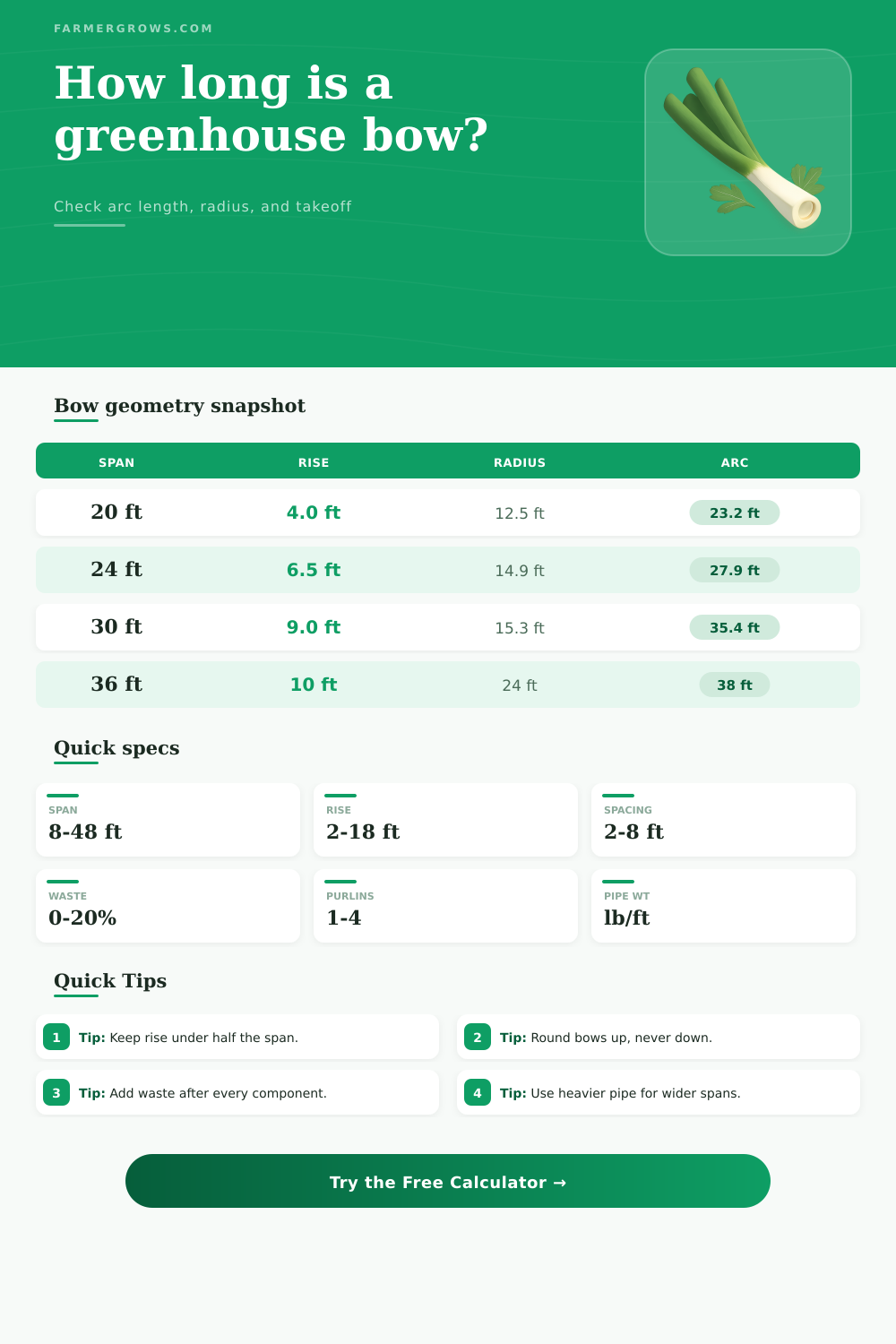
| Bow style | Span x rise | Radius | Arc length |
|---|---|---|---|
| Low tunnel | 20 x 4 | 12.5 ft | 23.2 ft |
| Standard | 24 x 6.5 | 14.9 ft | 27.9 ft |
| High tunnel | 30 x 9 | 15.3 ft | 35.4 ft |
| Semi-circle | 36 x 18 | 18 ft | 56.5 ft |
| Pipe profile | OD x wall | lb/ft | kg/m |
|---|
| Component | Formula | Included | Notes |
|---|---|---|---|
| Bows | arc x count | Yes | Every hoop plus ends |
| Side purlins | length x rows x 2 | Yes | Both sides counted |
| Ridge purlins | length x rows | Yes | Top line or top lines |
| Base rails | length x 2 | Yes | One rail on each side |
| Endwalls | 2 x (span + 2r) | Yes | Conservative frame allowance |
| Waste | raw x allowance | Yes | Applied after all parts |
| Project | Span x length | Bow count | Notes |
|---|---|---|---|
| Starter hoop | 12 x 24 | 7 bows | Easy budget build |
| Market tunnel | 20 x 48 | 13 bows | Good retail size |
| High tunnel | 24 x 96 | 25 bows | Most common row tunnel |
| Commercial bay | 40 x 120 | 31 bows | Heavy takeoff |
| Stock piece | Imperial | Metric | Use |
|---|---|---|---|
| Short stick | 20 ft | 6.1 m | Starter frames |
| Common stick | 24 ft | 7.3 m | Most greenhouse pipe |
| Long stick | 30 ft | 9.1 m | Fewer splice joints |
| Extra long | 40 ft | 12.2 m | Commercial bays |
When building a hoop house, you must calculate the length of the bow that will comprise the structure. The length of the bows will determine the shape of the hoop house. If the length of the bows are incorrect, the hoop house may sag or not provide enough space for the plant that will be grown within the hoop house.
A hoop house is constructed with curved pipes that determines the growing environment for the plants within an hoop house. A bow is a curved piece of pipe. The span of the bow is the distance from one side of the hoop house to the other side of the hoop house.
How to Calculate Bow Length for a Hoop House
The rise of the bow is the distance from the ground or the knee wall to the highest point of the bow. When building a hoop house, you must decide on the rise of the pipe. A shallow rise use less pipe but provides less headroom within the hoop house.
A rise that is too high than the span of the hoop house may cause the pipe to want to straighten out due to the weight of the plastic. A rise of one-quarter or one-third of the span of the hoop house is generally the best choice for the rise of the pipe. The bows need to be space apart in the hoop house.
Many farm builders places the bows four feet apart. This is the standard distance between bows for row crops. If the bows are placed too close together, there will be excess pipe require to build the hoop house.
If the bows are placed too far apart, the snow may accumulate between the bows. Once you have determined the distance between the bows, you can calculate the number of bows that will be required for the hoop house. The number of bows should always be rounded up so that there will be bows to frame the endwalls and the door of the hoop house.
The purlins will run the length of each bow and connect each bow together. Purlins will help to hold the plastic in place on the hoops and will add to the structural strength of the hoop house. One purlin may be used on each side of the hoop house for light-duty gardening project.
However, more purlin will be needed if the hoop house is to be built in an area that receives alot of wind or if the plastic will be a heavy plastic such as polyethylene plastic. The base rails will anchor the hoop house to the ground. The endwalls will form the entrance to the hoop house.
If the hoop house is to be narrow, thinner pipes will make it easier to move the hoop house to different locations in the garden. For hoop houses that are to be wide and span more than thirty feet, the pipes will need to be thicker so that they can support they’re own weight. The weight of the pipe will impact the labor that is required to build the hoop house and the weight that the trailer will have to support for transport of the hoop house to the garden.
A common mistake in building hoop houses is to not take into account the arc gain of the bows. The arc gain of the bows is the difference in length between the bows when they are straighten and when they are curved. The curved bows are longer than the spans of the bows.
For each span of the hoop house, the bows may be five to twenty percent longer. If the length of the bows is calculated only to cover the spans, there will not be enough bows to create the curve of the bows. A waste allowance of ten to twenty percent should always be added to the length of the bows to account for potential cutting and bending of the bows in the construction of the hoop house.
A formula can be used to calculate the radius of the bows and the arc length of the bows. To calculate the radius, you can take the span of the bow twice and divide the result by eight times the rise. To this result, half of the rise is added.
The arc length is calculated by taking the radius of the bows and multiply it by the central angle in radians. The arc length of the bows will show how long each bow should be. Environmental factors will influence the way in which the hoop house is built.
For example, if the hoop house is to be built on a slope in the garden, the rise of the bows on the low side of the slope may need to be increased so that the hoop house remains even with the remainder of the garden. If the garden is well known for high winds, thick pipes and close proximity between the bows may be necessary for the hoops. Additionally, purlin may be used to prevent the plastic from rattling in the wind.
After calculating each of these variable, a complete list of the materials for the hoop house can be prepared.