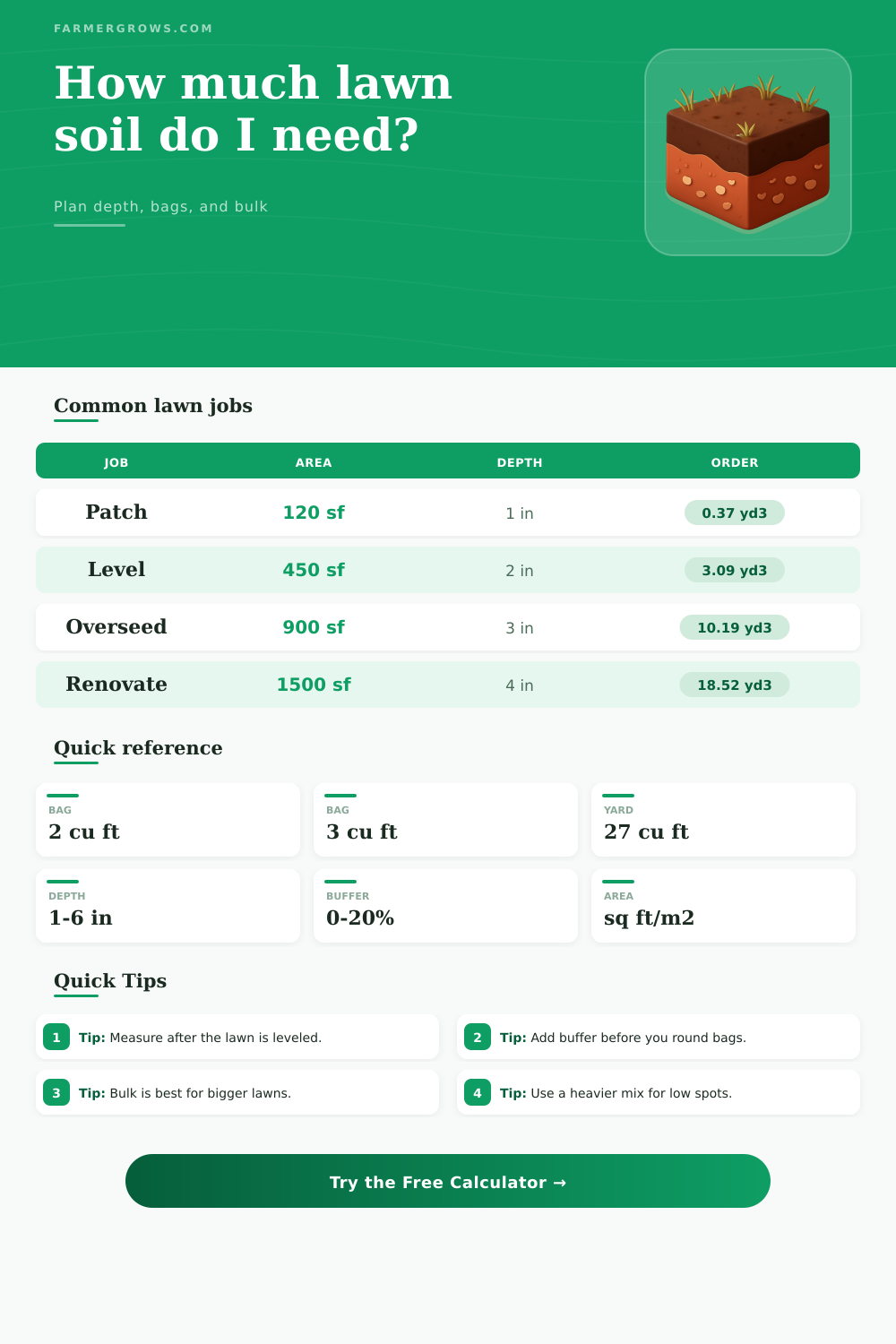
Soil Calculator for Lawn Topdressing
Estimate lawn topdressing area, depth, bag counts, bulk yards, and weight. Use a preset or fine-tune the surface, overage, and material density for the order.
Choose a real lawn scenario to seed the fields. Each preset sets dimensions, zone count, depth, bag size, compaction allowance, overage buffer, density, and material type.
Lawn Topdressing Output
Calculated from lawn area, depth, material density, and overage above.
| Bed | 8 in | 12 in | 18 in | Notes |
|---|---|---|---|---|
| 2x4 | 4.00 ft3 | 6.00 ft3 | 9.00 ft3 | Small herb box |
| 3x6 | 9.00 ft3 | 13.50 ft3 | 20.25 ft3 | Handy narrow bed |
| 4x4 | 8.00 ft3 | 12.00 ft3 | 18.00 ft3 | Square planter |
| 4x8 | 16.00 ft3 | 24.00 ft3 | 36.00 ft3 | Standard layout |
| 3x10 | 13.33 ft3 | 20.00 ft3 | 30.00 ft3 | Long kitchen row |
| 4x12 | 24.00 ft3 | 36.00 ft3 | 54.00 ft3 | Large market bed |
| Bag size | 6 in depth | 8 in depth | 12 in depth | Use note |
|---|---|---|---|---|
| 0.75 cu ft | 1.50 sq ft | 1.13 sq ft | 0.75 sq ft | Top-off only |
| 1.50 cu ft | 3.00 sq ft | 2.25 sq ft | 1.50 sq ft | Small zones |
| 2.00 cu ft | 4.00 sq ft | 3.00 sq ft | 2.00 sq ft | Common bag |
| 3.00 cu ft | 6.00 sq ft | 4.50 sq ft | 3.00 sq ft | Heavy duty |
| 40 L | 1.41 cu ft | 1.06 cu ft | 0.71 cu ft | Metric bag |
| 1000 L | 35.3 cu ft | 26.5 cu ft | 17.7 cu ft | Bulk tote |
| Crop type | Depth | Root note | Bed fit |
|---|---|---|---|
| Lettuce | 6-8 in | Shallow roots | Quick turnover |
| Herbs | 6-8 in | Compact root zone | Great edge rows |
| Strawberries | 8-10 in | Even moisture | Low profile |
| Beans | 10-12 in | Moderate roots | Easy fit |
| Tomatoes | 12-18 in | Deep feeder | Stakes help |
| Root crops | 12-16 in | Loose soil | Choose fine mix |
| Squash | 12-18 in | Wide feeder | Needs room |
| Asparagus | 18-24 in | Long-lived crowns | Deep bed only |
| Blend | Topsoil | Compost | Coir | Aeration | Use note |
|---|---|---|---|---|---|
| All-purpose | 50% | 30% | 15% | 5% | Best value fill |
| Veg boost | 40% | 40% | 10% | 10% | Feeding zones |
| Tomato rich | 35% | 45% | 10% | 10% | Heavy feeders |
| Berry light | 45% | 30% | 15% | 10% | Moist but airy |
| Seed start | 30% | 35% | 25% | 10% | Soft texture |
| Dry climate | 50% | 20% | 20% | 10% | Drains fast |
| Waterwise | 55% | 20% | 15% | 10% | Retains more |
| Loamy deep | 45% | 35% | 10% | 10% | Strong structure |
Topdressing involve the spreading of materials like soil, compost, or sand over a lawn. Lawn topdressing is performed to even out uneven surface and to provide better health to the grass roots. Topdressing can help fix low spots in the lawn where water tend to collect and can provide nutrients to the grass.
If there is to little topdressing, the low spot in the lawn will remain. However, if there is too much topdressing, it will smother the grass roots. Therefore, you should of perform calculating the correct amount of topdressing to allow the grass to grow through the added layer of topdressing material.
How to Topdress Your Lawn
To calculate how much topdressing is needed, you must first determine the total square footage of the lawn. The total square footage are obtained by multiplying the length of the lawn in feet by the width of the lawn in feet. If the lawn is comprised of several patch, each patch must be measured separately and the measurements added together to determine the total lawn area.
Once you determine the total lawn area, the depth of the topdressing must be select. The depth of the topdressing is usually measured in inches. A thin layer of topdressing is usually between a quarter of an inch and a half-inch.
A thick layer of topdressing is usually between one and two inch deep. The depth impact the amount of topdressing needed because a small increase in depth requires a much larger quantity of topdressing material. The type of topdressing material will impact the total weight and number of bag of topdressing that are ordered.
The density of the topdressing material impact the total weight of the topdressing material. A blend of soil and compost will be denser than a blend that contains more air and organic matter. The density will impact how much the topdressing will weigh.
During the topdressing process, the topdressing will compact. When you water the topdressing, it will settle into the ground. During this process, the lawn will lose approximately 10 percent of the total topdressing volume.
Another potential loss of topdressing material is spillage. During the spreading of the topdressing, some of the material may spill from the edge of where it was spread. This loss in volume is typically between 5 and 10 percent of the total volume of the topdressing material.
Due to these two losses of topdressing material during the process, it is recommended that homeowners order more topdressing then the mathematical calculation of the total amount of material required. When purchasing topdressing, there are two main option, buying it in bags or buying it in bulk. If the lawn area to be topdressed is small, it is best to buy bags of topdressing to make transport of the product easy in the vehicle.
For lawns of larger areas, buying top dressing in bulk will result in cost savings for the homeowner. Topdressing in bulk is typically cheaper per cubic yard than bags of topdressing. However, buying bulk may require the delivery of the product to the lawn area which might cost an additional fee.
You can compare the cost of buying many bags of topdressing with the cost of buying bulk topdressing to determine the cost of topdressing the lawn. Topdressing should be performed during the spring or fall months when the grass is growing the most fast. When the grass is growing quickly, it can easily grow through the layer of topdressing.
Before laying the topdressing material on the lawn, the grass should be mowed to a short height. The soil should also be aerated if it is compacted. After you spread the topdressing with a rake or a drag mat, the area should be watered to help settle the topdressing into the soil.
There are many different blend of topdressing. An all-purpose blend contains soil and compost and is used for general lawn maintenance. Other topdressings are designed to improve drainage in the soil while others are used to improve the moisture content of the soil.
The density of the blend will impact the total volume of topdressing required to topdress the lawn. Prior to purchasing a blend of topdressing for the lawn, it is important to test the soil. When testing the soil, information will be provided regarding the type of nutrients that is needed in the soil, such as lime.
By selecting the proper blend of topdressing for the soil type, the lawn will benefit as the microbe in the soil will be fed and the pH of the soil will be maintained. Its important to remember that the soil’s health is the most importent thing. The homeowners’ lawn will look much more luxurius.