🥚 Egg Incubation Calculator
Plan the setting date, hatch window, lock-down timing, humidity, temperature, and turning checkpoints for chicken, duck, goose, turkey, quail, and similar eggs.
Choose a common egg type to load a realistic incubation day count, lock-down offset, humidity band, and turning schedule. You can fine-tune everything after the preset fills.
Hatch schedule results
Set the dates and the calculator will show the day count, hatch window, lock-down timing, climate plan, and turn schedule.
| Bird | Days | Temp | Lock | Humidity |
|---|---|---|---|---|
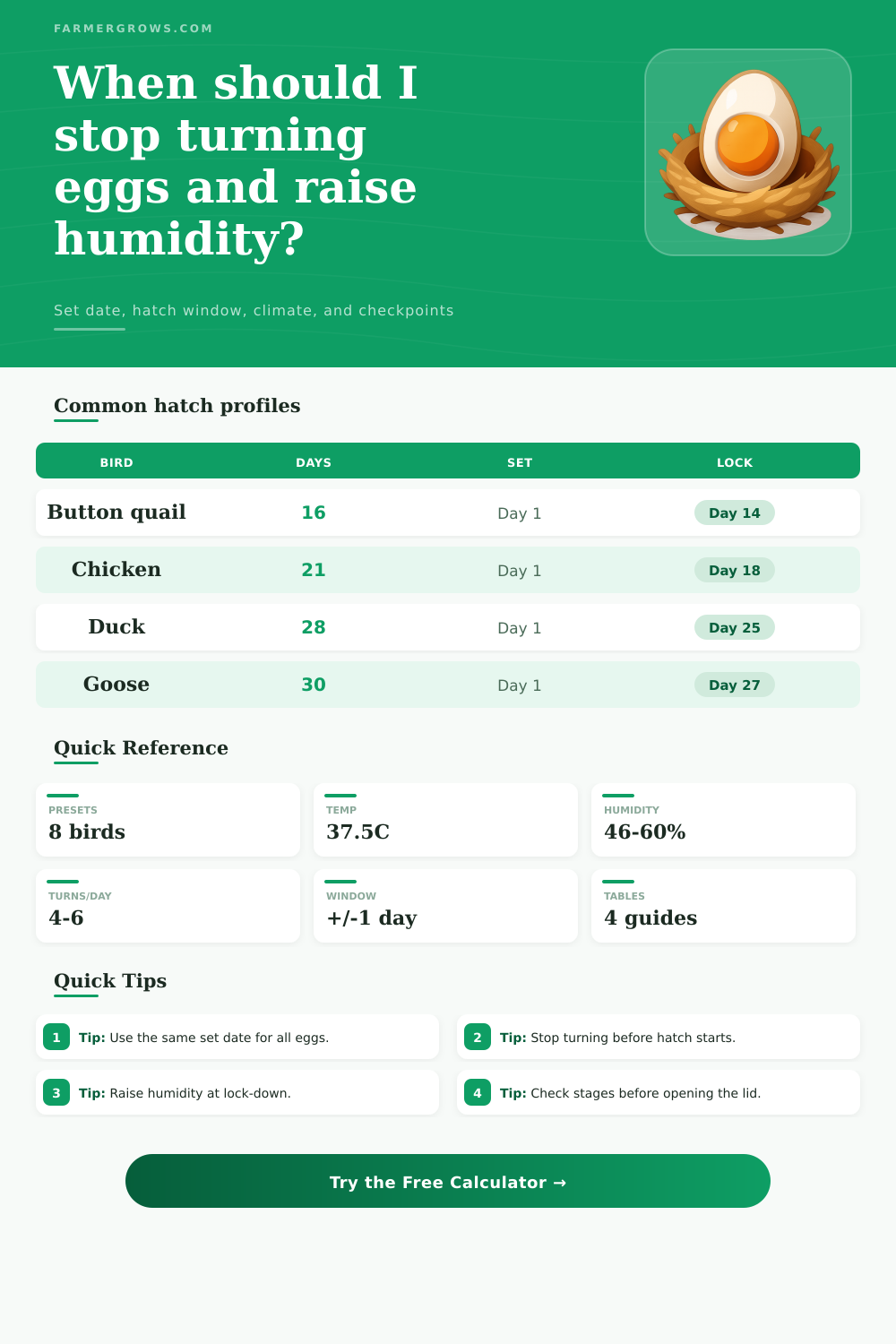
| Button quail | 16 | 37.6 C | Day 14 | 46% |
| Coturnix quail | 17 | 37.5 C | Day 15 | 48% |
| Chicken | 21 | 37.5 C | Day 18 | 50% |
| Pheasant | 24 | 37.5 C | Day 21 | 50% |
| Guinea fowl | 26 | 37.5 C | Day 23 | 50% |
| Duck | 28 | 37.2 C | Day 25 | 58% |
| Turkey | 28 | 37.4 C | Day 25 | 56% |
| Goose | 30 | 37.2 C | Day 27 | 62% |
| Phase | Day range | Temp | Humidity | Turning |
|---|---|---|---|---|
| Early incubation | Day 1 to 33% | Base temp | Base humidity | Turns/day |
| Middle phase | 33% to lock | Base temp | Base humidity | Turns/day |
| Lock-down | Stop day to hatch | Base temp | Base + 8% | Stop turning |
| Hatch window | Hatch +/- window | Base temp | Lock + 4% | No turning |
| Value | Formula | What it means | Use |
|---|---|---|---|
| Interval | 24 / turns per day | Hours between each turn | Spread turns evenly |
| Stop day | Days - lock offset | First no-turn day | Start lock-down |
| Turning days | Stop day - 1 | Number of turn days | Before lock-down |
| Total actions | Eggs x turns x days | All turn events in batch | Workload estimate |
| Checkpoint | Day formula | Date formula | What to check |
|---|---|---|---|
| Early check | round(days x 0.25) | Set date + day - 1 | Evaporation trend |
| Mid check | round(days x 0.50) | Set date + day - 1 | Turning and growth |
| Pre-lock | Stop day - 1 | Set date + day - 1 | Humidity and shell drying |
| Hatch window | Days +/- window | Set date + day - 1 | No turning and high humidity |
To ensure that the incubation processes for the eggs is successful, you need to follow a consistencies schedule because the incubation of the eggs depend on time. To ensure that the embryos within the eggs develops correctly, you must maintain an proper temperature, humidity, and ensure that you turn the eggs regular. If the incubator maintain the correct temperature, humidity levels must also be maintained so that the chicks will not dry out or drown in there eggs.
Additionally, you must turn the eggs regular to ensure that the yolk does not stick to the insides of the shells; if the yolk do stick to the shell, the embryo within will not be able to develop correctly. The date on which you begin the incubation of the eggs is referred to as a set date; this is the date on which you will place the eggs into an incubator. The number of day that the eggs will be incubated will vary according to the species of the bird; button quail takes sixteen days to incubate while geese takes thirty days.
How to Incubate Eggs
During this period, you will also need to establish a hatch window; embryos from the same batches of eggs will not all hatch at the same time. Instead, you will establish a few day before and after the target hatch date to account for some embryos hatching earlier then others and some later then others. During the lock-down stage of incubation, which occur in the eggs a few days before they are to hatch, you will not turn the eggs.
Additionally, you will increase the humidity levels during this period; higher humidity will soften the shells of the eggs, which will make it easy for the chicks to hatch from their shells. If humidity levels is not increased during lock-down, the chicks may become stuck in their shells. The type of incubator that you use will impact both the temperature and humidity levels within the incubator.
Fan forced incubators use fans to ensure that the eggs within the incubator are exposed to the same temperature. Fan-forced incubators maintain a temperature of approximately thirty-seven point five degree Celsius within the incubator for chicken eggs. Still-air incubators does not use fans to circulate the air within the incubator.
As a result, the incubator may be hotter at the top of the incubator than at the bottom. To compensate for the uneven heat within the incubator, you will need to set the temperature at a higher level for still-air incubators. Additionally, the humidity settings will also vary according to the species of the bird whose eggs you are incubating; ducks requires more moisture within the eggs than do quail.
To create a plan for incubating the eggs, you can use formula to calculate when to turn the eggs. For instance, you can calculate the number of hour that pass between turns of the eggs by dividing 24 by the number of times that you turn the eggs each day. If you turn the eggs five time each day, for instance, you can use this formula to calculate when you should turn the eggs.
Additionally, you can perform a checkpoint during the incubation process to ensure that the development of the embryos within the egg shells is proceeding correct. Checkpoints can be performed both at the first quarter of the incubation period and midway through incubation to ensure that the eggs is turning and the embryos are developing correctly. A strict schedule must be followed during the incubation process; if you do not follow a proper schedule, there may be error during the incubation process.
For instance, if the humidity levels within the eggs are under-humidified, the air cell within the eggs will shrink. Another error that can be made is ignoring batch variance; some eggs may hatch earlier than others. To account for this error, you can create preset profiles for the various species of bird; profiles can be established for quail, turkeys, geese, and other bird species.
By using these pre-established baselines for each batch of eggs to incubate, you can avoid errors made by using the wrong humidity or temperature level for the species within the eggs. Finally, you can use the technique known as candling to ensure that the embryos is developing correctly within the eggs. Candling is the process of shinning a light into the eggs to examine the embryo and the veins within the shells of the eggs.
Using this process, you can ensure that the embryo is developing or that the embryo has died. Additionally, it is recommended that you not peek into the incubator during the lock-down period of incubation; during this period, the humidity and the temperature of the eggs will drop if the incubator is opened. During lock-down, the humidity and temperature should be maintained so that the chicks can absorb the yolk and hatch from the membrane that surrounds them.