Acreage Perimeter Calculator
Estimate fence perimeter from acreage, shape, side ratio, setback, gates, corner posts, post spacing, and waste buffer for square, rectangular, circular, and triangular parcels.
📋Parcel and fencing presets
Start from a common field, paddock, orchard, lane, or homestead layout, then adjust the acreage, side ratio, gates, setbacks, post spacing, and buffer.
⚙Acreage perimeter inputs
Fence perimeter estimate
Results update as you edit the parcel and fencing inputs.
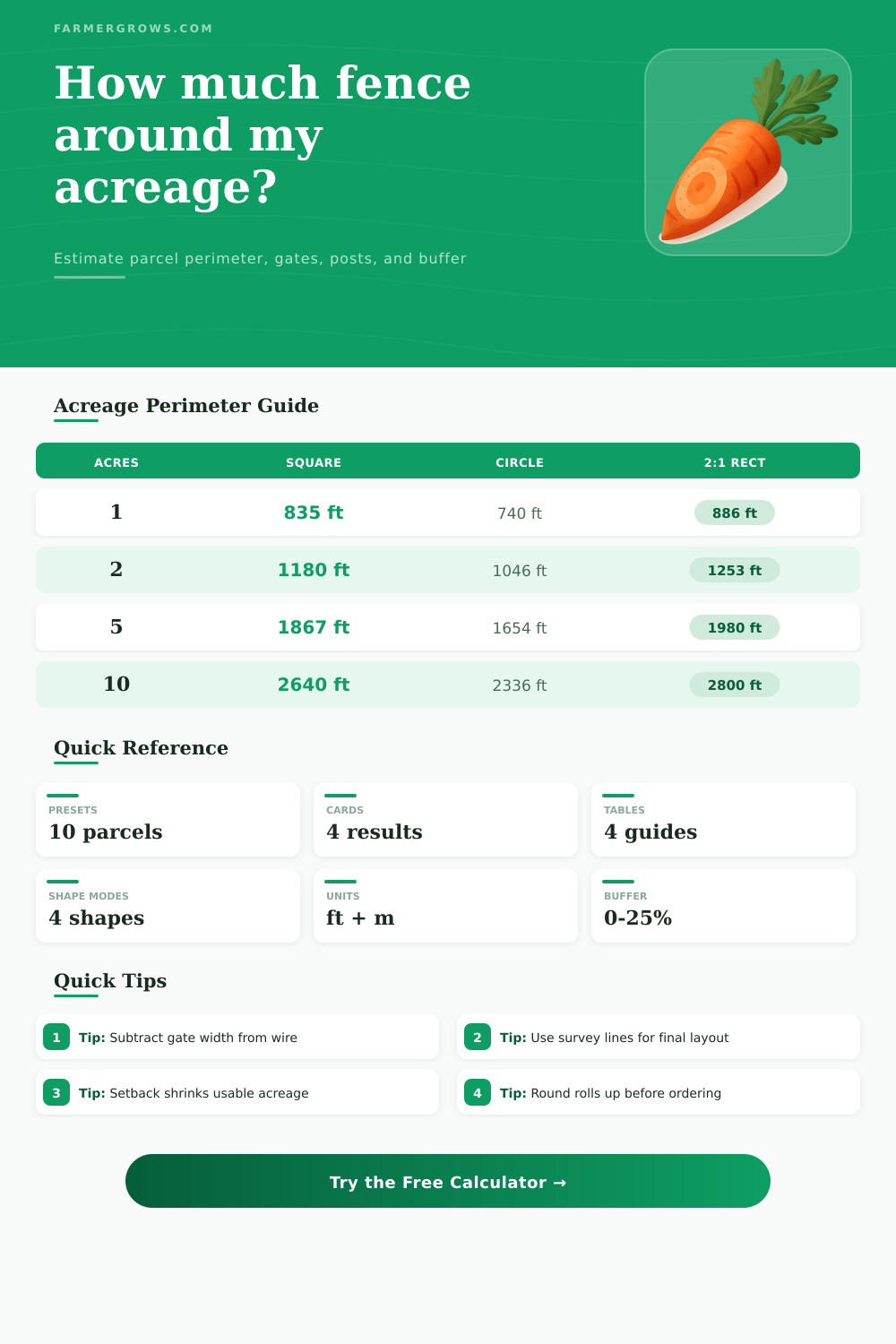
📐Shape perimeter comparison grid
The same acreage can need very different fence lengths. Circle is shortest in theory, square is practical, and long rectangles or triangles usually need more fence.
🔧Fence planning cards
📚Reference tables
| Shape | Area setup | Perimeter formula | Best use |
|---|---|---|---|
| Square | side = sqrt(area) | 4 x side | Balanced fields |
| Rectangle | long:short ratio | 2 x long + 2 x short | Pastures and lanes |
| Circle | radius from area | 2 x pi x radius | Pivot or round pens |
| Triangle | base and height ratio | sum of three sides | Corner parcels |
| Area | Side | Perimeter | Rolls at 330 ft |
|---|---|---|---|
| 0.25 ac | 104 ft | 418 ft | 2 rolls |
| 0.5 ac | 148 ft | 590 ft | 2 rolls |
| 1 ac | 209 ft | 835 ft | 3 rolls |
| 2 ac | 295 ft | 1,180 ft | 4 rolls |
| 5 ac | 467 ft | 1,867 ft | 6 rolls |
| 10 ac | 660 ft | 2,640 ft | 8 rolls |
| Fence type | Typical spacing | Post note | Buffer cue |
|---|---|---|---|
| Woven wire | 8 to 12 ft | Wood or T-posts | 10% common |
| Barbed wire | 10 to 16 ft | Brace corners well | 5% to 10% |
| High tensile | 12 to 20 ft | Strong end assemblies | 5% common |
| Deer fence | 10 to 15 ft | Tall corners matter | 10% to 15% |
| Board fence | 8 ft | Rails set spacing | 5% to 10% |
| Item | Common value | Calculator effect | Field note |
|---|---|---|---|
| Walk gate | 4 ft | Subtracts opening | Add latch post |
| Equipment gate | 12 to 16 ft | Subtracts opening | Brace both sides |
| Drive gate | 16 to 24 ft | Subtracts opening | Allow turning room |
| Fence setback | 2 to 25 ft | Shrinks fence path | Check easements |
| Waste buffer | 5% to 15% | Adds order length | Terrain and tie-ins |
💡Perimeter tips
A setback on all sides reduces both fence length and usable acreage. Use the larger setback when property lines, roads, drainage, or neighboring fences compete.
Subtract gate openings from wire length, but still count brace posts around gate openings, corners, and any hard bends in the line.
This calculator is a planning estimate. Final fence layout should follow surveys, boundary markers, terrain, local rules, livestock pressure, and installer recommendations.
Planning for an installation of a fence requires a person to determine the total length of the fence that are needed to enclose the land that is to be fenced in. The length of the boundary that is to be fenced in is dependent upon the shape of the land, the setback distance of the fence from the boundary of the land, and the number of gate that are to be included in the fence. Many individuals attempt to use the guess of the length of the boundary of the land to order fencing materials.
These guesses can lead to the individual buying either too much fencing material or not purchasing enough fencing materials. The shape of the land is one of the primary factors that influences the length of the fence that is to be built around the property. Land that is in the shape of a square will require less fencing material than land of the same acreage that is in the shape of a long rectangle.
How to Work Out the Length of a Fence
A circular plot of land will require the least amount of fencing materials to contain the land and fence in the individuals living on that land. Triangular plots of land may occur in corners of plots and may require more fencing materials than some of the other land shape. An acreage perimeter calculator can calculate these measurements based off the shape and acreage of the land that is to be fenced in.
Setback is the measurement of the distance between the boundary of the land and the fence. If the fence is moved inward from the boundary of the land, then the length of the fence will be reduced. The setback distance will reduce the amount of land that is enclosed by the fence.
For small plots of land, a small setback distance will have a large impact upon the amount of land that is enclosed by the fence. For large plots of land, a small setback distance may seem small to the individual until the individual multiplies the setback distance by the number of sides of the land. The acreage perimeter calculator allows the individual to specify a setback distance to determine how that distance will impact the length of fence that is to be purchased.
The number of gates that is to be constructed in the fence will impact the length of the fence. Each gate will require the removal of a section of fence. However, each gate will require fence posts on both the left and right sides of the gate, and each of those posts may require the installation of additional bracing posts.
The acreage perimeter calculator will account for these additional posts to the fence. The acreage perimeter calculator will subtract the length of the gates from the length of the land, but will add the number of posts for both the corners and the gates of the fence. In ordering fencing materials, an individual may desire to purchase additional fencing materials than those that is calculated for the individual plots.
This waste buffer allows for the possibility that there will be a shortage of fencing materials. A shortage of fencing materials may result from the land having an uneven terrain, needing to be tied to an existing fence, or due to fencing materials coming in certain lengths and not being able to match the length of fence that is needed. The distance between fence posts is referred to as the post spacing.
The spacing of the posts will influence the type of fence that is constructed. For instance, if the land contains livestock, then the fence will need to be made of tight spacing between the fence posts to prevent the animals from pushing against the fence. If the land does not contain any livestock, then the fence posts may be spaced further apart.
High-tensile wire has greater distance between the fence posts than other types of fencing wire. The acreage perimeter calculator will calculate the number of line fence posts according to the post spacing that the individual chooses. The calculated number will include the number of corner and gate posts that will be required to build the fence.
There are some physical constraints in the land that may alter the fence plan. These features include survey markers that may be within the boundary of the land, drainage areas that may necessitate the movement of the fence, and existing fences that neighbors of the land may erect. These features are not accounted for in the acreage perimeter calculator.
However, they will alter the length of the fence that is constructed and the difficulty of installation of the fence. Before ordering the fence, the individual should walk the perimeter of the land with a surveyor to determine any adjustments that may be required to the fence plan that the acreage perimeter calculator could not determine. A person should of run the fence calculations twice.
The first time, the fence can be calculated according to the individual’s desired shape of the fence and setback distance. The second calculation can be made according to the shape that requires the least amount of fencing materials for that area. By comparing the two sets of calculations, an individual can determine whether there will be cost savings from adjusting the fence plan, or if there will be the development of a different problem altogether.
By performing these two calculations, an individual can determine the cost of ordering extra fencing material compared to the convenience that comes from having a fence with a specific layout. An acreage perimeter calculator can be used as a planning tool to determine the length of fence that is to be purchased, the number of fence posts that will be required, and how many rolls of fencing material will be necessary to enclose the land. However, the acreage perimeter calculator is not the final plan that will be used to construct the fence.
The acreage perimeter calculator allows an individual to begin to have a conversation with a fence supplier or fence installer about the fence plans, using calculated numbers instead of the individuals guess as to the number of fence materials that will be required for that construction plan.