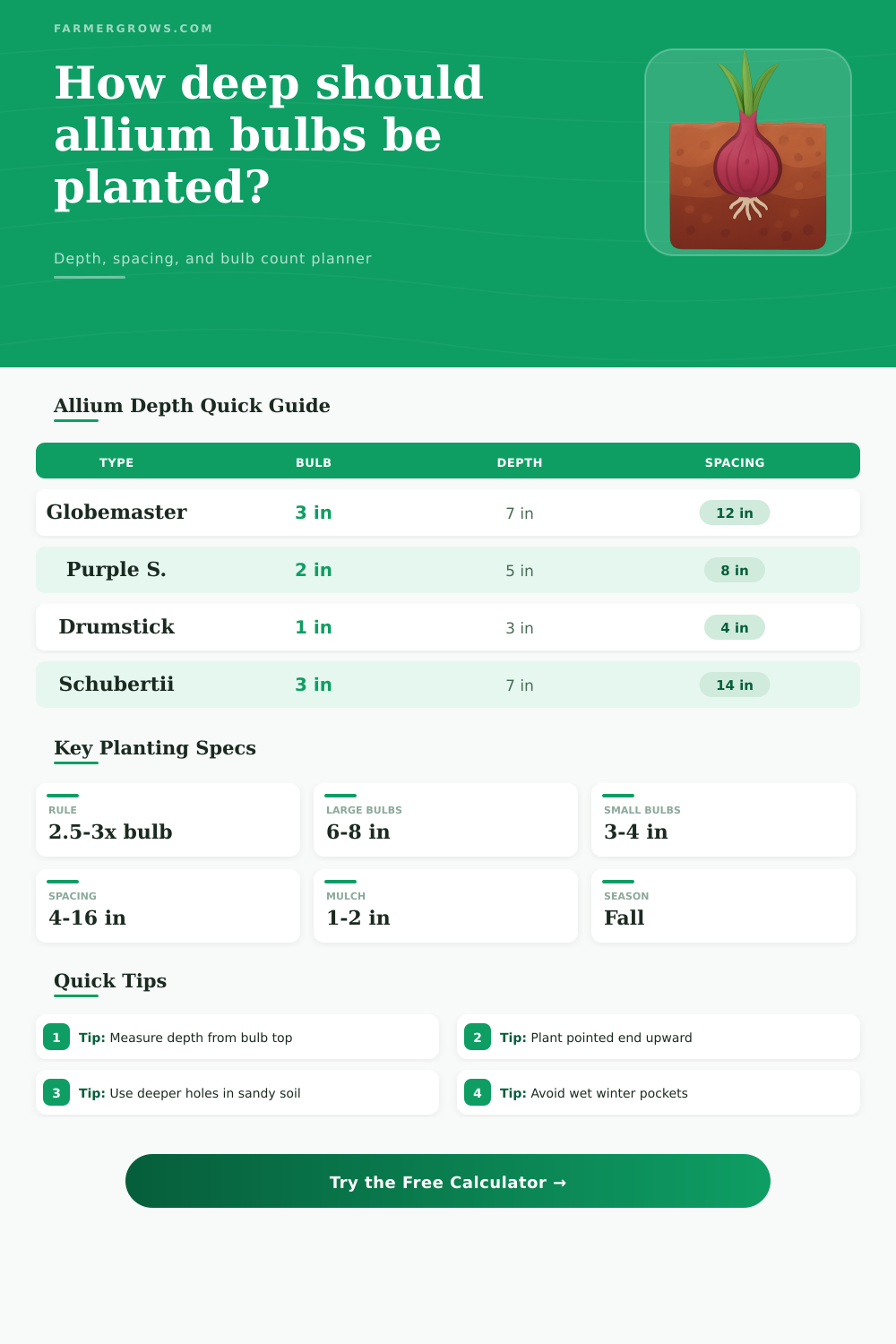
Allium Bulb Planting Depth Calculator
Dial in ornamental allium planting depth, spacing, bed capacity, and bulb count for large globe alliums, drumsticks, nectaroscordum, and small species types.
Depth is calculated as soil cover above the top of the bulb, with a separate total hole depth that includes the bulb diameter.
| Allium type | Typical bulb | Soil cover | Spacing |
|---|---|---|---|
| Allium Globemaster | 3 in / 7.6 cm | 7 to 8 in | 12 to 15 in |
| Allium Purple Sensation | 2 in / 5.1 cm | 5 to 6 in | 8 to 10 in |
| Allium cristophii | 2.25 in / 5.7 cm | 5.5 to 6.5 in | 10 to 12 in |
| Allium schubertii | 2.75 in / 7 cm | 6.5 to 8 in | 14 to 18 in |
| Allium sphaerocephalon | 1 in / 2.5 cm | 3 to 4 in | 4 to 6 in |
| Allium moly | 0.75 in / 1.9 cm | 2.5 to 3.5 in | 3 to 4 in |
| Bulb diameter | 2.5x cover | 3x cover | Total hole at 3x |
|---|---|---|---|
| 0.75 in / 1.9 cm | 1.9 in | 2.3 in | 3 in |
| 1 in / 2.5 cm | 2.5 in | 3 in | 4 in |
| 1.5 in / 3.8 cm | 3.8 in | 4.5 in | 6 in |
| 2 in / 5.1 cm | 5 in | 6 in | 8 in |
| 3 in / 7.6 cm | 7.5 in | 9 in | 12 in |
| Spacing | Formal grid | Staggered drift | Best use |
|---|---|---|---|
| 4 in / 10 cm | 9 bulbs per sq ft | 10 to 11 bulbs | Small species alliums |
| 6 in / 15 cm | 4 bulbs per sq ft | 4 to 5 bulbs | Drumstick alliums |
| 10 in / 25 cm | 1.4 bulbs per sq ft | 1.7 bulbs | Medium globe alliums |
| 14 in / 36 cm | 0.7 bulbs per sq ft | 0.9 bulbs | Large airy flower heads |
| Planting layout | Example area | Recommended depth | Likely bulb count |
|---|---|---|---|
| Front border ribbon | 20 sq ft | 3 to 4 in | 70 drumsticks |
| Mixed perennial drift | 48 sq ft | 5 to 6 in | 55 Purple Sensation |
| Specimen island | 25 sq ft | 7 to 8 in | 15 Globemaster |
| Container cluster | 7 sq ft | 4 to 6 in | 9 medium bulbs |
Large globe alliums
Need the deepest holes, broadest spacing, and the most stable soil cover so heavy flower stems stay upright.
Medium border alliums
Work well in staggered drifts where moderate spacing gives each sphere enough room above nearby perennials.
Small species alliums
Plant in tighter pockets with shallower cover, especially where the goal is a dense early-summer edge.
Wet winter sites
Use slightly shallower placement, grit-amended backfill, and raised areas instead of deep pockets that hold water.
When you stand there in your dark garden holding a bag of allium bulbs and a shovel in late fall, it’s a certain sort of panic. Yes, get the bulbs in before frost comes, but what does that mean? The packet directions says to plant them at “two to three times their height,” which is helpful advice for a professional horticulturist…but gives someone digging by flashlight way too much leeway.
If you go too deep, the bulbs might not push up their stems in time in spring. If you go too shallow, they will be vulnerabl to freeze damage. They may also get lifted out of ground by winter heave, which looks unsightly.
How Deep and How Far Apart to Plant Allium Bulbs
The calculator above take away any guessing, and translates those vague ratios into actual numbers based off your own soil type. It’s easy to understand, though not necessarily how to apply: “About one inch of soil above each inch of the diameter of the bulb,” the rule says, and by diameter I mean the widest point of the bulb, as shown here.
Why? Because we want the bulb to be buried with its neck covered (to prevent rot) and the roots anchored under frost level. Alliums, being a hardy perennial, are storage organs; their energy reserves form a sphere beneath the ground, and require a secure thermal environment to weather winter’s sleep. That’s why the multiplier help to calculate the depth; to keep the bulb’s neck out of sight, and still have the rest of the body well-anchored.
All you do is type in the diameter of your bulb (the giant-sized Globemaster or even the teeny-tiny drumstick version), and the system does the rest by automatically calculating how deep you need to plant it for proper coverage. It also considers other factors like soil texture, which is something too few gardeners think about. Sandy loam drains rapidly and lacks insulating power; the calculation will recommend that you dig a little deeper. Heavier clay retains heat and moisture, and can gets away with planting a fraction shallower.)
Depth matters, obviously, but so does spacing. Without air circulation, alliums can gets fungal problems. They are also ugly when crowded. They need room to grow their flower stems upward freely or they’ll bend over. That’s all spelled out in the table on the page by variety. Ideally each flower cluster should stand on its own stage where you can see it, not hidden away in some tangle of foliage. And if you’re designing a formally planted border, use the grid to keep everything looking balanced. For a more naturalized effect, try staggering them (you can fit more bulbs per square foot this way yet still have an airy feeling).
The calculator figures out precisely how many bulb will fit in any bed size and design or pattern you specify. Some folks read that the depth is measured from the base (bottom) of the bulb. No. The shoot grows out from the top, the part called the crown; the roots are below. From the top down. Get it wrong and the bulb won’t grow as much as the cover you wanted, and the “cover” you get will be less then you hoped for.
Another often-missed point: Watch out for drainage in the winter! Alliums rot quickly if the soil is waterlogged. Bulbs are foolish about this; they rot fast if the soil around them is soggy. Again: If your winter weather proves particularly wet, amend the ground around bulbs with some grit (to help drainage), or perhaps lift the bulbs slightly. Better a shallow but well-drained hole than a deep one that becomes a swamp.
Finally: What will it look like? How do you plan your planting layout? Will it be a row of little guys down a border edge, or maybe one big guy on an island bed? Same math; just swap out the numbers. The rest of the work. The calculation conversions between metric and imperial, is done for you by the calculator. This is helpful if some of those bulbs are imports that measure different than your usual size. And it even throws in a cushion of extras for anything that doesn’t fare as well, so there’s no gap in your display next spring.
That little tweak prevents exactly that, and gives you some insurance, too. The planting of alliums is not so much a matter of brute force as it is precision planting. This is an investment in a show that will extend into midsummer. Do your best with good drainage, honor the spacing, get the depth correct. You should of checked the soil first. Let the bulbs take over the rest during the winter when you’re sleeping. Then in earliest spring, when the first purple balls push up aboveground, you’ll understand how they pulled it off. It all boils down to good groundwork from the very start.