Bean Seed per Acre Calculator
Estimate bean seed per acre from bean type, planted acres, target population, seed size, germination, expected emergence, row spacing, in-row spacing, treatment loss, and planting method.
Start with a named bean crop, then fine tune population, seed size, tag germination, expected emergence, row width, in-row spacing, treatment loss, and planter method.
Bean Seeding Plan
Results adjust the desired stand for germination, expected emergence, treatment loss, method loss, and calibration reserve.
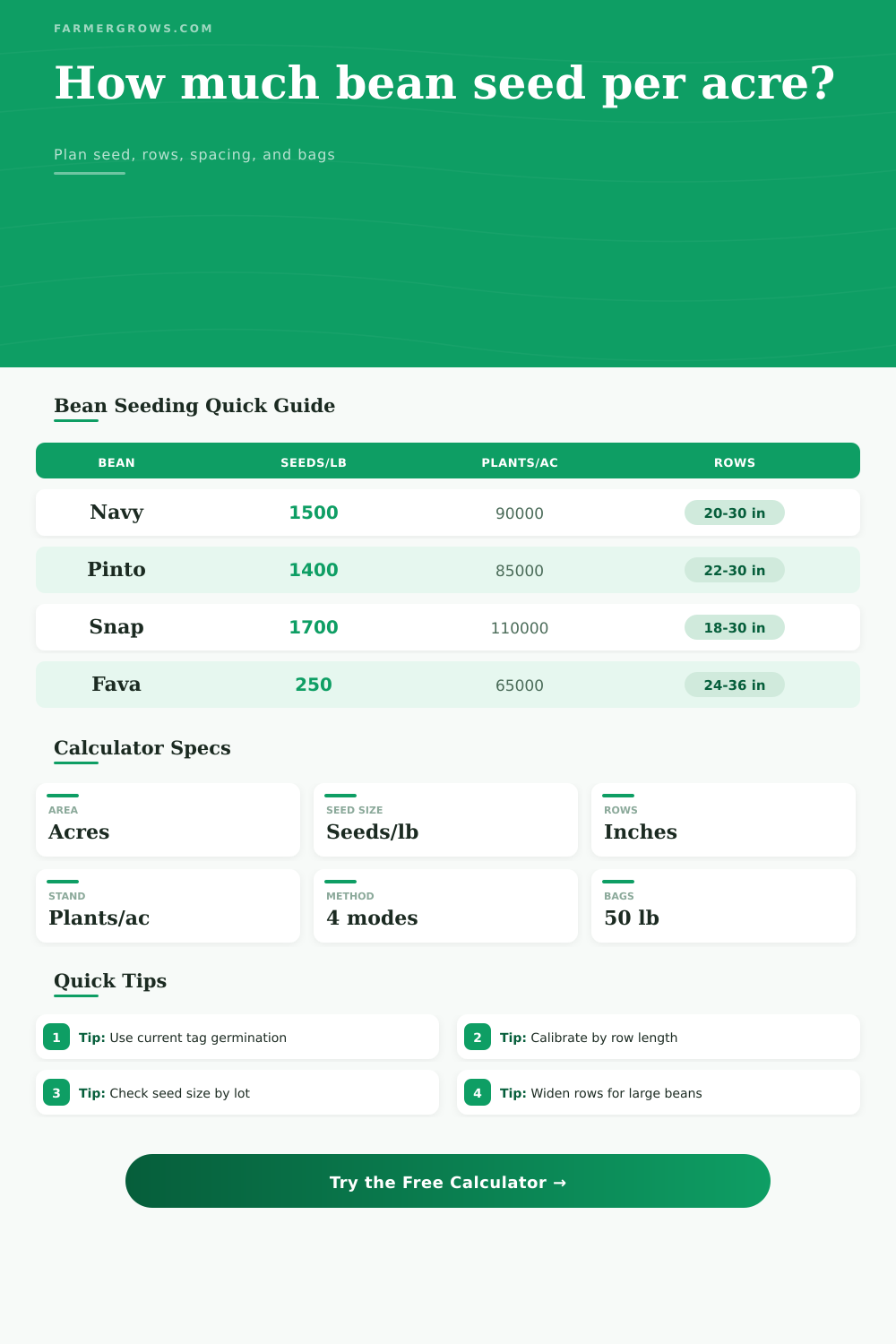
Use the grid to compare typical seed size, population range, and row fit before changing the calculator inputs for a specific seed lot.
Often 1400 to 1700 seeds per lb with dense stands near 85000 to 105000 plants per acre.
Usually more seeds per pound than pinto or kidney beans; suits narrow to standard row systems.
Common field targets run lower than navy beans, especially where dryland moisture limits canopy density.
Fewer seeds per pound means pounds per acre climb quickly even at moderate final populations.
Often planted for uniform harvest, so row drop and within-row spacing deserve a close calibration check.
| Bean type | Typical target plants/ac | Common seeds/lb | Common row spacing | Field note |
|---|---|---|---|---|
| Navy bean | 85000 to 105000 | 1400 to 1700 | 20 to 30 in | High stand helps close canopy on small upright plants. |
| Black bean | 80000 to 100000 | 1900 to 2600 | 20 to 30 in | Seed size may change sharply between varieties and lots. |
| Pinto bean | 70000 to 90000 | 1200 to 1600 | 22 to 30 in | Dryland fields often use the lower end of the range. |
| Kidney bean | 55000 to 75000 | 700 to 1100 | 28 to 36 in | Large seed and vine type make row spacing important. |
| Cranberry bean | 60000 to 80000 | 900 to 1300 | 28 to 36 in | Moderate stands reduce crowding in larger seeded classes. |
| Great northern | 75000 to 95000 | 1100 to 1500 | 22 to 30 in | Population goal often sits between navy and pinto beans. |
| Snap bean | 90000 to 125000 | 1400 to 2100 | 18 to 30 in | Fresh market harvest timing favors a uniform plant spacing. |
| Lima bean | 35000 to 65000 | 450 to 900 | 30 to 40 in | Large seed and bush size usually need more room per plant. |
| Fava bean | 45000 to 80000 | 180 to 350 | 24 to 36 in | Cool-season seed is large, so pounds per acre can be high. |
| Adzuki bean | 90000 to 130000 | 3500 to 5500 | 15 to 30 in | Small seed can be planted densely with accurate metering. |
| Row spacing | Row feet per acre | Seeds/ft at 70000/ac | Seeds/ft at 90000/ac | Seeds/ft at 110000/ac |
|---|---|---|---|---|
| 15 in | 34848 ft | 2.01 | 2.58 | 3.16 |
| 20 in | 26136 ft | 2.68 | 3.44 | 4.21 |
| 22 in | 23760 ft | 2.95 | 3.79 | 4.63 |
| 30 in | 17424 ft | 4.02 | 5.17 | 6.31 |
| 36 in | 14520 ft | 4.82 | 6.20 | 7.58 |
| 40 in | 13068 ft | 5.36 | 6.89 | 8.42 |
| Germination | Emergence | Treatment loss | Viable field fraction | Drop needed for 90000 plants/ac |
|---|---|---|---|---|
| 95% | 92% | 1% | 86.5% | 104000 seeds/ac |
| 92% | 88% | 2% | 79.3% | 113500 seeds/ac |
| 88% | 82% | 4% | 69.3% | 129900 seeds/ac |
| 85% | 75% | 5% | 60.6% | 148500 seeds/ac |
| 80% | 70% | 8% | 51.5% | 174800 seeds/ac |
| Planting method | Built-in method loss | Best use | Spacing control | Calibration note |
|---|---|---|---|---|
| Precision planter | 1% | Dry beans, snap beans, large seed | Excellent | Check plates, singulation, vacuum, and seed drop per row foot. |
| Grain drill or air seeder | 4% | Narrow rows and small seeded bean types | Moderate | Run a known distance test because seed cups may crack large seed. |
| Broadcast then incorporate | 10% | Cover crop beans or small plots | Low | Use shallow incorporation and increase reserve for uneven soil contact. |
| Hand or garden seeding | 2% | Small gardens, trials, and direct-marked rows | High | Use in-row spacing as the main setting and thin if emergence is high. |
Use the seed tag: Bean seed size changes by variety, crop year, screen size, and treatment. Enter the actual seeds per pound and germination from the lot you will plant.
Check row math: If calculated seed spacing is far from your intended in-row spacing, adjust target population or row width before filling the planter boxes.
REMEMBER: SEEDING isn’t just a matter of eyeballing it. Seeds differ in size and shape. Equipment can be odd. Germination and emergence rates also vary. What if your seed was cracked or didn’t have good soil contact? It is easy to go overboard with seed by forgetting those factors, or to underdo it because the weight doesn’t seem so big on paper.
Plugging in particulars about each seed lot into the calculator does heavy lifting for you. You won’t have to guess at conversions and coefficients which can trip up even seasoned growers.
Why Seed Rates Are Not Simple
The most common mistake is thinking of seed size as an absolute. I mean, sure, you may have heard that navy beans are about fifteen-hundred seeds per pound. But here’s what you don’t see when you hear the average: there’s a huge amount of variation within that average. A little bigger at harvest? That figure goes down; more pounds per acre will be required. Your seed tag will tell you exact seeds per pound of your particular lot, and that’s why the tool asks for it, since the generic figures aren’t good enough here. Because if you’re buying by weight without checking the count first, you’ll wind up with a sparse stand on your choicest ground.
Keep in mind that germination and emergence are not the same. Germination happens in a controlled lab test with ideal conditions, but emergence happen in your field where cold soils, crusts, and insects takes a toll. The calculator accounts for those differences in the input so you can make adjustments based off your local reality. Even though a seed tag may say ninety-five percent germination, if you’re planting into cold, wet ground, your expected emergence could be below eighty percent. Changing that field survival rate significant changes how much seed you need to plant to get the population you planned for.
The geometry of your field vary with row spacing. If you’re planting narrow rows, for instance, you have to use more seed per foot to get the same population goal that wider rows would produce. This affects not only seed used but also your calibration of equipment itself. The reference table on the page explain this well: As you go from wider (thirty-six inch) to narrower (twenty-inch) rows, there’s a change in seed density by foot.
But it isn’t only mathematics: It’s also weed competition and canopy closure. For example, smaller beans such as navies or adzukis tend to prefer narrower rows because they shade out weeds earlier. Larger beans such as favas or limas actualy require more physical space to develop their root systems without crowding each other.
Then there’s the loss associated with planting: An air seeder or grain drill, both common tools here, is much less precise than a precision planter with vacuum singulation, which might double up small seeds or crack large ones. Whatever method you choose, the calculator accounts for this mechanized imprecision by adding a slight percentage (a useful hedge against the fact that no machine does anything perfectly).
If you’re going to broadcast your seed into a cover crop mix, that loss factor increases more then a lot since the seed isn’t getting good soil contact and is distributed unevenly, too.
Lastly, factor in some margin. Having a couple extra percentage points of seed in reserve is always nice. It helps if you need to calibrate the tool during testing or if the plan goes wrong with a skip in the far corner of the field. Having a few extra percent on hand prevents an extra trip back to the supplier if you run into skips in the field. This buffer can also be specifically defined within the tool.
Seed requirements is both part art and science. When you get the input right, you can trust the output. It will turn that confusing spreadsheet into a dependable plan to ensure your planting plan is full and your yields remains consistent.