Kale Seed per Acre Calculator
Estimate kale seed per acre from acres, kale type, planting mode, row spacing, in-row spacing, target plants per acre, seeds per ounce, germination, thinning loss, and baby leaf or bunching harvest style.
Choose a named kale setup, then edit the acreage, seed tag germination, row spacing, seed count per ounce, thinning loss, and target stand for your field.
Kale Seed Per Acre Results
Use the calculator inputs above to estimate seed needed for the selected kale stand.
Use narrow rows, close in-row spacing, higher seeds per station, and a larger thinning percentage because leaves are cut young.
Use moderate spacing and direct seed thick enough to thin to clean, harvestable leaf bunches.
Use wider row and in-row spacing for curly, lacinato, winterbor, and overwintered plants.
Use lower thinning loss, one or two seeds per cell, and a reserve for weak cells or field gaps.
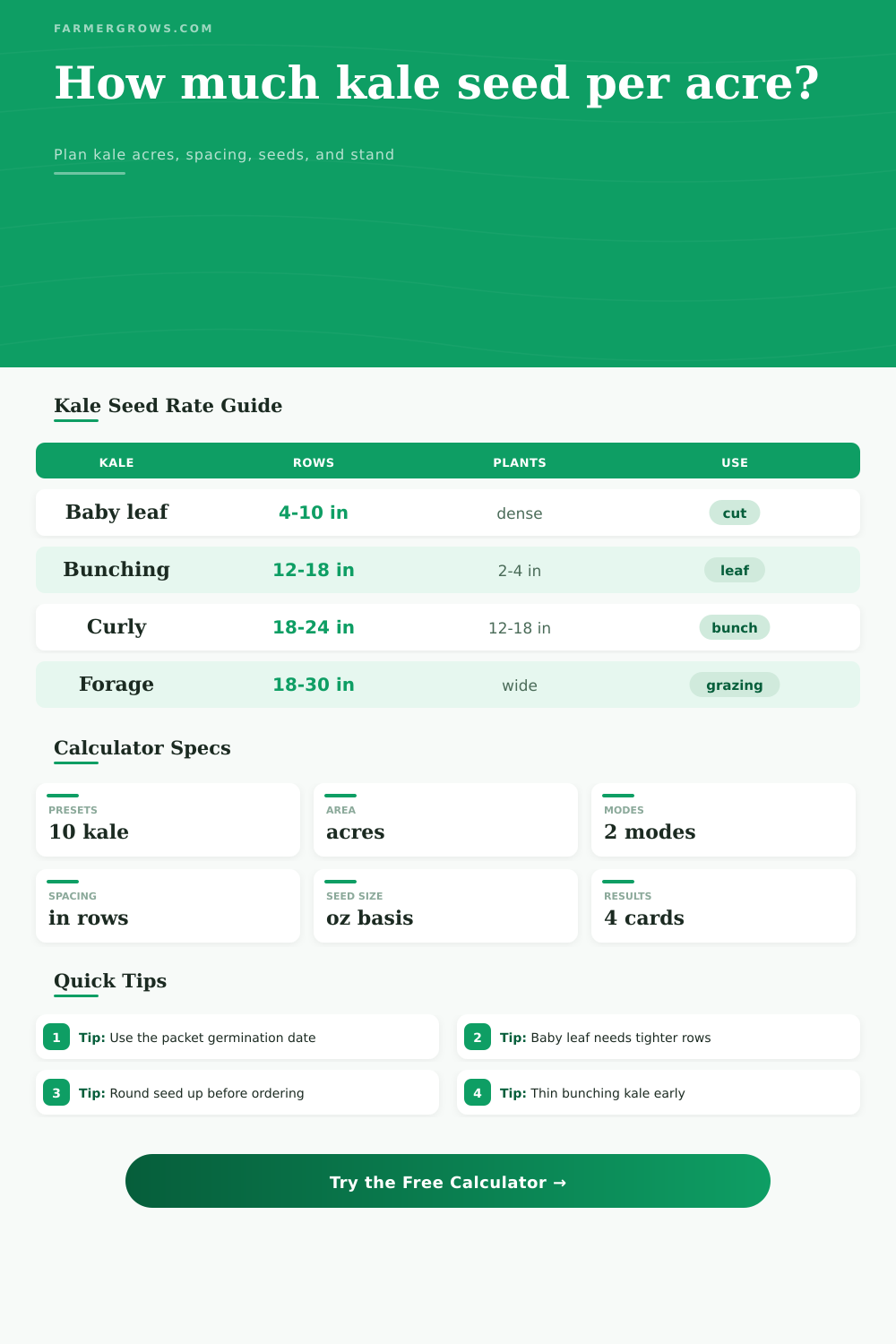
| Planting style | Row spacing | In-row spacing | Plants per acre basis |
|---|---|---|---|
| Baby leaf dense cut | 4 to 10 inches | 0.5 to 2 inches | 313,000 to 2,614,000 plant stations depending on row density. |
| Bunching kale | 12 to 18 inches | 3 to 6 inches | 58,080 to 174,240 stations before germination and thinning adjustment. |
| Mature curly kale | 18 to 24 inches | 12 to 18 inches | 14,520 to 29,040 final plants for repeated leaf harvest. |
| Lacinato or winter kale | 24 to 30 inches | 18 to 24 inches | 8,712 to 14,520 wider final plants for airflow and harvest access. |
| Seed lot condition | Germination input | Typical thinning loss | Practical seed response |
|---|---|---|---|
| Fresh transplant seed | 88% to 95% | 5% to 12% | Start 1 to 2 seeds per cell with a small cell reserve. |
| Fresh direct seed | 82% to 92% | 25% to 45% | Plan 2 to 4 seeds per station before thinning to stand. |
| Stored packet seed | 65% to 80% | 35% to 55% | Increase seed count or run a germination test before acre planting. |
| Rough outdoor seedbed | 60% to 75% | 45% to 65% | Add reserve and consider transplanting valuable kale varieties. |
| Seeds per ounce | Ounces for 50,000 seeds | Ounces for 100,000 seeds | Seed planning note |
|---|---|---|---|
| 7,000 seeds/oz | 7.14 oz | 14.29 oz | Use for larger or coated kale seed lots. |
| 8,000 seeds/oz | 6.25 oz | 12.50 oz | Common practical estimate for curly kale seed. |
| 9,000 seeds/oz | 5.56 oz | 11.11 oz | Useful for small uncoated baby leaf seed. |
| 10,000 seeds/oz | 5.00 oz | 10.00 oz | Confirm with the supplier before reducing seed orders. |
| Mode or harvest target | Seed math effect | Best spacing input | When to use |
|---|---|---|---|
| Direct seeded baby leaf | High seed count and high thinning/cut loss factor | 4 to 10 inch rows, 0.5 to 2 inch in-row spacing | Salad mix, repeated young cuts, or dense beds. |
| Direct seeded bunching | Moderate extra seed for thinning to usable plants | 12 to 18 inch rows, 3 to 6 inch in-row spacing | Market bunches, CSA leaves, or close garden rows. |
| Direct seeded mature | Lower station count but enough seed for missed holes | 18 to 30 inch rows, 12 to 24 inch in-row spacing | Full-size plants and long harvest windows. |
| Transplants | Seed needed for cells plus germination and backup | Use final plant spacing or custom plant target | Precise stand, early season plantings, or costly seed. |
Check both spacing and custom stand targets. Narrow baby leaf rows can create very high plant counts, so compare the spacing-derived target with your actual crop plan before ordering seed.
Use seed count per ounce from the lot. Kale seed size shifts with variety, coating, and cleaning grade; the calculator stays most accurate when the packet or supplier seed count is entered directly.
Looking at that one ounce seed packet in your hand, you hold a shovel for a two-acre field… panic sets in. That little packet doesn’t seem like enough filling that big field. Kale looked easy when growing it in your small garden, then moving it to large acres.
Math now come into play. And mistakes can cost you money. How dense do you want your rows of kale? Yes, variety matters, but more importantly: How dense?
Why Spacing Matters for Kale
Baby-leaf kale behave like a lawn; to grow an area of lawn, you need lots of seed. Mature curly kale demand wide spacing for airflow and head development, meaning fewer plant but more soil per unit. Plant baby kale too thickly and it will rot in the heat. Plant mature kale too widely spaced and you’ll have some heads with no growing room at all between.
Above, the calculator figures out math for you. No more guesswork about how wide to make your row or what spacing to use.
Many grower don’t understand how much seed goes to waste before it’s harvested. The first loss is germination. Even if your packet claims 90% will sprout, factors such as soil moisture and temperature may reduces it.
The second loss is thinning. Who wants a dozen plant on one spot? Transplanting is a less wasteful way to start things compared with direct seeding, which has you throwing seeds right onto the soil. With the tool, you enter a thinning loss percentage, which allows for the first-planting disorderliness. Many people buy only what they plan to end up with, forgetting the mayhem involved at the beginning.
Another factor is how many seed come in an ounce. Not all kale seeds are created equal; they’re various sizes, ranging from light to heavy. Eight thousand seeds per ounce differs from ten thousand, which may weigh as much as eight or weighs less than eight. It could of been different. Be sure to read what the seed company says on their tag. It’s risky guessing with a generic average. Weight matters, but count determines coverage. Count no.
What if you grow your own transplants? That’s a whole other story. If you sow seeds in cells instead of direct-sowing, you are in charge of the conditions. You use fewer seed per cell. You also select the strongest seedling for each cell.
When you’re direct seeding, your first big risk is germination, but when you switch to transplanting, the focus shift toward transplant shock. The math shifts. What happens? The calculator changes to reflect that shift: No need to count thinning losses, since you’ve already identified the winners. It is more hands-on at the beginning, but it is also a cleaner process. The math is the same, but variables change from soil to cell trays.
The answer: Spacing makes the difference. Baby-leaf rows are narrow, so it’s fast to sell but costly in seeds. Mature-head rows are wide (so they’re cheaper in seed), but you’ll wait awhile longer to get your crop. As the tables below shows, wider spacing result in lower plant counts. Winter storage or quick cash?
And then there’s the reserve: Add a buffer to what you order. You may be hit by bad weather, have birds eat your food, or have some piece of equipment malfunction. I like to add on ten or fifteen percent to my need. It is better to have too much seed than to have patchy areas that must be reseeded in July. Adding such a buffer, cheap insurance, is one reason why the tool will help you stay within your budget.
How does your plan look? The plan looks like a seed rate; that’s the difference between waste and profit. Respect the plant; respect the soil. The packet will be light; the plan will be solid. Tweak for germination; account for spacing; build in some buffer.