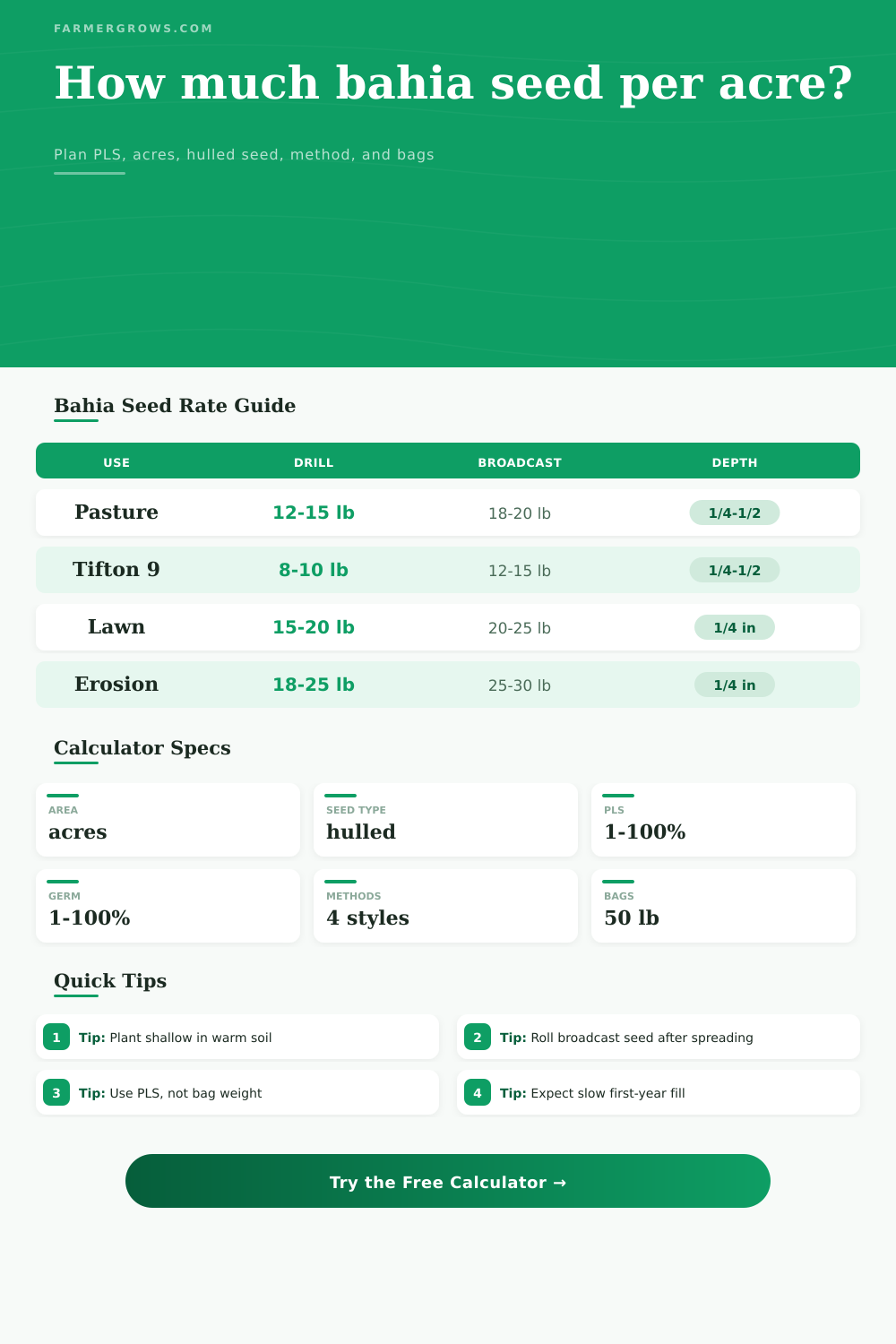
Bahia Seed per Acre Calculator
Estimate bahiagrass seed needs from acres, planting purpose, hulled or unhulled seed, seed tag PLS, germination, broadcast or drill method, row spacing, soil preparation, target PLS rate, and overage.
Start with a named Bahia situation, then fine tune acres, seed tag quality, row spacing, soil preparation, and your intended target pounds of pure live seed per acre.
Common forage choice for sandy, acidic soils. It usually uses moderate drilled rates and higher broadcast rates because seedlings are slow to fill.
A Pensacola-derived type with stronger early vigor. Prepared drill rates can be lower when seedbed moisture and depth are controlled.
Selected for quicker germination and early forage growth. It still benefits from shallow placement and a firm rolled seedbed.
Often used where a broader-leaf Bahia turf or grazing sod is desired. It may be seeded heavier for lawn cover and erosion work.
Bahia Seed Plan
Enter your field details to estimate Bahia seed by PLS rate, seed tag quality, method, row spacing, soil preparation, and overage.
Use these as practical starting ranges, then var the calculator adjust for your field conditions and seed tag.
| Planting purpose | Typical variety | Drilled prepared seedbed | Broadcast or no-till | Calculator note |
|---|---|---|---|---|
| Pasture or hay establishment | Pensacola, Common | 12 to 15 lb PLS/ac | 18 to 20 lb PLS/ac | Use the higher end when seedbed moisture or rolling is uncertain. |
| Improved seedling-vigor stand | Tifton-9, TifQuik | 8 to 10 lb PLS/ac | 12 to 15 lb PLS/ac | Lower rates fit clean prepared seedbeds; broadcast still needs more seed. |
| Bahia lawn or turf area | Argentine, Pensacola | 15 to 20 lb PLS/ac | 20 to 25 lb PLS/ac | Turf goals use heavier acre-equivalent rates for quicker cover. |
| Erosion or roadside cover | Common, Pensacola | 18 to 25 lb PLS/ac | 25 to 30 lb PLS/ac | Fast cover on slopes or disturbed soil may justify heavier seed. |
| Thin Bahia sod overseed | Existing sod match | 10 to 15 lb PLS/ac | 15 to 25 lb PLS/ac | Existing sod competition often makes seed-to-soil contact the limiting factor. |
| Field condition | Multiplier used | Best fit | Risk controlled | Practical note |
|---|---|---|---|---|
| Drilled into prepared seedbed | 1.00x method | Clean tilled fields | Depth variation | Press wheels or rolling help keep shallow seed in firm contact. |
| Broadcast then rolled | 1.18x method | Open pasture renovation | Uneven cover | Cultipacking after spreading improves contact without burying seed too deep. |
| Broadcast lightly incorporated | 1.28x method | Residue or rough surface | Surface loss | Use shallow incorporation; deep disking can bury small Bahia seed. |
| No-till or thin sod overseed | 1.32x method | Existing sod | Competition | Suppressed sod and open soil slots are often more important than added seed. |
| Rough or dry soil preparation | 1.18x prep | Cloddy fields | Weak emergence | Extra seed helps only modestly if moisture and seed-to-soil contact are poor. |
| Row spacing | Calculator factor | Where it fits | Cover speed | Management note |
|---|---|---|---|---|
| Broadcast or 0 inches | 0% row add | Spinner spreader or airflow seeder | Uniform if rolled | The method multiplier handles broadcast placement loss. |
| 6 to 8 inches | 0% row add | Grass drill or small-seed box | Fast row closure | Narrow rows spread Bahia plants evenly across the acre. |
| 10 inches | About 2% add | Older grain drill spacing | Moderate | A small allowance helps cover wider row gaps. |
| 12 to 14 inches | 5% to 8% add | Limited drill setup | Slower between rows | Consider cross-drilling only when erosion risk is high and soil is firm. |
| 15 inches or wider | Up to 12% add | Specialty or no-till rows | Slowest closure | Wider rows may be acceptable for forage, but turf cover can look open early. |
Bulk pounds increase when the seed tag PLS percentage drops. This table shows bulk seed needed to deliver 15 lb PLS per acre before other buffers.
| Seed tag PLS | Bulk lb for 15 lb PLS/ac | Bulk lb for 20 acres | 50 lb bags | What it means |
|---|---|---|---|---|
| 90% PLS | 16.7 lb/ac | 333 lb | 7 bags | High-quality tag; little conversion loss. |
| 80% PLS | 18.8 lb/ac | 375 lb | 8 bags | Common planning example for Bahia seed lots. |
| 70% PLS | 21.4 lb/ac | 429 lb | 9 bags | More inert or nonlive seed requires more bulk weight. |
| 60% PLS | 25.0 lb/ac | 500 lb | 10 bags | Check whether the lower tag is still suitable for your planting window. |
| 50% PLS | 30.0 lb/ac | 600 lb | 12 bags | Low PLS seed can make calibration and storage planning harder. |
Seedbed tip: Bahia seed is small and slow compared with many pasture grasses. A firm, moist seedbed and shallow cover often improve establishment more than simply raising pounds per acre.
Calibration tip: Convert the plan to bulk seed before setting the drill or spreader. PLS pounds describe live seed delivered; bag pounds describe what actually goes through the equipment.
This calculator is a planning aid for seed ordering and equipment setup. Local extension guidance, variety labels, seed lot dormancy, weather, weed pressure, and soil fertility should guide the final seeding decision.
When people plant bahiagrass on their property, most will do it like this: They look at the bag and see that it weighs “x” amount. Then they look in the field and see “y” number of acres and figure out answer using simple subtraction.
That’s not how it works. Bahia seed can be deviously deceptive. What you pay for doesn’t always equal what you get to plant. If purity and germination rates is modest, a fifty-pound bag may have just thirty pounds of pure live seed inside. Everything else is dead seed, chaff, or inert matter that does nothing for your pasture except increase its total weight.
Why You Need to Calculate Seed Correctly
In other words, it’s filler, which is one reason estimating seed requirements based off weight alone is so often a waste of money and results in sparse stand density. You’re spending good money for fillers that don’t add a single blade of grass to cover your soil.
How does that translate into actual pounds per acre of bulk weight? The calculator on top does the work for you so you don’t have to guess if buying that more expensive seed “is worth it” when you divide the percentages into pounds. It prompts you to enter how much you expect to get germinating (the expected germination) and what percentage is pure live seed (not caked-on dust). And based on those figures, it will raise or lower the base rate by appropriate amount.
The seed’s good? You don’t need as much bulk weight in order to achieve the same ground density. Lower-grade, older seed? The tool will tell you to purchase additional bags to make up for the reduced viability.
Why do this? Because Bahia seedlings is fragile and small. To compete with weeds, they must be planted at an adequate stand. However, they should not be planted so thickly that they cannot establish their roots before hot summer days arrive.
Another twist missed by most is the difference between hulled and unhulled seed. Seed from which the hull (or husk) has been removed is called hulled; this will sprout more rapidly and soak up water more readily than unhulled seed. But unhulled seed is less expensive per pound and takes longer to come out of dormancy. The calculator factors all this in, with an adjustment made toward the unhulled, since you’ll have to plant more physical seed to have as many emerge.
Also taken into account: how you’re planting. If you drill into a well-prepared seedbed, you’re making an accurate placement… Planting the tiniest of seeds where they can find their way to moisture. A broadcast application (machine or otherwise) is not so exact, not every bit of seed ends up in a spot where it can reach moisture, and some may be taken by birds or wind. The tool factors that into its broadcast rate: That’s why it’s higher. When you’re broadcasting, you’re paying extra for peace of mind about poor soil-to-seed contact. The calculation includes a margin for error… So when your seed is sitting atop a clod of earth instead of snugly settled onto moist soil, there will be no bare spots.
Another subtler factor is row spacing. Close rows (commonly between six and eight inches) form a carpet more quickly; they smother weeds. Wide ones provide openings for competition. Depending on those spacing decisions, the tool increases or decreases seed demand a bit, but helps you weigh your budget against how fast things establish.
The variable most likely to make the difference between success and failure, not just in terms of how many seeds you plant, but whether there are any at all. Is the soil prep. The seed of bahia grass is small. It will often die if buried any deeper than about a half-inch; the seedling can’t expend energy to force its way out of that much soil. This means you should of planted shallower than a half-inch, and that’s biologically correct for this grass. The tool also recommends keeping a reserve of seed if the soil was dry or otherwise rough when planted. This is not so much for the nutritional value of extra grass, but because physical conditions lower the chance that even one seed survives.
Last but not least, plan for the overage. No fields are square; there are corners, headlands, and spots where the spreader overlaps or the drill skips. Plan for real world imperfections by adding ten or fifteen percent to your overall calculation. Better to have a bit more seed leftover than to find yourself running out of seed half way through the field, leaving an exposed gap in your pasture. You want a uniform stand that fills out quickly, minimizing the opportunity for weeds to get going.
Let the math do all the conversion work so you can concentrate on what really matters. You need good seed-to-soil contact, to plant it at the right time, and to have enough living seed to ensure that when the rains hit, it will all green up evenly.
That is what makes a planting good.