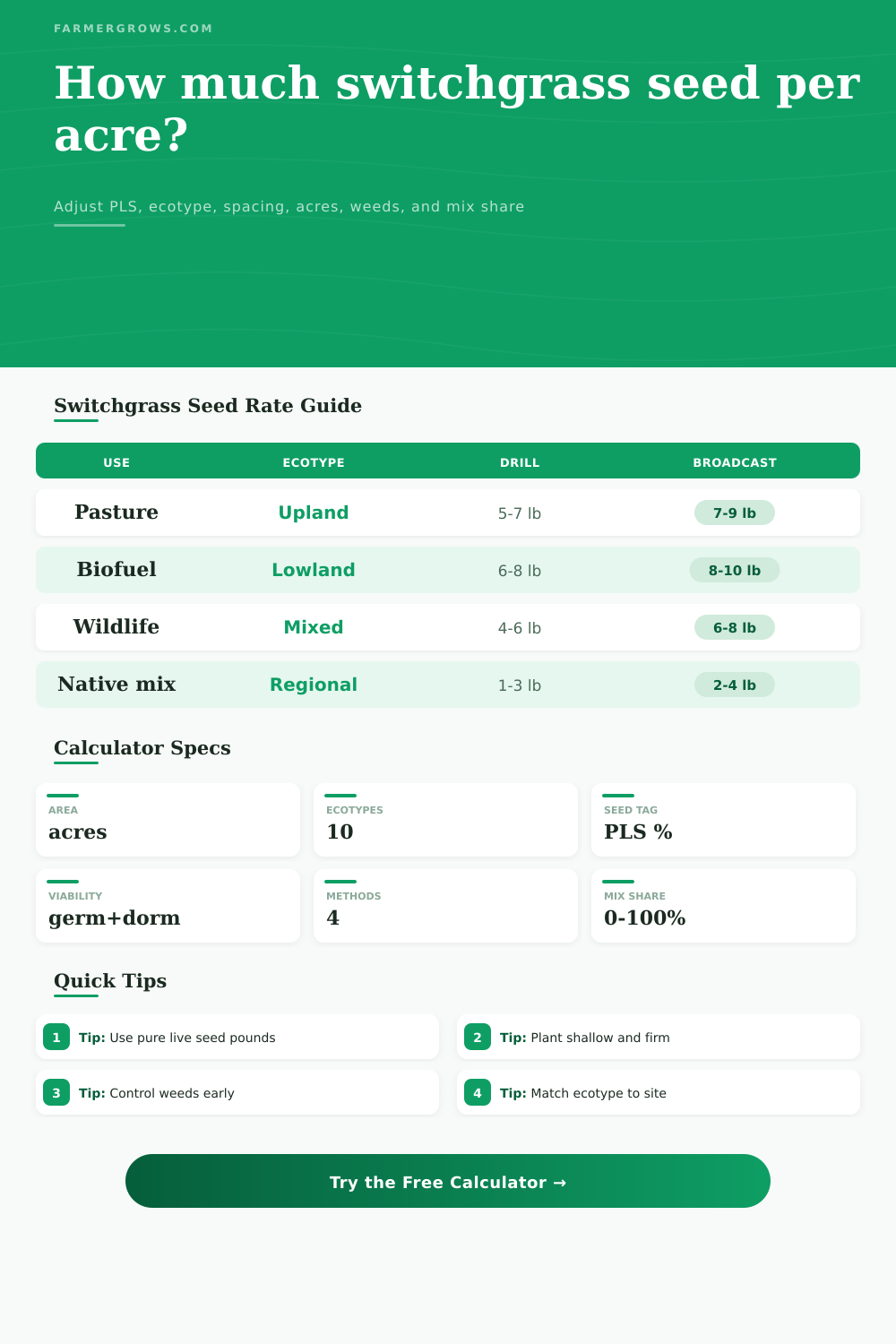
Switchgrass Seed per Acre Calculator
Estimate switchgrass seed per acre and total seed order from acres, ecotype, pure live seed percentage, germination, dormancy, drill or broadcast method, row spacing, weed pressure, site preparation, and native mix share.
Choose a common switchgrass establishment situation, then fine tune the acreage, ecotype, tag quality, row spacing, weed pressure, site preparation, and native mix percentage for your seed plan.
Shorter, finer stemmed types usually fit drier ridges, pastures, conservation buffers, and mixed native grass plantings.
Taller, heavier producing types favor moist soils, biomass goals, and wider rows with strong early weed control.
A broadly adapted northern cultivar often selected for wildlife, pasture, erosion control, and prairie restoration seedings.
A southern lowland cultivar with strong yield potential where winters are mild enough and moisture is dependable.
An upland cultivar often used in Great Plains conservation plantings, thinner soils, wildlife strips, and lower-input fields.
Switchgrass Seed Plan
Results convert your PLS target into bulk seed and show the adjustment from ecotype, method, row spacing, weeds, preparation, and native mix share.
| Ecotype or cultivar | Typical PLS lb/ac | Best fit | Management note |
|---|---|---|---|
| Upland regional type | 5 to 7 | Drier soils, mixed native stands, pasture, wildlife | Usually lower growing and more forgiving on upland fields. |
| Lowland regional type | 6 to 8 | Moist bottomland, biomass, tall cover | Needs good weed control because seedlings establish slowly. |
| Cave-In-Rock | 5.5 to 7.5 | Northern and central wildlife, pasture, erosion seedings | Broadly adapted, but still match local winter hardiness. |
| Alamo | 6 to 8.5 | Southern lowland biomass or screening stands | Higher yield potential where winters are mild enough. |
| Blackwell | 4.5 to 6.5 | Great Plains, conservation cover, thin upland soils | Good fit for lower-input conservation plantings. |
| Planting method | Calculator multiplier | Use when | Seed contact reminder |
|---|---|---|---|
| Native grass drill | 1.00 | Fluffy or chaffy seed box is available | Keep seed shallow and press wheels engaged. |
| Grain drill with fluffy box | 1.06 | Calibration is acceptable but metering is less precise | Watch bridging and recheck drop rate during planting. |
| Broadcast then cultipack | 1.20 | No drill is available and soil is prepared firm | Cultipack before and after broadcasting where practical. |
| Broadcast light incorporation | 1.30 | Seed is spread and lightly dragged or rolled | Avoid burying seed deeper than about one quarter inch. |
| Tag PLS % | Target 5 PLS lb/ac | Target 6 PLS lb/ac | Target 8 PLS lb/ac |
|---|---|---|---|
| 90% | 5.6 bulk lb/ac | 6.7 bulk lb/ac | 8.9 bulk lb/ac |
| 80% | 6.3 bulk lb/ac | 7.5 bulk lb/ac | 10.0 bulk lb/ac |
| 70% | 7.1 bulk lb/ac | 8.6 bulk lb/ac | 11.4 bulk lb/ac |
| 60% | 8.3 bulk lb/ac | 10.0 bulk lb/ac | 13.3 bulk lb/ac |
| 50% | 10.0 bulk lb/ac | 12.0 bulk lb/ac | 16.0 bulk lb/ac |
| Native mix share | Pure stand rate | Switchgrass PLS/ac in mix | Common purpose |
|---|---|---|---|
| 100% | 6 PLS lb/ac | 6.0 PLS lb/ac | Dedicated switchgrass field or biomass planting. |
| 50% | 6 PLS lb/ac | 3.0 PLS lb/ac | Dominant warm-season grass in a simple native mix. |
| 30% | 6 PLS lb/ac | 1.8 PLS lb/ac | Wildlife cover with other grasses and forbs. |
| 15% | 6 PLS lb/ac | 0.9 PLS lb/ac | Diverse prairie restoration where switchgrass is minor. |
Use local extension or seed supplier guidance where a conservation plan, CRP specification, or restoration mix sheet gives a required PLS rate.
Tag first: Order by pure live seed when possible. Bulk seed pounds can change sharply when germination, dormancy, purity, or chaff content differ by lot.
Firm and shallow: Good weed control, firm seed-to-soil contact, and shallow placement often matter more than adding seed to compensate for a rough seedbed.
I see the golden swaying stands of switchgrass in the prairie photos, all tall and easy-looking; who knew they just grew from the earth? But the truth was anything but romantic. And involved getting out my seed-tag list of dormant percentages and germination rates, then squinting as I stared at them. Those are vague numbers, and need to be translated into concrete: how many pounds of what will I actualy put into this drill?
There’s a Switchgrass Calculator above that will do the math for you. But first you have to know what to plug into it. This can make the difference between a thick stand or something lumpy and messy, where weeds takes hold.
How to Use the Switchgrass Calculator
It also explains why “pure live seed,” which is the most confusing bit for novice gardener, appears to be pretty good, say, a germination rate of seventy percent, as it may say on the seed tag. But that’s not what you’re buying. You aren’t getting pounds of grass, just viable embryos. This ignores all the other seeds, like chaff or even dormant seeds that will never germinate now or soon. That’s why the required volume is sky-high when the purity of your tagged seed go down. To achieve the same population goal, you can order a lot with higher purity and use perhaps half as much seed, a five-pound-per-acre lot instead of a ten-pound lot. Or get a lower-quality lot, which means you need more volume to reach the same result. It is all about volume, but measured in correct units.
But what about the end result? What about how the plant establish? Ecotype choice changes everything, from your establishment strategy to the final yield. For example, upland types such as Cave-In-Rock has a thinner stem and shorter overall size. They fit better on mixed native stand or drier ridges where fast ground cover is wanted. Conversely, lowland types such as Alamo are taller, heavier producers and require greater moisture, so they emerge slower and thus need strict weed control. The tool knows this, and the base rate adjusts based off your selection, because a thick canopy is needed to reach a biomass goal instead of just providing a wildlife buffer.
And it also factors in the way you plant, and remember that when drilling, precision is possible; with broadcasting, it’s a gamble. If you’re casting seed by hand or using a broadcast spreader, the calculator applies a buffer. Typically twenty percent, to allow for less-than-perfect soil contact. Because it’s sitting on top of a corn stalk, there’s no way to push the seed into the ground.
I’m going to tell you something about depth that you might not know: Switchgrass seeds is small and depth matter. If you bury them an inch deep, good luck… They’re dead. You want them shallow, perhaps a quarter inch… And you want soil over them to be firm. Any looser fluffier soil will suck up moisture and dry out before any anchoring can take place.
That’s where some of the other inputs from your site prep come into play. The tighter and firmer your seedbed, the less you should of have to compensate by watering or adding seed, because you can trust the conditions rather than work around them. Switchgrass seeds can take weeks to sprout, and weed pressure is one silent killer. Pigweed and foxtail, if they’re lurking in your soil already, will beat the grass to the sun, and outcompete it for the rest of its life. The calculator assumes a reasonable buffer if you assume heavy weed pressure; some seeds just won’t survive their first summer alive. Better to overestimate slightly then be left with gaps after running out of seed.
The math changes again when planting a more diverse native mix. Switchgrass may account for just 30 percent of the total mixture by weight, and even less if you want maximum diversity among forb species. You plug that percentage into this tool. It then orders the right amount of grass seed compared to everything else to ensure your overall order is correct. This way, you don’t wind up with a field that’s half forb and no grass, or half grass and no forb.
In short: Precision and patience are key to growing switchgrass. You must plant correctly. Throwing even more seed on an inferior seedbed won’t fix anything. Get your numbers correct with the calculator, plant shallow and firm, and do as little else (except wait for the rain).