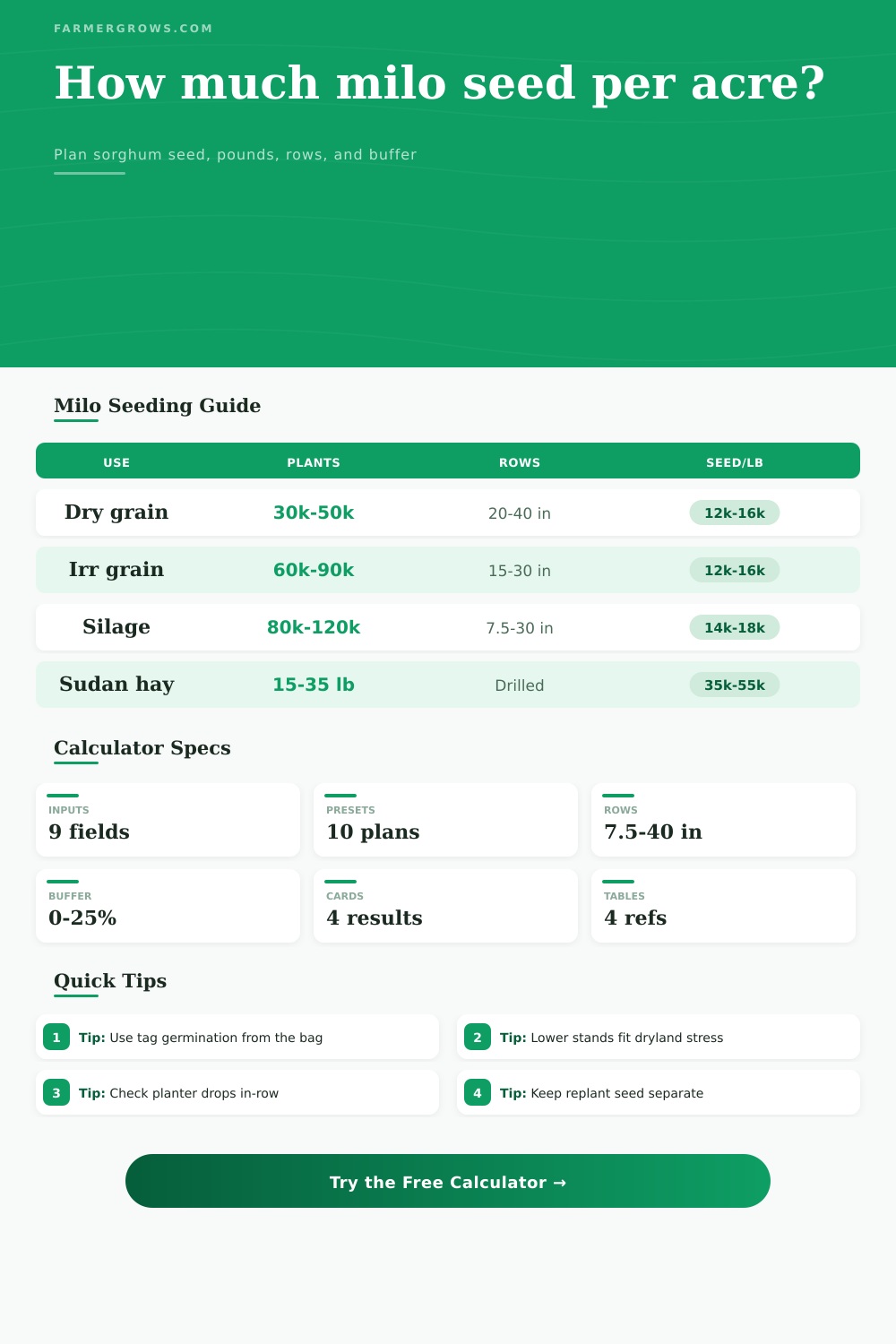
Milo Seed Per Acre Calculator
Estimate grain sorghum and milo seeding from acres, sorghum type, target population, seeds per pound, germination, emergence, row spacing, drop spacing, moisture class, and replant buffer.
Choose a starting field plan, then edit the population, seed tag values, row width, current drop spacing, acres, and replant buffer for the seed lot and planting conditions.
Built for harvestable heads and combines. Dryland fields usually sit lower; irrigated grain can carry thicker stands.
Higher populations help canopy, tonnage, and stalk count when moisture and fertility can support the crop.
Drilled or narrow-row forage plans use more plants for stem density, grazing, greenchop, or haylage production.
Sudan seed is often planned by pounds per acre, but this calculator still checks emergence, pounds, and total seed.
Milo Seeding Plan
The calculated sorghum seed plan appears after the first calculation.
| Sorghum use | Dryland stand target | Irrigated stand target | Typical row spacing |
|---|---|---|---|
| Grain milo, tough dryland | 28,000 to 40,000 plants/ac | 45,000 to 65,000 plants/ac | 30 to 40 inches |
| Grain sorghum, balanced field | 40,000 to 60,000 plants/ac | 60,000 to 85,000 plants/ac | 20 to 30 inches |
| High-yield irrigated grain | 55,000 to 70,000 plants/ac | 75,000 to 100,000 plants/ac | 15 to 30 inches |
| Silage or biomass sorghum | 70,000 to 95,000 plants/ac | 90,000 to 125,000 plants/ac | 7.5 to 30 inches |
| Forage sorghum or sorghum-sudan | 90,000 to 130,000 plants/ac | 110,000 to 160,000 plants/ac | Drilled or narrow rows |
| Seed rate | 30 inch rows | 20 inch rows | 15 inch rows | 7.5 inch drill rows |
|---|---|---|---|---|
| 40,000 seeds/ac | 5.2 in drop | 7.8 in drop | 10.5 in drop | 20.9 in drop |
| 60,000 seeds/ac | 3.5 in drop | 5.2 in drop | 7.0 in drop | 14.0 in drop |
| 80,000 seeds/ac | 2.6 in drop | 3.9 in drop | 5.2 in drop | 10.5 in drop |
| 100,000 seeds/ac | 2.1 in drop | 3.1 in drop | 4.2 in drop | 8.4 in drop |
| 140,000 seeds/ac | 1.5 in drop | 2.2 in drop | 3.0 in drop | 6.0 in drop |
| Seed tag germination | Field emergence | Survival factor | Seed needed for 50k stand |
|---|---|---|---|
| 95% | 90% | 85.5% | 58,480 seeds/ac |
| 90% | 85% | 76.5% | 65,359 seeds/ac |
| 90% | 80% | 72.0% | 69,444 seeds/ac |
| 85% | 75% | 63.8% | 78,431 seeds/ac |
| 80% | 70% | 56.0% | 89,286 seeds/ac |
| Seeds per pound | 50,000 seeds/ac | 75,000 seeds/ac | 100,000 seeds/ac | 50 lb bag plants |
|---|---|---|---|---|
| 12,000 seeds/lb | 4.17 lb/ac | 6.25 lb/ac | 8.33 lb/ac | 600,000 seeds |
| 14,000 seeds/lb | 3.57 lb/ac | 5.36 lb/ac | 7.14 lb/ac | 700,000 seeds |
| 16,000 seeds/lb | 3.13 lb/ac | 4.69 lb/ac | 6.25 lb/ac | 800,000 seeds |
| 18,000 seeds/lb | 2.78 lb/ac | 4.17 lb/ac | 5.56 lb/ac | 900,000 seeds |
| 45,000 seeds/lb | 1.11 lb/ac | 1.67 lb/ac | 2.22 lb/ac | 2,250,000 seeds |
| Named preset | Target population | Seed size | Buffer |
|---|---|---|---|
| Dryland Grain Low | 32,000 plants/ac | 14,000 seeds/lb | 10% |
| Dryland Grain Medium | 45,000 plants/ac | 14,000 seeds/lb | 10% |
| Irrigated Grain Push | 82,000 plants/ac | 15,000 seeds/lb | 5% |
| Silage Sorghum Rows | 105,000 plants/ac | 16,000 seeds/lb | 10% |
| Sudangrass Hay Drill | 350,000 plants/ac | 45,000 seeds/lb | 15% |
Stand check: Revisit emergence after the first stand count. If plants are thin from crusting, cool soil, or herbicide stress, use the measured stand before making replant decisions.
Buffer check: Keep the replant buffer separate from the planter fill plan. That makes it easier to tell actual field use from reserve seed held for repairs or drowned-out spots.
There’s no such thing as certainty when planting grain sorghum. There’s your field, which will have some sort of moisture profile. There’s your seed lot with a germination tag that might be slightly optimistic. And then there’s your planter, which has quirks all its own.
Understanding how many seeds won’t sprout, and accounting for those in the ground, can make or break getting a full stand versus a thin stand; not to mention a profitable crop. The problem is most people think about their final stand without considering what happens to the seeds in bag once they are planted in field.
How to Plant the Right Amount of Seed
At each step there is some loss factor. First is germination. Assuming your seed tag claims 90 percent, then you’re starting out behind. Next comes emergence. Cool weather, soil crusting or maybe residual herbicide can knock this figure down even more. One of the mistakes I see frequently is that someone figures they need to plant fifty thousand seeds per acre to get fifty thousand plants. Those numbers work if all those seeds makes it, which isn’t often reality.
Plug in estimates of survival rates and seed sizes into the calculator. It does the math for you so you don’t have to guess how much extra seed to buy.
“The key is knowing what you’re measuring. The main difference between varieties are the number of seeds per pound. You have some milo seed that’s heavy and big, which requires more pounds per acre to reach your desired number of plants. Others are light and small, requiring fewer pounds to achieve equivalent numbers. So if you forget that aspect and apply a flat pound rate as in previous years, you’ll either undersow or oversow without even knowing it. And that’s where folks mess up. A pound is not a pound; it is a volume of seed that varies greatly across hybrids.”
There’s more: Row spacing. Narrow rows change the way plants compete and close their canopy. Tightening them from thirty to fifteen inches alters plant density, and that influences seed dropping. You see this spelled out on the reference table; it shows that the planter will adjust its drop spacing to maintain a constant population no matter the width of the row. It must do this. Otherwise there will be skips or clumps, and neither help yield.
Keep in mind moisture availability. If it’s a dryland field, your population should typically be lower; you don’t want to allow the crop to fight for scarce resources. If it’s an irrigated field, however, you can get away with heavier stand since limiting factor (water) has been eliminated. You can set the program to either mode and toggle back and forth, allowing you to modify default parameters based off your water-holding capacity.
Don’t expect to seed a corn belt irrigation plot at the same density as a drought-prone field. They’ll stress one another out and yield potential will go down the tubes.
A replant buffer acts as insurance. You might call it a waste, but I say it’s practical. Ten to 15 percent more seed isn’t wasted. It is practical for headlands and the turns. It covers the occasional drowned-out spot that requires patching and act as a calibration check. Seed up to the last bit of your seed supply and you might find yourself short if you miss a calibration check. Having some seed set aside from your primary fill plan give you options in case field conditions changes throughout the day.
Planting seed is an act of engineering a stand; it’s not simply dumping seed in the ground. Respecting biology is precision planting. Seed size, germination rate, emergence rate, you’re turning a guess into a plan when you account for these factors. Planting a crop isn’t just planting seed. Grow a crop. Work with the reality of the seed and the reality of the soil instead of fighting them. That’s when potential becomes production.