
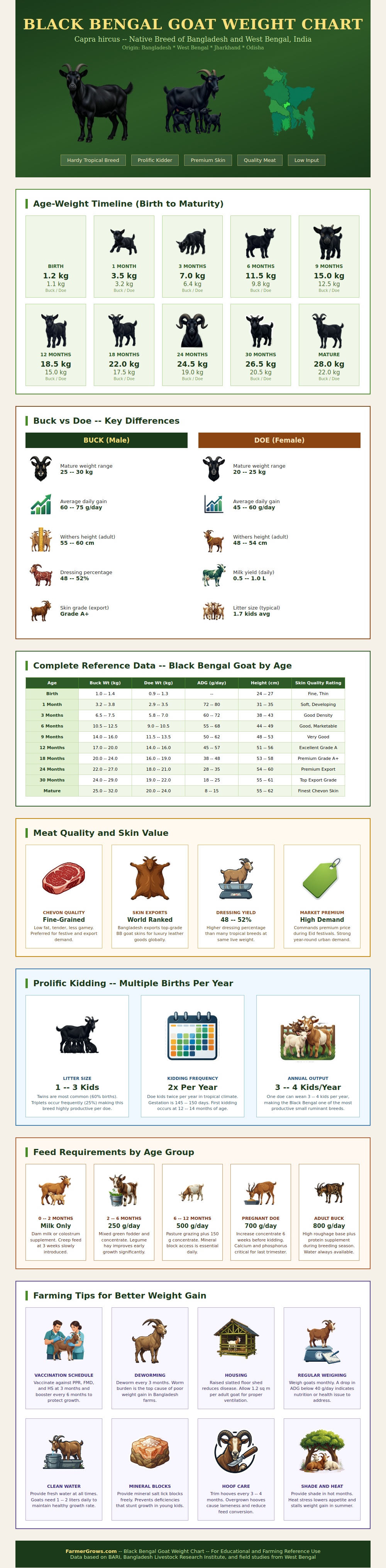
Beyond their home range, the Black Bengal goat is well known for being an efficient and fast-growing animal. Because of this, smallholders relies on these goats. They need animals that can produce both skins and meat in one growing season without taking up too much space. These goats fit well in a modest backyard system and do not require expensive inputs.
The growth chart below makes it clear why: A baby kid starts off at just-over-a-kilo big and, in about two years’ time, is ready for market. When guessing how soon a doe might help the household bank account, or planning how many animals you want to finish before the next festival, keep in mind this progression.
Why Black Bengal Goats Are Good for Small Farms
If you’re raising Black Bengal goats primarily for meat, it’s important to know there are consistent differences in weight between bucks and does. While males tend to put on weight quicker throughout all ages, females focus more on reproduction than body size. You can use this information to help determine who you’ll want to retain as breeding stock and who will be sold.
It’s also worth noting that once the goats hit their first birthday, their daily gains slow down. In other words, the window for quick gains is shorter then many new keepers expect. Because the breed does have multiple births, it makes weight chart even more useful. If your doe consistently has twins or triplets every year, she increase the profit from feeding her.
You know when to begin the next round of breeding by looking at the timeline and seeing when those kids hit weaning weight. With proper care and feeding, one doe can provide up to three or four market animals per year in real life, making small farms sustainable despite limited access to capital and land.
As young kids get bigger, they start needing different feed, according to this chart. First they need milk (and then later some pasture and a little concentrate). At about 6 months old their daily feed requirements double, and lactating/pregnant does requires yet again larger amounts. To avoid wasting money by over-feeding or stunting growth by under-feeding, you want to ensure that you give them the amount of feed appropriate for their stage (indicated on the chart).
Health care follows the same principle: regular weights against the expected curve will tell you whether there is something wrong with your goats, whether it’s due to heat stress, poor housing, or worms. The animal can get up to those expected weights, assuming good management (basic care) and housing. Clean water and shade from summer heat protect the appetite, while raised floors minimize parasites and keep hooves dry. To ensure your daily gains show up in the above chart, be sure you have your animals vaccinated and dewormed every three months.
It’s all pretty simple stuff, but failure at any step means a lighter market animal (or slower growing). Another plus is that the Black Bengal remains reasonably sized, a factor that figures into the skin market as well: Black Bengals has thin, supple hides that sell at a good price overseas. Even if the meat market goes up and down, that’s still a selling point.
It means farmers can target their sales to coincide with demand, no guesswork required, since they can compare their animals’ weight against the posted curve. Numbers are not a hard goal, but they are a planning guide. They are an indication of what is possible with reasonable management. If your animals is lagging behind, you can see what changes to make.
As they follow their pattern on your farm, you watch it develop into a working record, one that shows consistent producers from those who keep wondering why every next batch doesn’t meet expectations. You should of checked the chart more often.
The Black Bengal goat are naturaly good for small farms and can grow moddernly in many conditions. Most people find it comfortabley to raise them if they have enough space. They actualy grows fast.