
Fruit trees are islands in most home gardens. We dig hole for one sapling. Maybe we toss in a bag of mulch, then we step away and wait for peaches or apples to come.
That’s missing forest for the trees. In nature, things don’t work alone. An orchard that thrive is an interconnected community of living things mutually helping each other along. Without any chemicals, these organisms cycles nutrients, keeping pests under control.
How Companion Plants Help Your Fruit Trees Grow
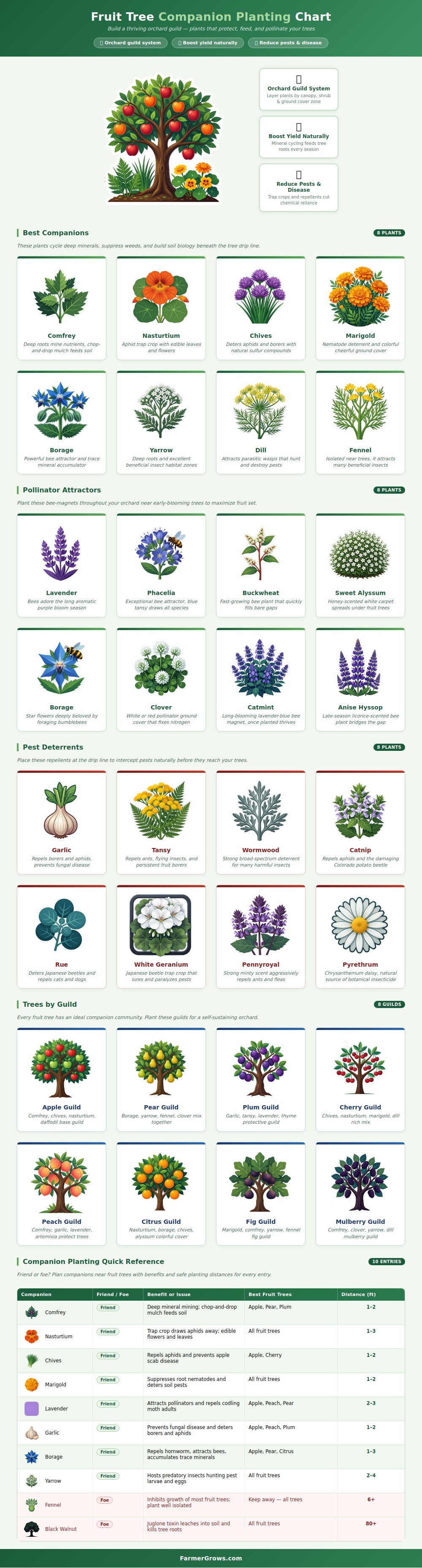
Exactly how? The companion planting chart above reduces it all down to manageable groups, who helps whom to live and thrive as a tree. Not just pretty; it’s creating a self-sustaining ecosystem in your own backyard. At its heart are guilds (the whole thing). Imagine it’s a composting operation, with a bit of a neighborhood watch party thrown into the mix.
As you’ll see in the infographic, there are certain layers of plant under your fruit tree canopy that play different roles. There is nutrient miners. Think of comfrey, a deep-rooted plant that pulls nutrients from deep underground and carries them up to the surface. You can then chop and drop the foliage as mulch, which feed the tree roots each season.
And most of us does it all wrong. We worry about what the tree wants to eat, but not how we feeds the soil biology itself. And then there are the pollinators: Without them you get no fruit, even if you have all the blossom in the world. Eight pollinator attractors is on the chart, including lavender, borage, and phacelia. Sow them around your earliest blooming trees to ensure a continuous supply of pollinators when they’re needed most. The prized borage has deeply loved star-shaped flowers that foraging bumblebees especially adore. An added bonus: It builds up trace minerals as well. One plant does double duty. It is a little thing, but it is very important for fruit set.
Companion planting truly excels at pest management. No sprays here; no sprays that kills everything in sight. Instead, use repellent plants like chives and garlic, which emit sulfur compounds to keep away borers. You can also use trap crops like nasturtiums, which attracts aphids. The bugs don’t touch your precious apple tree. They go for the nasty-looking nasturtium first.
This visual guide shows who is attacking whom. This lets you place deterrents right at drip line to stop pests before they gets to the fruit. Yarrow and dill are favorite hangouts of predatory insects. This include parasitic wasps, which prey on the pests that eat your crops.
Not all your neighbors will be friendly, though. The chart’s “reference” section cautions you off from planting black walnut or fennel near your fruit trees, for example: Fennel suppresses virtually everything else growing around it. Black walnut exudes a toxin called juglone, which is fatal to tree roots. Keep these guys far, far away. The chart recommends a minimum distance from fennel of six feet; black walnuts even more so. All your careful efforts could of gone for nothing if you ignore such antagonists.
Therefore, you need to plan ahead. That requires watching over time, and building those guilds. Start by planting a few key companion plants near each apple tree: marigold and comfrey might be good ones to start with. Observe what happens in the soil over time. What pests appear? Which don’t? Tweak actualy accordingly.
Remember: it’s about creating something resilient, but not perfect. Because there are many elements in the mix, even if one falls prey to a pest, its neighbors will protects it. It’s a living thing; not a rigid diagram.
Don’t view the orchard only in terms of trees. View the community supporting them. That is the heart of growing an orchard that endures.