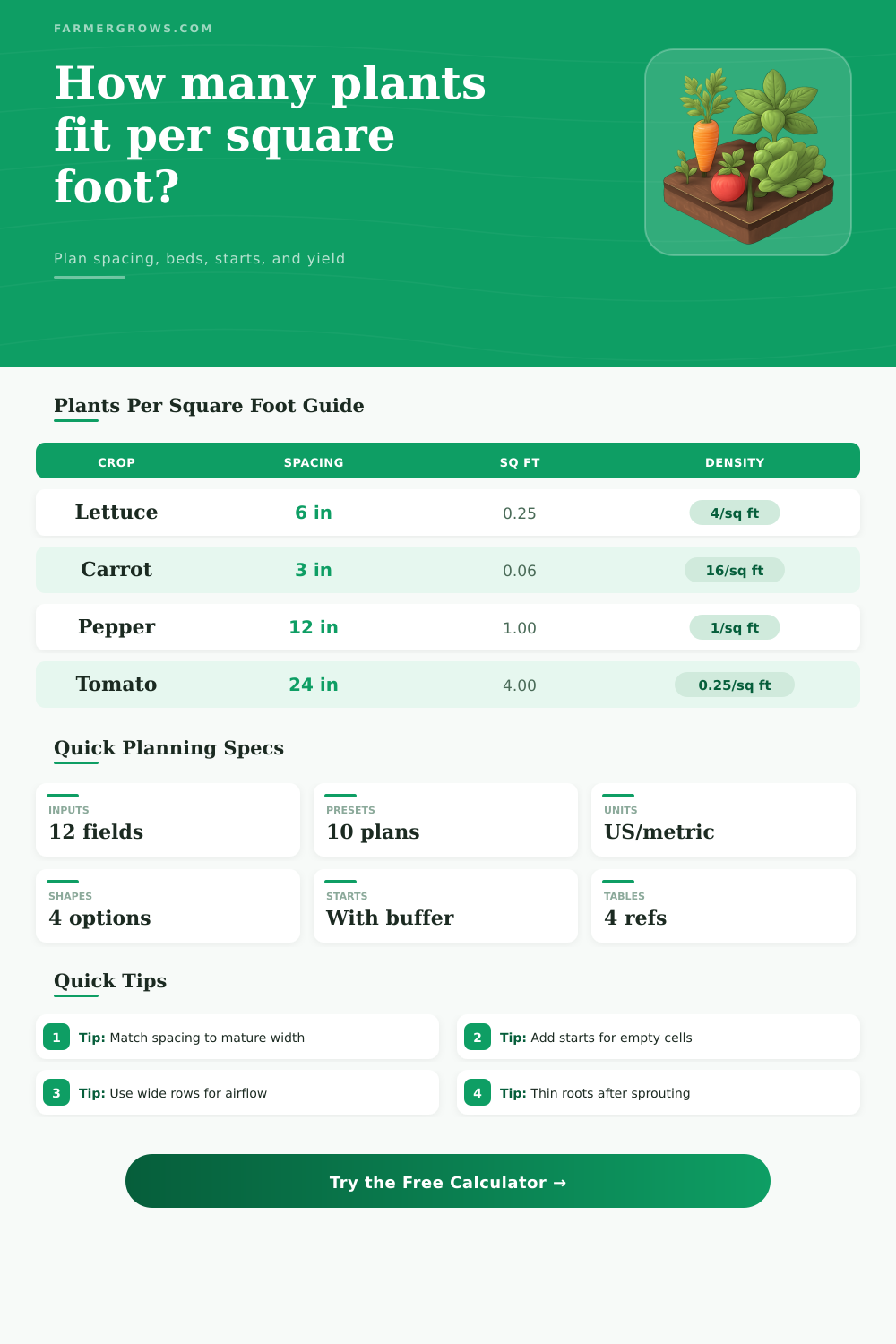
Plants Per Square Foot Calculator
Estimate garden plant density, row count, total plant stations, seed or transplant starts, and harvest range for square-foot beds, row gardens, greenhouse benches, and field blocks.
Use this calculator when spacing seed packets, plug trays, transplants, and mixed garden beds. It converts mature spacing into plants per square foot, then scales that density across your actual planting shape.
Planting Density Results
Use these numbers to mark planting grids, order starts, seed trays, and compare whether the spacing is realistic for the crop style.
| Plant spacing | Row spacing | Sq ft per plant | Plants per sq ft | Typical crops |
|---|---|---|---|---|
| 3 in | 3 in | 0.06 | 16.0 | Carrots, radishes, bunching onions after thinning |
| 4 in | 4 in | 0.11 | 9.0 | Spinach, beets for baby roots, small turnips |
| 6 in | 6 in | 0.25 | 4.0 | Leaf lettuce, parsley, cilantro, compact greens |
| 8 in | 8 in | 0.44 | 2.25 | Bok choy, romaine, dwarf flowers, basil starts |
| 12 in | 12 in | 1.00 | 1.0 | Peppers, eggplant, Swiss chard, basil, kale |
| 18 in | 18 in | 2.25 | 0.44 | Broccoli, cabbage, cauliflower, large herbs |
| 24 in | 24 in | 4.00 | 0.25 | Tomato, winter squash starts, wide kale, melons |
| Crop group | Dense spacing | Balanced spacing | Wide spacing | Planning note |
|---|---|---|---|---|
| Leafy greens | 4 to 6 in | 6 to 8 in | 10 to 12 in | Cut-and-come-again beds tolerate closer spacing |
| Root crops | 2 to 3 in | 3 to 4 in | 5 to 6 in | Thin early so roots can size without twisting |
| Fruiting crops | 12 in | 18 to 24 in | 30 to 36 in | Use wider spacing for tomatoes, trellises, and airflow |
| Brassica heads | 12 to 15 in | 18 to 24 in | 24 to 36 in | Head size falls quickly when leaves overlap too much |
| Culinary herbs | 4 to 6 in | 8 to 12 in | 18 to 24 in | Harvest frequency changes the useful density |
| Flowers | 6 in | 9 to 12 in | 18 to 24 in | Use wide spacing for large branching annuals |
| Bed size | Area | 16 per sq ft | 4 per sq ft | 1 per sq ft |
|---|---|---|---|---|
| 2 x 4 ft box | 8 sq ft | 128 plants | 32 plants | 8 plants |
| 3 x 6 ft bed | 18 sq ft | 288 plants | 72 plants | 18 plants |
| 4 x 8 ft bed | 32 sq ft | 512 plants | 128 plants | 32 plants |
| 4 x 12 ft bed | 48 sq ft | 768 plants | 192 plants | 48 plants |
| 10 x 20 ft block | 200 sq ft | 3,200 plants | 800 plants | 200 plants |
| Planning factor | Conservative | Typical | Strong | How to use it |
|---|---|---|---|---|
| Transplant establishment | 80% | 90% | 95% | Start extra plugs when planting heat, wind, or weak starts |
| Direct seed stand | 60% | 75% | 90% | Use a lower value before thinning small-seeded crops |
| Edge allowance | 15% | 5 to 10% | 0% | Subtract space for trellises, boards, and harvest access |
| Offset row gain | 0% | 8% | 12% | Use only when staggered rows still leave airflow |
| Seedling buffer | 5% | 10% | 20% | Add extras for gaps, failed plugs, and replacements |
For airflow: Treat the calculator result as the maximum stand count. If a crop makes broad leaves, vines, or humid canopy, widen rows before planting more seedlings.
For direct seeding: Calculate the final stand first, then sow extra seed and thin back to the target density once seedlings are strong enough to select.
Why isn’t your garden shown off in an orderly display, not a jumble? Why did the plants seems packed so closely when you stood there with seedlings in hand, craning them up at eye level in hardware aisle? Well: Spacing makes all the difference. Chances are that most newbies puts things too darned close (because they think about the little sprout, not the grown-up plant). It is no big deal, except that you might lack airflow, lose yield, or lose crops to fungal disease.
Translating adult sizes to useful planting densities connects impulse-buying to smart-planting. That’s where the calculator come in. The first step is understanding that every plant has some kind of footprint, the amount of square footage it requires. A head of lettuce may require just six inches of space, while a beefsteak tomato need almost four feet to grow well without competing for nutrients and light with other crops.
Why Plant Spacing Matters for Your Garden
As you enter the dimensions of your beds, the tool calculates more than just a grand total. It also takes into account the shape of your garden, such as if you have wider rows for easier harvest access or if you are using an intensive gardening system with a tighter grid. The page’s reference table explains it simply enough with typical crops… But the magic happen when you tweak that number based on your own conditions.
Seedling survival rates are one of the most under-considered factors when planning the garden. Inevitably, even with the best soil and plenty of moisture, not every plant will make it. That’s where the buffer settings comes into play: Do you intend to start out thick (and plan on thinning) such as with radishes or carrots direct-seeded in summer heat? Then set that number high from the get-go. Know what you’re measuring is half the secret. Are you after a percentage of total seed planted, or a percentage of desired number of final harvestable plants? Those can be wildly different figures.
The stakes are a little higher for transplants such as tomatoes or peppers, where each plug is a substantial investment in both dollars and time. Nobody wants to have half their bed blown by heat or wind damage the first week and suffer poorer-than-expected establishment. A few more starts, to cover a possible 10 percent loss, can be a small hedge that pays off big when harvest comes and there’s a solid green block instead of patches here and there. Nature is messy; a rigid plan never survives contact with the real world out there, so it works for a reason.
But that’s not all: Airflow (which many people sacrifice in the name of getting as much production as possible) is another factor. A dense planting also forms a sort of humid environment under its canopy, inviting powdery mildew and botrytis to lurk and love. It’s particularly important with cucurbits and leafy greens. Even if the math tell you you can fit an extra half-dozen or so plants into each square foot, expand your row width a bit if your crop includes broad-leafed varieties, and enjoy the increased resistance to disease. More heads may not be worth it when measured different than how much produce you’ll probably lose due to powdery mildew and such.
But with the tool, I can also get a sense of what my range of potential yield would be (low/high per plant). This lets me set appropriate expectations not only after harvest but before the growing season begins. Is that little box on my patio going to really provide enough food for the family, or will it just be an ornamental display? Getting that information, converting those vague horticultural hopes into concrete pounds of food, is why you plan in the first place, right?
The point of square-foot gardening isn’t cramming things in boxes; it’s cramming things where they’re useful on your property, while taking their biology into account. Use the presets as a baseline with things that are widely grown (like onions or lettuce), then adjust the spacing according to how much sun you have and what kind of soil you grow in. Roots need room, too: A good loam that’s rich and drains well can usually allow closer spacing than bad soil, since there aren’t as many battles over resources for nutrients. Over time, you’ll get a sense of what’s too far apart and what isn’t close enough; some crops will tolerate a little elbow room (such as the herbs) while others needs their very own personal island (like the broccoli).
Until then, though, let the math be your friend, run it through the calculator first so you know what you’re getting into before you’ve dug a single hole. It avoids any frustration, and means you won’t have a garden full of plant just barely making it by come summertime. The feeling of not knowing your way around the hardware aisle soon gives way to a plan outlined before you…and nothing beats that.