Centrifugal Pump Efficiency Calculator
Estimate hydraulic horsepower, wire-to-water efficiency, pump bowl efficiency, shaft horsepower, impeller trim effect, BEP offset, and operating point health from field pump readings.
Enter measured flow, total dynamic head, electrical input power, motor efficiency, fluid specific gravity, RPM, impeller trim, and the pump's best efficiency point flow. Use field TDH, not only discharge pressure, so the efficiency calculation reflects the full lift and friction load.
Pump Efficiency Results
Your pump efficiency summary will appear here.
| Metric | Formula | Units | Use |
|---|---|---|---|
| Hydraulic horsepower | HP = GPM x TDH x SG / 3960 | HP | Useful power delivered to the fluid. |
| Hydraulic kilowatts | kW = hydraulic HP x 0.7457 | kW | Same hydraulic output in electrical power units. |
| Motor shaft horsepower | shaft HP = input kW x motor eff / 0.7457 | HP | Power available at the pump shaft. |
| Pump efficiency | pump eff = hydraulic HP / shaft HP x 100 | % | Hydraulic efficiency of the pump end. |
| Wire-to-water efficiency | wire eff = hydraulic kW / input kW x 100 | % | Full electrical-to-fluid system efficiency. |
| Flow vs adjusted BEP | Likely condition | Common symptom | Field check |
|---|---|---|---|
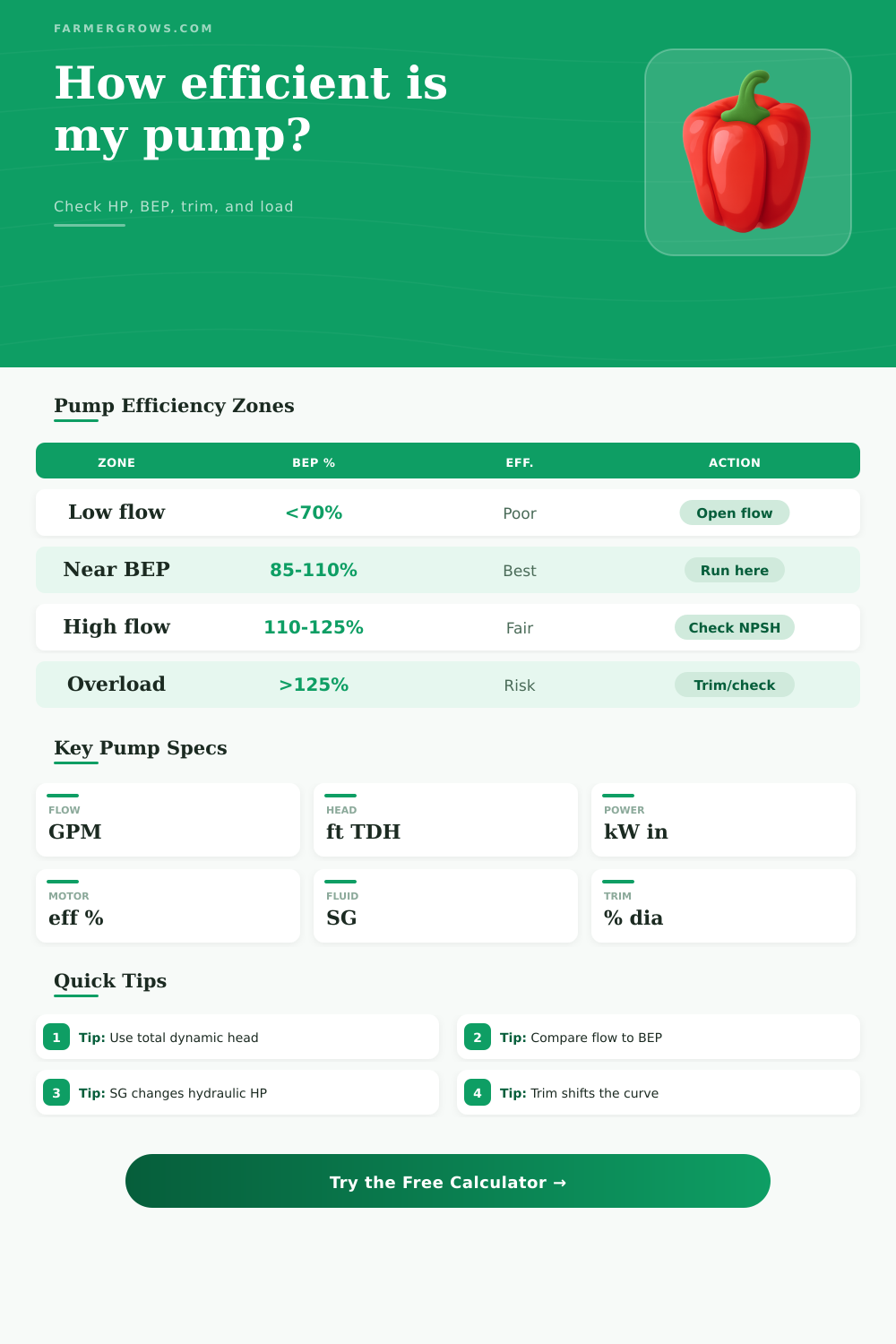
| Below 70% | Low-flow operation | Recirculation, heat, noise, seal stress | Check throttling, minimum flow bypass, and valve position. |
| 70% to 85% | Left of preferred zone | Lower efficiency and possible vibration | Compare system curve against pump curve. |
| 85% to 110% | Near best efficiency point | Usually stable and efficient | Good target for continuous farm water service. |
| 110% to 125% | Right of preferred zone | Higher load and lower head margin | Check NPSH available and motor amps. |
| Above 125% | Far right of curve | Overload, cavitation risk, poor control | Review impeller trim, speed, and pump selection. |
| Fluid or mixture | Typical SG | Power effect | Use in calculator |
|---|---|---|---|
| Clean water | 1.00 | Baseline hydraulic HP | Use 1.00 for most irrigation and wash water. |
| Warm water | 0.98 to 1.00 | Slightly lower load | Use actual SG when temperature is known. |
| Fertilizer solution | 1.05 to 1.25 | Higher hydraulic HP | Use blend SG from the product or hydrometer. |
| Manure lagoon liquid | 1.02 to 1.10 | Higher load and more wear | Use a solids-aware pump curve when available. |
| Brine or dense process water | 1.10 to 1.30 | Motor load can rise quickly | Verify horsepower margin before running. |
| Preset | Flow and head | Power setup | Operating intent |
|---|---|---|---|
| Farm well booster | 450 GPM at 160 ft | 28 kW, 92% motor | Continuous pressure supply near BEP. |
| Irrigation mainline | 900 GPM at 125 ft | 48 kW, 93% motor | Large zone flow with moderate head. |
| Greenhouse loop | 120 GPM at 70 ft | 5.4 kW, 90% motor | Smaller recirculation pump. |
| Fertigation skid | 260 GPM at 135 ft | 18 kW, 91% motor | Specific gravity above clean water. |
| Water transfer pump | 650 GPM at 85 ft | 24 kW, 91.5% motor | Tank filling and field transfer. |
| Trimmed reuse pump | 380 GPM at 110 ft | 19 kW, 90% motor | Reduced impeller diameter check. |
Measure TDH carefully: include suction conditions, pressure head, pipe friction, valves, strainers, filters, elevation, and discharge pressure before judging pump efficiency.
Use BEP as the anchor: a pump can still move water while wasting power if the operating flow is far left or right of its adjusted BEP flow.
Centrifugal pumps is extensively used in the farming, processing, and municipal industries. Yet, many centrifugal pumps do not operate at there best efficiency point. Operating away from the best efficiency point can result in higher electric bill, warmer pump bearing, and cavitation that shortens the life of the pump seal.
Use the calculator on this page to calculate the relationship between flow, total dynamic head, and power for your centrifugal pump. You can easy be collected the numbers used in the calculation from the pump in the field. Flow and total dynamic head are the two central components of the efficiency check for a centrifugal pump.
How to Check Centrifugal Pump Efficiency
Flow is the amount of water that is passing through the system. Total dynamic head is the total amount of work that is required to move the fluid through the system. The total dynamic head includes the static lift of the fluid, the friction loss of the system, and the pressure that is required at the discharge of the centrifugal pump.
Many people incorrectly measure only the pressure at the discharge of the centrifugal pump. To account for the total dynamic head in the calculation, the user must supply the total dynamic head to the calculator so that the resulting number for hydraulic horsepower represent the work that is being done on the fluid. The next component to consider with the efficiency of a centrifugal pump include the input power for the pump and the efficiency of the motor.
The power that is indicated on the power meter for the motor includes power loss within the motor. To determine the power available to the centrifugal pump, the user must multiply the input power by the efficiency of the motor. The calculator will automatically calculate this value if the user enters the efficiency of the motor into the calculator.
If the efficiency of the motor is not accounted for, the hydraulic power output of the centrifugal pump will be compared to the electrical input power of the motor to calculate the efficiency of the centrifugal pump. However, this is an incorrect method of calculating efficiency. Two-stage calculation are necessary to find the efficiency of the centrifugal pump so that the power loss within the motor is separated from the power loss of the impeller and volute of the centrifugal pump.
Another factor in determining the efficiency of the centrifugal pump is the specific gravity of the fluid that is being move by the centrifugal pump. If the fluid that is being moved is not plain water, then the calculation will account for the specific gravity of the fluid. Fluids such as fertilizer blends, manure, and brine have a higher weight per gallon than plain water.
The higher the specific gravity of the fluid that is being moved through the system, the more power that is required to perform the function of moving the fluid. This factor scales the hydraulic horsepower that is calculated in the pump. For instance, if the specific gravity increase from 1.00 to 1.10, the hydraulic horsepower of the pump will increase by ten percent.
If the specific gravity of the fluid is too high for the centrifugal pump, the motor will be pushed into an overload state. Impeller trim can be an adjustment made by the operator to a centrifugal pump if the pump is found to be running too far to the left or the right of the best efficiency point. By trimming the impeller of the centrifugal pump, the flow and the head of the pump will be reduced.
However, the head of the pump will decrease at a faster rate than the flow will decrease. The user can multiply the best efficiency point flow of the pump by the impeller trim ratio to determine the flow of the pump at its current operating point. This factor can be used to determine that a centrifugal pump that used to run at or near its best efficiency point is now operating within a zone of low efficiency for that pump.
Another way to use the calculator is to compare the operating point of the centrifugal pump. After determining the hydraulic horsepower of the pump, the shaft horsepower of the pump, and the flow of the pump at its best efficiency point after applying the impeller trim ratio, the calculator will determine the percentage of the flow of the pump in comparison to the flow at its best efficiency point. If the percentage of the flow at which the pump is operating is between 85 percent and 110 percent, the centrifugal pump is within its best efficiency point range.
However, if the percentage of the flow of the pump that is being delivered is less than 70 percent of the best efficiency point flow of that pump, then the centrifugal pump is likely experiencing recirculation of the fluid and the fluid is heating within the pump. Furthermore, if the percentage of the flow of the pump that is being delivered is above 125 percent of the flow of the pump at its best efficiency point, then the centrifugal pump is experiencing a shortage of net positive suction head margin and the motor is working harder than its rated capacity for the pump. Wire-to-water efficiency is a measurement that account for all of the factors of efficiency of the system.
Even if the centrifugal pump has an acceptable efficiency, the centrifugal pump may have poor wire-to-water efficiency if the motor that drives the centrifugal pump is old or if the impeller of the centrifugal pump is worn. The calculator provides the wire-to-water efficiency so that the efficiency of the entire drive train for the centrifugal pump can be understood. Finally, real systems change over time.
The suction strainers for centrifugal pumps may become clogged, the discharge valves may drift from their set positions, and the demands on the centrifugal pumps may change seasonally or with the growth of the area in which the centrifugal pumps is installed. Therefore, it is important to run these calculations periodically using readings that are obtained from the centrifugal pump in the field. The reference tables that is provided will assist in the understanding of the efficiency calculations without the need to refer to another manual.
To develop a habit of determining the efficiency of centrifugal pumps in the field, it is necessary to log certain measurement of each centrifugal pump that is inspected. The user can log the flow of the centrifugal pump using a flow meter or an ultrasonic clamp meter. The discharge pressure, suction pressure, the electrical input power in kilowatts, and the speed of the centrifugal pump can be logged if the centrifugal pump is driven by a variable frequency drive.
By logging these measurements for a centrifugal pump, the calculator will return to the user the hydraulic horsepower that the centrifugal pump is developing, the efficiency of the centrifugal pump, the wire-to-water efficiency of the centrifugal pump, and the percentage of the flow of the centrifugal pump that is in comparison to the flow of the pump at its best efficiency point. By logging these value over several operating seasons for the centrifugal pump, you will be able to determine not only which centrifugal pumps are operating at or near their best efficiency point, but also which centrifugal pumps may require an impeller trim adjustment or another change to the operation of the pump. The efficiency of a centrifugal pump is not a fixed value.
The efficiency changes based upon the flow through the centrifugal pump, the density of the fluid that is being move by the centrifugal pump, the speed of the centrifugal pump, and the condition of the impeller of the centrifugal pump. The calculator makes possible the observation of such changes. The intention of calculating wire-to-water efficiency is to determine whether or not the centrifugal pump is performing the work for which the user is paying for the pump.
Based on the efficiency calculations, a decision can be made as to whether or not altering the speed of the centrifugal pump, trimming the impeller of the centrifugal pump, or altering the valve setting will result in cost-saving alteration to the centrifugal pump.