
It’ll look good (it survived winter); it flowers each spring perfectly reliably; it produces some fruit, which means you plant one Legacy blueberry bush in your yard, and every year or so you get maybe 5 pounds of berries. And you think: Hey, that’s not bad; I’m not complaining! It didn’t die, right? Everything is fine.
Wrong. If you plant a lone Legacy bush, the berries are often less sweet, smaller, and fewer in number then the plant’s genetics would produce. This means you’re not getting the full yield. Why? Even though blueberries can technicaly manage on their own, they don’t really want to be alone. Skipping the step of planting a neighbor is actualy a trap that leads to lower yields.
Why You Need Two Blueberry Bushes
It’s a northern highbush type. It was one of several releases in 1998 by USDA breeders looking to create a variety suited to cold-winter climates that also bore fruit late in the season. So it has been bred to be a tall thing, reaching six or seven feet tall if given room to grow.
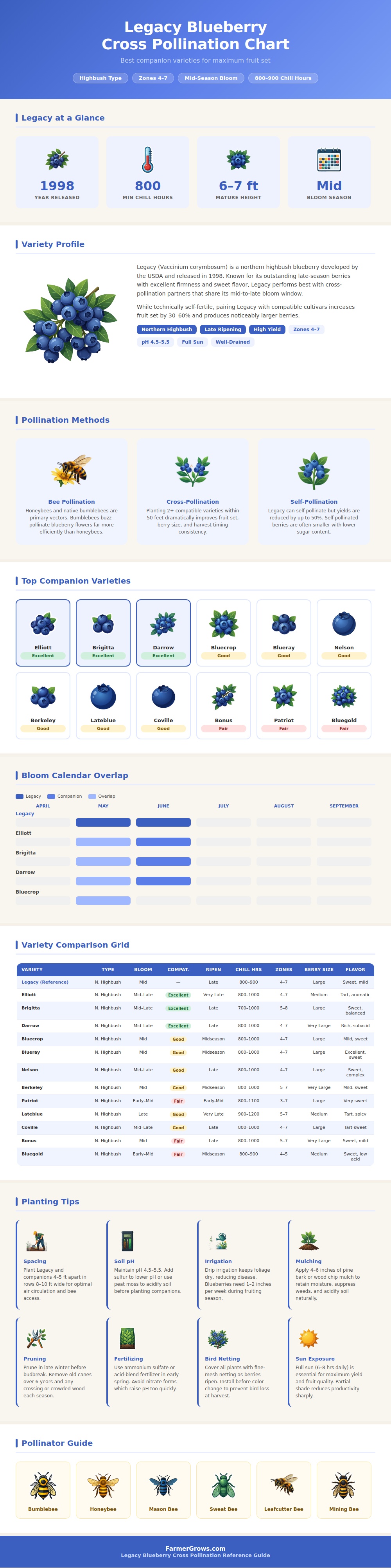
As the chart above details, in terms of compatible companions (so you don’t have to guess which bush will talk to whom during bloom time), they lay it all out for you. Proximity is not necessarily the issue as much as timing: If your pollinator partner completes its bloom cycle two weeks prior to when Legacy begins hers, you’re going to have a ghost town on your hands.
The secret of a really good crop versus an okay one: cross-pollination. Although Legacy is self-fruitful, research shows that you can increase fruit set up to sixty or even thirty percent if you include a compatible pollinator. It is not nothing. It is not just a little bit. A bigger bucket or just barely enough for a bowl?
Elliott and Brigitta and Darrow, marked here in the chart as great partners, has such a big overlap in bloom timing with Legacy (mid- to late season) that they’re all on deck when bees need to be buzzing from flower to flower. Bluecrop is shown as good, too, though there’s less overlap since it blooms somewhat earlier.
All that work is done by the bees. While most gardeners use honeybees (which of course get all the credit), bumblebees are much more effective at pollination on blueberries because they can buzz, vibrating the bloom open to dislodge the pollen as opposed to simply settling onto it and taking a drink. That mechanical action promotes better fertilization.
Other types of bees, such as mining bees, leafcutter bees, mason bees and sweat bees help out, particularly earlier in spring before honeybees have shaken off any lingering effects of a cold snap. Having some native flowers planted nearby will encourage these solitary bees to stick around longer and get the job done right. Even the best variety pairings won’t save you without active pollinators.
Soil chemistry: Just as important as variety selection is soil chemistry. Blueberries require an acid soil (pH range 4.5-5.5). No matter how many berries you get from them, if your soil is alkaline they’ll simply lock out nutrition. To correct it, amend with pine bark mulch, which helps keep things acid but also retains moisture. Use drip irrigation to water so the leaves stay dry, which reduces fungal diseases that love moist environments.
Pruning: This is another place where people take shortcuts. Remove old canes more than six years old to allow light into the interior of the plant, making it productive again. Failure to do so will result in a dense thicket of unproductive wood.
Regarding fertility, ammonium sulfate feeds new wood well without making the soil pH jump as fast as nitrate forms of fertilizer can. When berries begin to color up, they need protection from birds… Which notice when fruits are ripening long before you do. A bird net works but must be installed before appearance of any bluishness, or all will be lost.
Maximum sweetness in fruit comes from full sun exposure. If you have part shade, it will result in a modest crop instead of a large one.
The point: The ideal partner is not necessarily your soulmate; instead, it’s someone who’s timed out for picking together (or in this case, not). On that front, both Patriot and Bluegold score “fair,” because their bloom period is slightly different than Legacy’s. Efficiency was lost.
It is best to choose varieties with similar hardiness zones and chill hour requirements so they both wake up more or less on cue each spring. A little thing, logistically speaking; but it means you know when harvest’s coming. When planting, buy two compatible bushes (within 50 feet) and the resulting microclimate will be plentiful. The bees buzz back and forth, crossing the pollen as they travel.
And suddenly you have bigger berries, tastier berries (and those sweet), sweet jewels hold longer in the fridge, too. It’s not magic. It is just nature doing what it does best.
If you don’t know where to start, try Darrow or Elliott. They fit right into Legacy’s late ripening profile. Then sit back and wait for the proof that isolation wasn’t ever an option. The company makes the bowl fill faster.