
Plant a paw paw tree and wait for years as it grows into a tall thing that has amazing tropical-looking leaves. Maybe you’ll even get to witness those odd maroon-colored flowers dangling from its branches in springtime, but then there’s nothing but green all summer long…except maybe some fruit, which never materializes.
Why? Most people who try growing them at home fails to understand how this tree reproduces, and the problem isn’t their patience (or their soil quality). But rather pollination. Unlike most fruits, the paw paw is biologically stubborn when it comes to self-fertilization (meaning: breeding with its own kind). To get any fruit at all, you must have two genetically different trees.
How to Get Paw Paws to Bear Fruit
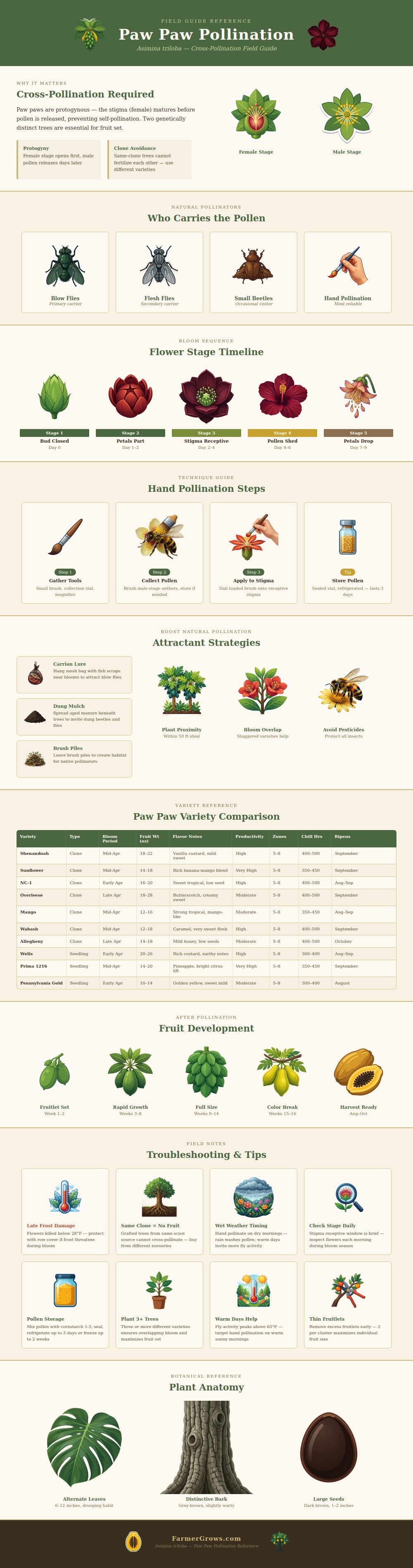
The infographic above shows this by illustrating that paw paws are protogynous-flowered. This means their female parts becomes receptive before the male pollen-producing anthers shed. That timing discrepancy ensures no paw paws can pollinate themselves either in the same flower or on the same tree.
A common error is planting two pawpaw varieties as clones next to one another. As genetic twins, they cannot fertilize each other.
Some insects visit paw paws. In general, bees don’t pay much attention to the flowers. Flesh flies and blow flies is more interested, since they’re drawn to the aroma, which has been compared to over-ripe bananas or rotting meat. Some tiny beetles is also interested, helping with pollination by carrying pollen from one blossom to another.
Hand-pollination may be an option if there isn’t sufficient natural fly action in your yard; it sounds worse then it really is. For the latter, hand pollination is required. You’ll do this by visiting two different paw paw tree daily as they are in bloom. Keep an eye out for one whose anthers (the yellow part) are showing their pollen and use a small soft brush to lightly dab at them. Then, carry the brush over to another tree where the female part, the stigma, is wet and ready. Dab again, and congratulations; you’ve helped fertilization.
But hurry up, the opportunitys fleeting. Check each of your trees daily at the height of its bloom. Read that how-to carefully. There is a specific stage for both male and female flowers. The stigma only accepts pollen for a day or two. You’re looking to transfer pollen from a male-phase flower on one tree to a female-phase flower on another.
The timing can vary… Sometimes an early one is already female when a later one drops its pollen… But if not, the flower withers and drop to the ground without ever setting fruit.
You can save pollen to prolong your pollination window. Pollen is viable up to three days in the fridge if stored as a paste of pollen mixed with cornstarch in a sealed container. That means you can collect extra pollen from the bountiful blooms now, then use it on days when cool temps and/or rain may have knocked down fly activity.
This is the reason. Not every variety bloom exactly on time, so growing several different kinds that bloom at different times is your best bet for getting good pollination. The idea is to have maximum overlap but avoid using the exact same genetics. Try combining one of these varieties with another, such as NC-1 or Overleese with Shenandoah or Sunflower.
It’s not just you: The weather has a part to play, too, with any late frost capable of killing the flower altogether (when it’s below zero at the time of opening). Watch the weather report, and be sure to cover your trees in spring if frost is on the way… But also know that rain makes natural pollination somewhat less successful, since it washes pollen from the stigmas.
Both hand pollination attempts and fly activity are best when it’s warm and dry first thing in the morning. After successful pollination, the fruit develops pretty quickly: Within weeks, tiny fruitlets appear. If you have more than one or two on a cluster, thin them early so that the few fruits left in each grouping can get bigger and tastier.
In late summer, the fruits will start to turn yellowish-brown and gets really soft. Paw paws are tropical-tasting fruits with the flavor of a cross between a mango and a banana laced with some vanilla custard. They’re rich and creamy, and the pollination requirements makes them really simple to grow (with the right knowledge).
No more guessing about why you haven’t gotten any fruit on your tree; you’ll have the exact details for next year’s crop once you understand how to get one of these odd natives to bear fruit in your garden. Just plan multiple varieties, watch each other flower, and don’t be afraid to give your trees a little human help when Mother Nature doesn’t deliver. You should of known about this earlier.