Raised Planter Soil Calculator
Estimate soil volume, reservoir water, wicking layer displacement, blend components, crop root depth, retail bags, and loaded weight for elevated raised planters.
Use inside planter dimensions and the depth actually available above the false bottom. Elevated beds concentrate weight on legs, rails, casters, brackets, and deck boards, so the load estimate includes soil, retained water, wicking media, and planter frame weight.
Raised Planter Results
Your planter volume, root depth, reservoir water, and load estimate will appear here.
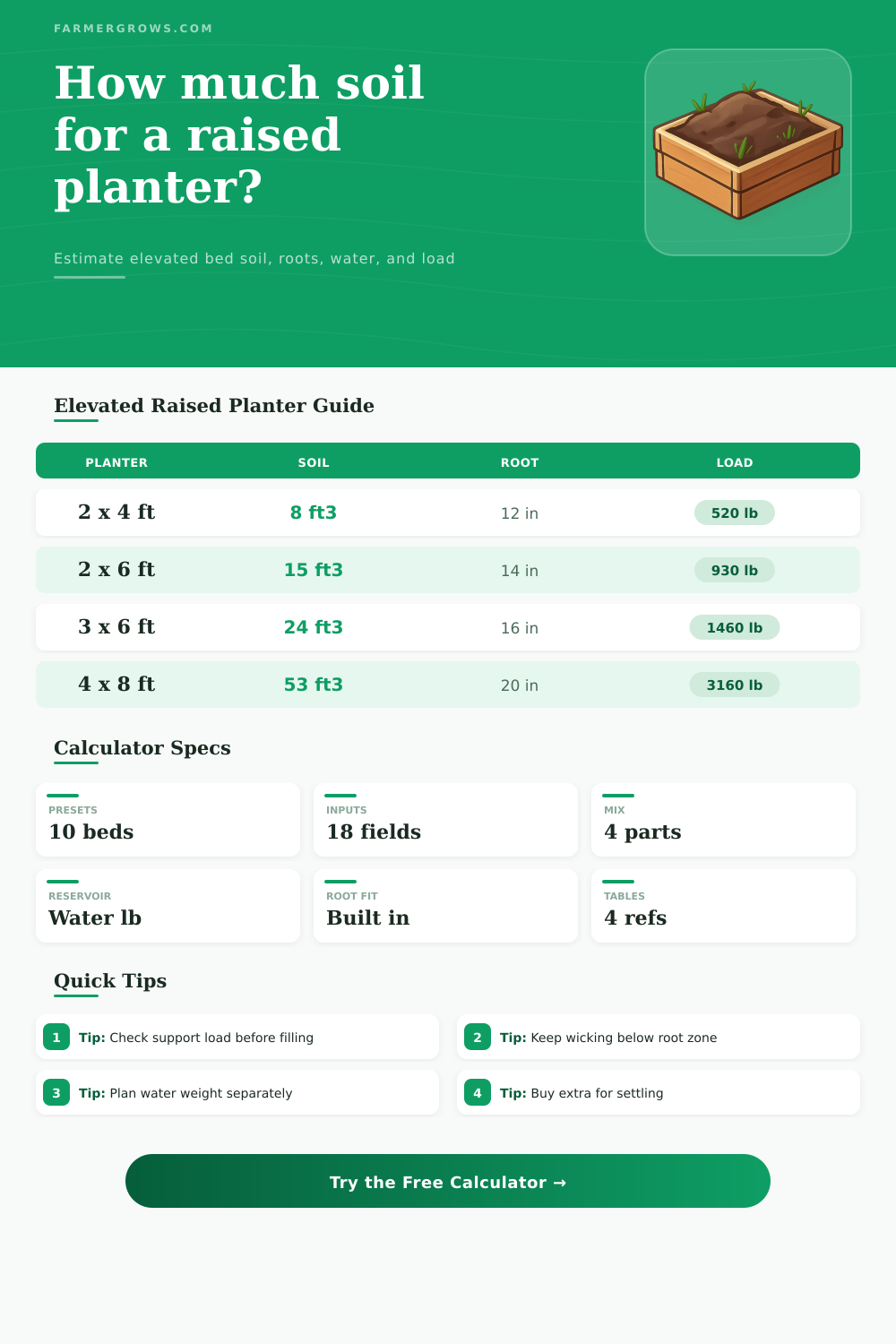
| Raised planter size | Footprint | 14 in soil volume | Common crop fit | Elevated planning note |
|---|---|---|---|---|
| 1.5 x 3 ft rail trough | 4.5 sq ft | 5.3 cu ft | Herbs, lettuce, flowers | Use light mix and strong rail brackets. |
| 2 x 4 ft patio table | 8 sq ft | 9.3 cu ft | Greens, strawberries, peppers | Good height for frequent picking. |
| 2 x 6 ft bench planter | 12 sq ft | 14.0 cu ft | Tomatoes, peppers, herbs | Check racking if the planter rolls. |
| 3 x 6 ft accessible bed | 18 sq ft | 21.0 cu ft | Mixed vegetables | Spread load across more legs or skids. |
| 4 x 8 ft elevated bed | 32 sq ft | 37.3 cu ft | Deep vegetable rotation | Usually needs structural framing, not light legs. |
| Material or layer | Typical density | Weight per 2 cu ft bag | When to choose it | Load note |
|---|---|---|---|---|
| Light peat or coir mix | 30 to 38 lb/cu ft | 60 to 76 lb | Rail planters and movable carts | Dries faster but lowers support load. |
| Raised bed bag mix | 38 to 48 lb/cu ft | 76 to 96 lb | General elevated vegetables | Good balance of water and weight. |
| Compost-rich blend | 52 to 62 lb/cu ft | 104 to 124 lb | Heavy feeders in sturdy planters | Can become dense after repeated watering. |
| Pumice or lava wicking layer | 45 to 65 lb/cu ft | 90 to 130 lb | Self-watering beds | Lighter than gravel with better pore space. |
| Water reservoir | 62.4 lb/cu ft | 125 lb per 2 cu ft | Sub-irrigated planters | Include full reservoir weight in support checks. |
| Crop group | Minimum rootable soil | Preferred elevated depth | Moisture behavior | Planter note |
|---|---|---|---|---|
| Herbs and compact flowers | 6 to 8 in | 10 to 12 in | Fast dry-down | Good for narrow rail and table planters. |
| Leafy greens | 8 to 10 in | 12 to 14 in | Even moisture matters | Works well over shallow reservoirs. |
| Strawberries | 8 to 10 in | 12 to 14 in | Avoid wet crowns | Keep mulch above wicking media. |
| Peppers and eggplant | 12 to 14 in | 16 to 18 in | Moderate reserve | Anchor stakes to the frame, not only soil. |
| Tomatoes and vines | 14 to 18 in | 18 to 24 in | Large water demand | Trellis wind load may exceed soil load concern. |
| Root crops and potatoes | 14 to 18 in | 18 to 24 in | Loose depth needed | Leave room for hilling or straight roots. |
| Drainage or wicking layer | Typical depth | Volume in 2 x 4 ft bed | Best use | Design caution |
|---|---|---|---|---|
| Open air false bottom | 2 to 8 in | 1.3 to 5.3 cu ft void | Reducing soil weight and raising root zone | Needs a rigid shelf that will not sag. |
| Thin drainage mat | 0.5 to 1 in | 0.3 to 0.7 cu ft | Planters with outlet holes | Does not replace a real overflow path. |
| Pumice wicking layer | 1 to 2 in | 0.7 to 1.3 cu ft | Sub-irrigated planter base | Keep soil in contact with wick columns. |
| Water reservoir | 2 to 5 in | 1.3 to 3.3 cu ft | Hot patios and travel gaps | Add overflow so roots do not drown. |
| Washed gravel layer | 1 to 2 in | 0.7 to 1.3 cu ft | Heavy-duty permanent beds | Often adds more weight than benefit. |
Load before soil: Compare the full wet weight with the rated capacity of legs, casters, brackets, rails, and the surface under the planter before filling it in place.
Reservoir before roots: In self-watering planters, keep the saturated zone below the active root depth and use an overflow so the soil column can breathe.
Filling a box isn’t all there is to getting the soil right in an elevated planter. Its root zone must remains effective as water travels through its base; and then there’s the weight of a wet garden resting on things (legs), rails, casters; that were not designed for such a purpose. No wonder it takes a bit of math.
The calculator above do this work when you feed it your dimensions, crop choice, and mix. It converts those few measurements into bag counts, volumes, and a load check. This way, you know if the frame can really handle completed bed.
How to Plan Your Soil Mix
Why use elevated planters? Because I don’t have to bend over, and I like my work done at a comfortabley height. They also impose another set of constraints. Each additional inch of soil weight go right through the support structure below. A layer of soil with a reservoir beneath weigh even more. And then there’s the wicking layer, feeding moisture up from the reservoir, which will add even more when wet, to the growing medium above.
This calculator splits each of those into its own component, so you know which one is controlling total. If the per-support loading gets too great for your hardware, the numbers warns you in advance, before you have a sagging frame or a failed caster on the deck.
It guards against over-planting, too, and the wrong plant for the space: With tomatoes, for instance, knowing your soil’s overall depth and depth to crop roots helps ensure you don’t plant an 18-inch-deep variety in a 12-inch bed (even though the planter might be tall enough). You enter the soil depth together with crop-root depth as separate figures, and the tool flags such a disparity until you do something about it (reducing the soil depth or selecting a shorter-growing crop).
That’s why I like it, too: It will help me know what to order before my materials arrive. The same applies to the mix ratios. You can get away with a lightweight coir/perlite mix to hold down total weight in movable carts; an even heavier one (loaded up with compost) will be denser after settling and be better fertilized, too. Because you input what you want, the calculator translates that into actualy volume, meaning the number of bags you order matches the true ratio (not some generalized guess). So you won’t accidentally buy three bags of an ingredient when you only need two.
NO, the first fill isn’t exactly right in real gardens. Roots consume space; soil settles; top dressing is applied year to year. You can create your little buffer without wondering whether you should of ordered enough excess bags. And that extra soil is accounted for in the load check too, which prevents the support margin from becoming optimistic but rather realistic.
Folks tend to overlook water weight. The same few gallons in a reservoir can still add dozens of pounds once it is full. You can choose your fill percentage and plug it into the calculator, so you can compare a dry regime with a wetter one and watch as the numbers change. And those pounds matter, whether you’re dealing with a rolling cart that you don’t want top-heavy or a second-floor deck where each pound matters.
These are all backed up by the reference tables on the page that provide some background for the choices. For example, they shows common crop depths, types of mixes and their densities, and which layers increases weight without adding much benefit. Scan through them and you should be able to determine if a basic air gap is going to get the job done, or if it makes sense to use one of those fancy pumice wicks in your set-up.
But all of this doesn’t take the place of the real thing. Even if a piece of hardware is rated to carry more weight, it might not be strong because its fastener is weaker. And even if the combined weight is rated OK, a deck board may still have enough give in it to flex. Use the calculator to handle the math. Then ask questions about where things will go and how they will stand up, different than how many cubic feet will fit into the planter.
The point is a well-made planter that stays put, drains properly, and doesn’t surprise you at the first watering… Or give roots less space then they require for growing. The numbers gets us there.