Wind Turbine Efficiency Calculator
Estimate available wind power, measured turbine efficiency, Cp against the Betz limit, generator and drivetrain losses, expected output, and capacity factor from rotor diameter, wind speed, air density, and measured watts.
Choose a starting point, then edit the field values to match your own rotor, wind reading, measured electrical output, air density, generator, drivetrain, Cp estimate, and rated turbine power.
Wind Turbine Efficiency Results
Results compare measured electrical output with total wind power through the rotor, the Betz-limited maximum, your Cp estimate, drivetrain loss, generator efficiency, and rated turbine output.
| Measure | Typical low | Useful range | Upper planning limit |
|---|---|---|---|
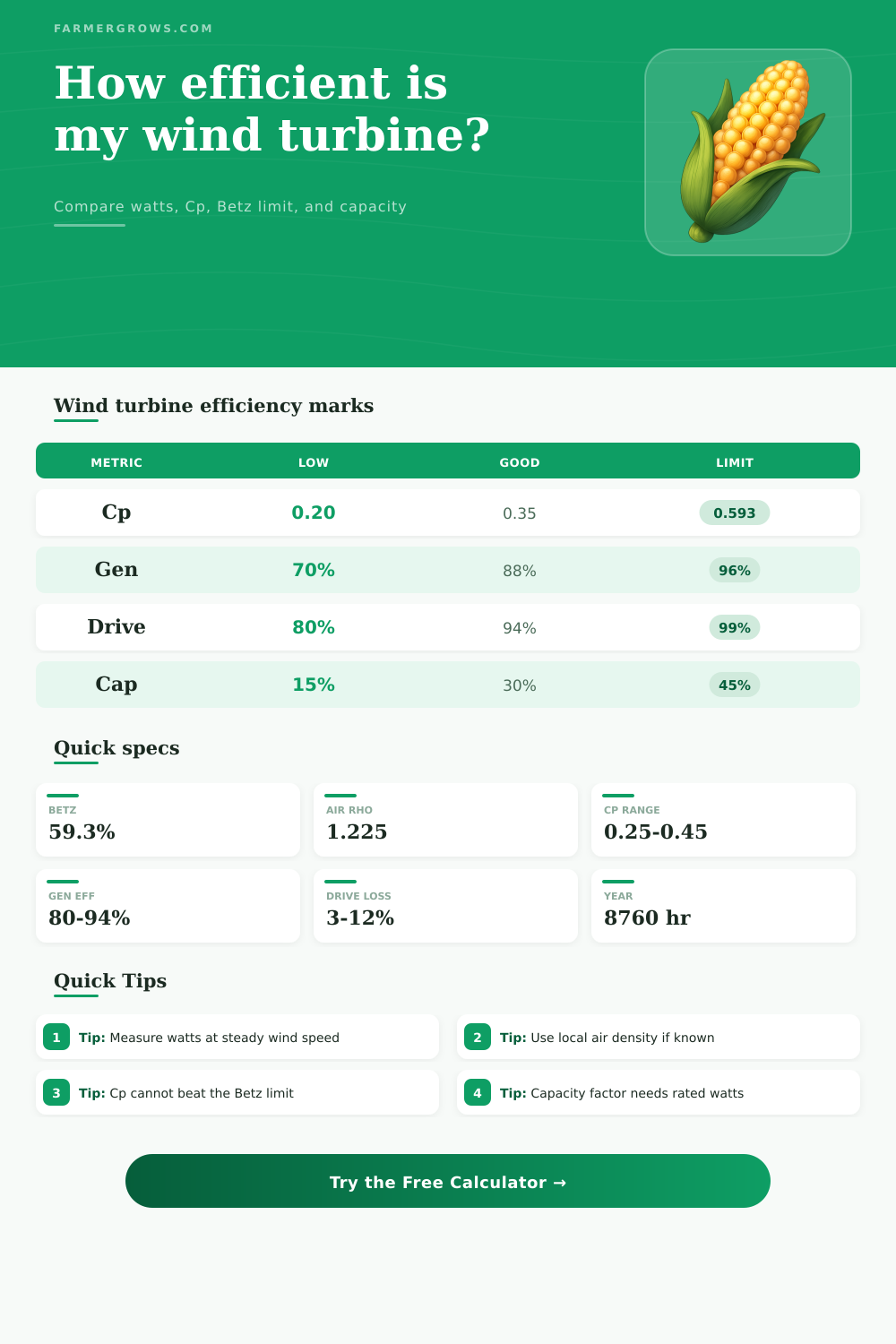
| Rotor Cp | 0.15 to 0.25 | 0.25 to 0.42 | 0.593 Betz limit |
| Overall electrical efficiency | 12% to 22% | 22% to 38% | Usually below Betz after losses |
| Generator efficiency | 65% to 78% | 80% to 92% | 94% to 96% for strong designs |
| Drivetrain efficiency | 80% to 88% | 90% to 97% | Direct-drive can be very high |
| Small wind capacity factor | 10% to 18% | 18% to 35% | Good sites may reach 40%+ |
| Wind speed | Power change | What to expect | Planning note |
|---|---|---|---|
| 4 m/s | Low available power | Charging may be light or intermittent | Good rotor design matters most |
| 6 m/s | 3.4x power of 4 m/s | Useful small turbine production begins | Compare steady readings, not gusts |
| 8 m/s | 8x power of 4 m/s | Many small turbines approach strong output | Check controller and dump load limits |
| 10 m/s | 15.6x power of 4 m/s | High output and high loading | Watch furling, braking, and tower loads |
| 12 m/s | 27x power of 4 m/s | Near rated zone for many small units | Efficiency may flatten as controls intervene |
| Condition | Approx. density | Effect on power | Use when |
|---|---|---|---|
| Cold dense air | 1.28 kg/m³ | About 4% above standard | Winter or cold clear testing |
| Standard sea level | 1.225 kg/m³ | Baseline calculation | No local density data is available |
| Warm lowland air | 1.18 kg/m³ | About 4% below standard | Hot afternoons and humid sites |
| Moderate elevation | 1.05 kg/m³ | About 14% below standard | Hill farms or upland valleys |
| High elevation | 0.90 kg/m³ | About 27% below standard | Mountain sites and thin air |
| Step | Formula | What it means | Why it matters |
|---|---|---|---|
| Swept area | pi x radius² | Circle area covered by blades | Bigger rotors collect more wind energy |
| Wind power | 0.5 x rho x A x V³ | Total kinetic power through rotor | Baseline for all efficiency comparisons |
| Betz limit | Wind power x 0.593 | Maximum theoretical rotor capture | No rotor can capture all wind energy |
| Expected output | Wind x Cp x gen x drive | Electrical watts after losses | Compares design estimate to measured output |
| Measured Cp | Watts / wind / gen / drive | Rotor Cp implied by measured output | Shows whether inputs are physically plausible |
| Capacity factor | Measured watts / rated watts | Share of rated output at this condition | Helps compare current output to nameplate |
Wind power is a processes where the wind move the blades of a turbine, and the moving blades move electricity through the wire. While the concept of wind power may seem simple to some individuals, the use of wind power involve several different conversion step, and each step result in the loss of some of the energy of the wind. The calculator that can determine the efficiency of a wind turbine will remove the need for you to memorizing the formulas that you must enter into a calculator to determine the efficiency of a wind turbine.
To use this calculator, you will need to supply information regarding the size of the rotor of the wind turbine, the speed of the wind, the density of air, and the electrical output of the turbine. The first number that will factor into the calculation of the efficiency of a wind turbine is the swept area of the turbine. This is the area that the rotation of the turbine’s blades covers.
How to Calculate Wind Turbine Efficiency
The larger the swept area, the more wind the turbine will be able to capture. However, using a larger swept area does not nesecarily mean that the wind turbine will create more energy. The measurement of the efficiency of the swept area is referred to as the power coefficient (Cp).
This value will never reach 100% because of the physical limitations of wind turbines. The Betz limit of 59% is the theoretical maximum of the power coefficient of any wind turbine. The actual power coefficient of any turbine will always be less than the Betz limit because the air must pass through the blades of the turbine to create the rotational energy necessary to produce electricity.
A value for the power coefficient of 0.35 is considered a good value for small wind turbines. A value for the power coefficient that is less than 0.25 indicate that the blades of the turbine may not be appropriately matched to the turbine, or that the turbine may be placed in a location that experiences turbulent air movements. The next factor to consider in the calculation of the efficiency of a wind turbine is the density of the air.
The density of the air is higher for areas that experience colder temperatures. This is because cold air molecules are closer together than warm air molecules. Additionally, high elevations have thinner air than areas at sea level.
Because less air contains less energy than more air, turbines that are placed at high elevations or in warmer climates will create less energy. This factor may make a difference in the energy output of the wind turbine in the winter as compared to the summer months. Such differences are a result of the environment in which the turbine is constructed, and they are not indicative of a failure of the wind turbine itself.
The mechanical power of the wind turbine will need to be converted to electrical power in order to power the electrical components of the turbine. Energy will be lost in the drivetrain that connects the rotor to the generator. Additionally, the efficiency of the generator will also lead to some energy loss.
The efficiency of permanent magnetic generators is very high; however, older induction generators has lower efficiencies. Small wind turbines typically dont exhibit more than 85% efficiency in their electrical components. Overall, small wind turbines have efficiencies between 20 and 35%.
The capacity factor of a wind turbine is another measure of the efficiency of the wind turbine. The capacity factor compares the amount of energy that a wind turbine actualy produce with the amount that is indicated for the turbine. The rated power of a wind turbine is determined at higher wind speeds than the current wind speed at which the turbine is operating.
Therefore, it is normal for the actual energy output of a wind turbine to be less than its rated power. The capacity factor allows manufactures and users of wind turbines to compare the performance of a turbine to its potential performance. Many individuals make mistakes when measuring the wind speed at which a turbine is operating.
Using an anemometer that is too close to the roof of the structure that houses the wind turbine will result in the anemometer detecting turbulent air movements instead of the steadier movement of the wind at the height of the turbine blades. Additionally, the data from a weather station that may be hundreds of feet from the wind turbine will not accurately reflect the wind speed at which the turbine is operating. Such errors in measuring the wind speed will result in inaccurate measurements of the efficiency of the turbine.
However, the calculator will flag any results of the efficiency that are higher than 59% (the Betz limit) so that you are aware that something may be wrong with your measurements or calculations. Wind speed is the most important factor in the calculation of the efficiency of a wind turbine. The power that can be extracted from the wind is proportional to the cube of the velocity of the wind.
Small increases in wind speed create large increases in the energy that the wind turbine can harvest. Small changes in the height of the turbine can have major effects on the amount of energy that the wind turbine can harvest each year. Steady wind measurements are the best measurements of the efficiency of a wind turbine.
A gust of wind will create a high reading on a measuring device, but the gust of wind does not represent the average wind speed during a set period of time. The controller of many small wind turbines will create limitations on the efficiency of the wind turbine. The controller will furl the blades or use brakes on the turbine if the measured wind speed reaches a certain limit.
In these instances, the amount of electrical production will drop, even though the turbine blades are still rotating. The efficiency value of the wind turbine will drop when the controller is using the brakes. However, the efficiency of the rotor itself is not changing.
The calculator of the efficiency of the wind turbine is based on the assumption of steady operation of the turbine, so the calculator will provide conservative estimates of the actual efficiency of the turbine when the turbine controller is in “protection” mode. Some factors affect the efficiency of small wind turbines that the calculator cannot measure. The stiffness of the tower that the turbine is mounted to may result in energy loss due to vibrations.
Additionally, the blades may be exposed to weathering that reduces their efficiency. Energy may also be lost due to voltage drops along the cable that connects the generator to the battery. Such losses are outside the scope of the calculator.
However, the theoretical efficiency of the turbine will allow you to calculate where energy losses in the system may be occurring. The reference tables can help you understand the typical values of the efficiency of small wind turbines. These tables do not provide targets for the efficiency of your turbine.
For instance, a value of 0.28 for the power coefficient may be a good value for a turbine that is located in an area with low wind speeds. For a turbine in an area with high wind speeds, the same value of 0.28 would indicate a poor efficiency. However, the efficiency of the entire system is not just due to the efficiency of the rotor, so a higher value of the power coefficient does not nesecarily indicate a higher efficiency for the entire system.
Additionally, the reference tables will help you understand when the density of the air is or is not a critical factor in your system. Finally, regular use of this calculator will allow you to form an understanding of the year-round performance of your small wind turbine.