🏖 Sand Calculator
Calculate exactly how much sand you need for any project — quick and accurate
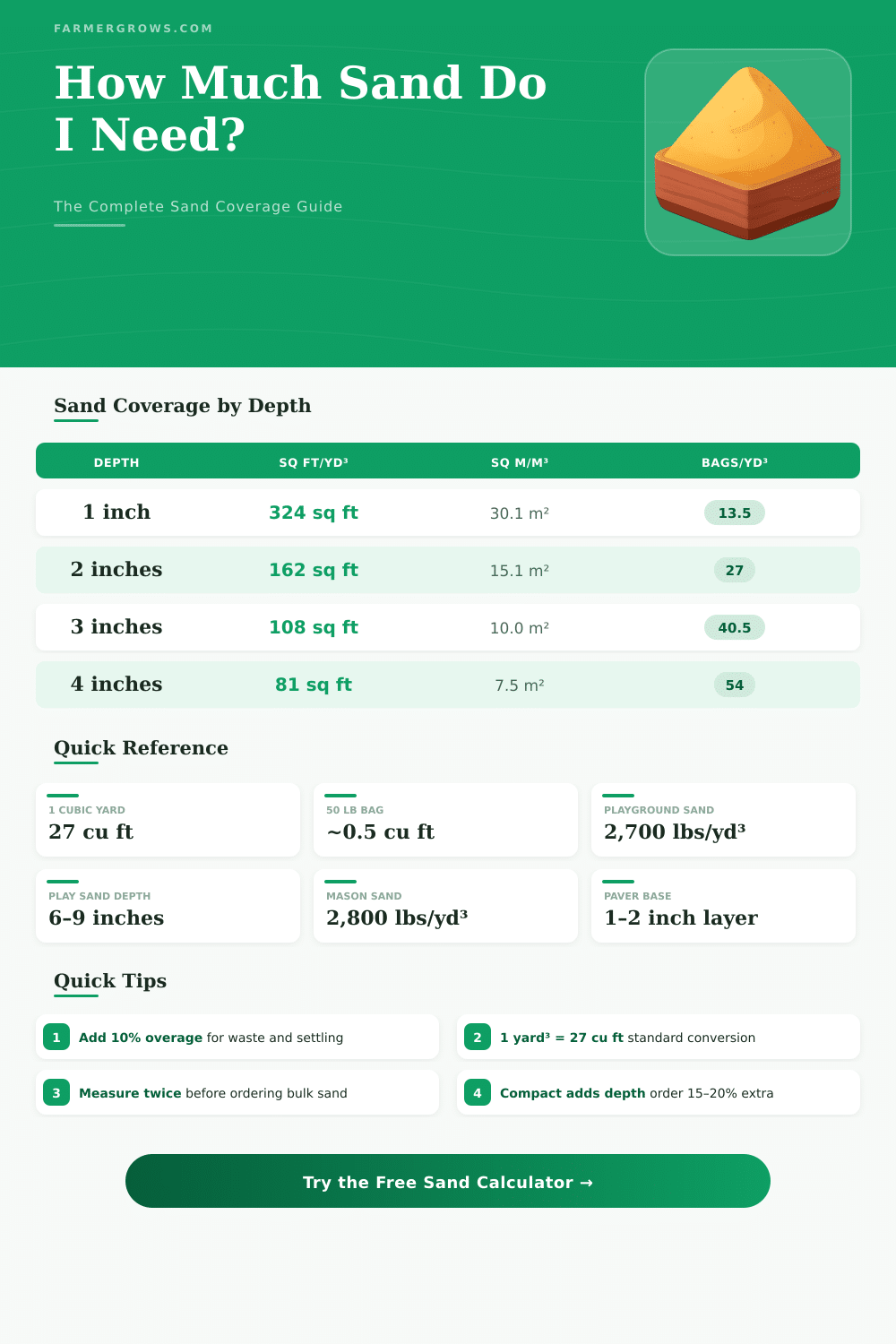
| Depth (in) | Depth (cm) | Sq Ft per Yd³ | Sq M per M³ | Cubic Ft per Yd³ |
|---|---|---|---|---|
| 1 inch | 2.54 cm | 324 sq ft | 30.1 m² | 27 |
| 2 inches | 5.08 cm | 162 sq ft | 15.1 m² | 27 |
| 3 inches | 7.62 cm | 108 sq ft | 10.0 m² | 27 |
| 4 inches | 10.16 cm | 81 sq ft | 7.5 m² | 27 |
| 6 inches | 15.24 cm | 54 sq ft | 5.0 m² | 27 |
| 8 inches | 20.32 cm | 40.5 sq ft | 3.8 m² | 27 |
| Bag Size | Volume (cu ft) | Bags per Yd³ | Coverage at 2 in | Coverage at 3 in |
|---|---|---|---|---|
| 50 lb bag | ~0.5 cu ft | 54 bags | 3 sq ft | 2 sq ft |
| 60 lb bag | ~0.6 cu ft | 45 bags | 3.6 sq ft | 2.4 sq ft |
| 2 cu ft bag | 2.0 cu ft | 13.5 bags | 12 sq ft | 8 sq ft |
| 3 cu ft bag | 3.0 cu ft | 9 bags | 18 sq ft | 12 sq ft |
| 1/2 yd³ bulk | 13.5 cu ft | 2 loads | 81 sq ft | 54 sq ft |
| 1 yd³ bulk | 27 cu ft | 1 load | 162 sq ft | 108 sq ft |
| Project | Typical Area | Depth | Cubic Yards | 50 lb Bags |
|---|---|---|---|---|
| Small Sandbox | 100 sq ft | 2 in | 0.62 | 33 |
| Kids Playground | 225 sq ft | 6 in | 4.17 | 225 |
| Patio Paver Base | 200 sq ft | 1 in | 0.62 | 33 |
| Pool Surround | 300 sq ft | 3 in | 2.78 | 150 |
| Driveway Base | 900 sq ft | 4 in | 11.11 | 600 |
| Volleyball Court | 1,800 sq ft | 12 in | 66.67 | 3,600 |
| Trench Fill (1 ft wide, 10 ft long) | 10 sq ft | 12 in | 0.37 | 20 |
sand is the first thing you need to know about. Whether you plan to fill a sand box, build a terrace, dig a trench or lay a foundation knowing the right amount saves time and money for all. For help here, sand calculators are useful tools.
They allow to estimate the needed volume, for instance in cubic feet, cubic yards or cubic metres. They also count weight, giving results in tons, pounds or kilos.
How to Calculate How Much Sand You Need
To get a reliable estimate, choose the form that best matches the bin or the surface that you want to cover. Then simply enter the sizes. Such tools can work with square, rectangular, five-sided, hexagonal, eight-sided and round patterns.
This is very handy for items like sand boxes, sand tables or sand trays.
Also the density of sand plays a role. It normally ranges between 1400 and 2200 kg per cubic metre. Dry and lightweight sand weighs around 1400 to 1600 kg each cubic metre.
Wet or heavily pressed sand weighs more, between 1800 and 2200 kg each cubic metre. A value of 1600 kg per cubic metre works well for many cases. One cubic yard of sand can reach from 2600 to 3000 pounds.
That matches about one and half tons. One ton of sand covers around 80 to 100 square feet at two-inch depth.
In building works the calculations about sand amount become more detailed. For mortar from cement in ratio 1:3, one cubic metre of sand needs around 480 kg of cement. As for M-15 concrete, one needs about 6.336 bags of cement, 0.44 cubic metres of sand, 0.88 cubic metres of gravel and around 99 liters of water.
The ratio between sand and cement by volume usually is four too one, or even more. It is better to use volume than weight, because the moisture changes the weight.
Also, think about cost before. Depending on the market, amount and kind of sand, the price ranges between 20 and 150 dollars each cubic yard. Minimum order usually is one cubic yard, which needs a truck to transport it.
For small projects, for instance aquariums, it is hard to find the right amount. Different sources sometimes give different numbers for the same size of the tank, so a calculator helps the cause. Sand for pool filters ranks among popular options.
It has natural colour, even size of particles, costs around 10 to 15 dollars for 50 pounds and it already is washed before. Builder sand is another cheap option, available in stores for less than four dollars for a bag of 50 pounds.
The area in square feet is the first thing that one must figure out when one fills holes in landscape design or construction. When thatpattern is right, the rest of the math gets much easier.