Yukon Gold Potato Growth Time Calculator
Estimate Yukon Gold emergence, hilling dates, first new potato digging, main harvest, yield, cure timing, and storage readiness for waxy yellow-flesh potatoes.
Yukon Gold is an early to midseason yellow potato with moist, waxy-all-purpose flesh. It is usually timed differently from red new potatoes, long russets, or generic seed potato charts because flavor, skin tenderness, and modest storage life all matter.
📋Yukon Gold Crop Presets
🥔Gold Potato Variety, Cooking, and Storage Grid
⚙Yukon Gold Timing Inputs
Yukon Gold Growth Timeline
Enter your field details to estimate the potato crop timeline.
🌿Gold Potato Reference Grid
📚Yukon Gold Timing Tables
| Gold potato type | New potato window | Main harvest window | Cooking strength | Storage note |
|---|---|---|---|---|
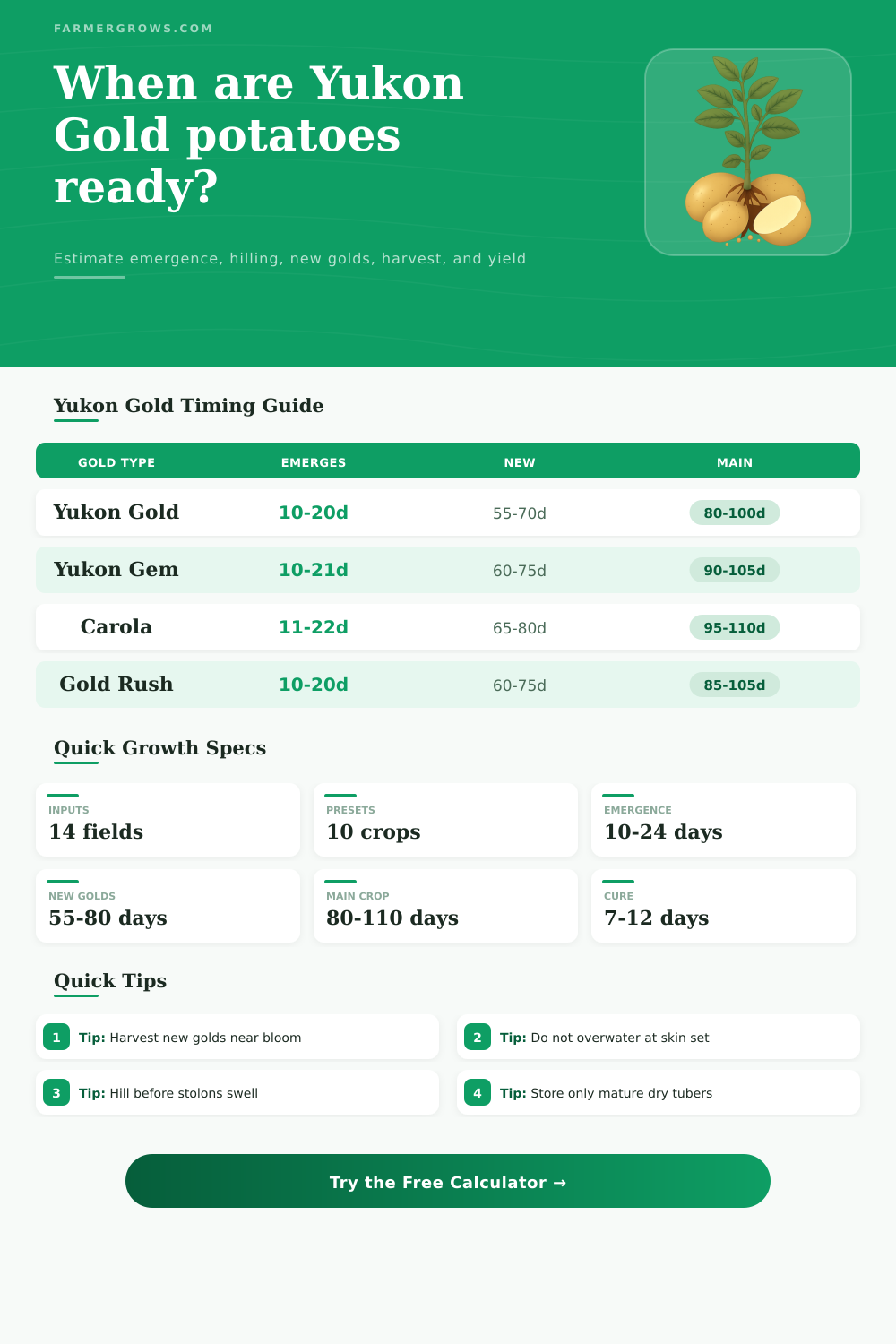
| Yukon Gold | 55 to 70 days | 80 to 100 days | Boil, mash, roast, gratin | Moderate storage after skin set |
| Yukon Gem | 60 to 75 days | 90 to 105 days | Table gold, roasting, soups | Usually stores longer than Yukon Gold |
| Carola | 65 to 80 days | 95 to 110 days | Firm waxy salads and steaming | Good yellow storage type when mature |
| Gold Rush | 60 to 75 days | 85 to 105 days | Fresh table and boiling | Medium storage if cured well |
| German Butterball | 70 to 85 days | 100 to 120 days | Rich roasting and baking | Better storage, longer season |
| Soil condition | Emergence effect | Yukon Gold risk | Timing adjustment |
|---|---|---|---|
| Below 45°F and wet | Very slow sprouting | Cut seed decay and uneven stand | Add 5 to 9 days |
| 45 to 50°F workable soil | Slow but acceptable | Delayed canopy closure | Add 2 to 5 days |
| 50 to 65°F soil | Best practical range | Even emergence and early stolons | Use base timing |
| Warm soil above 70°F | Fast emergence | Lower tuber set if nights stay hot | Subtract 1 day, watch heat |
| Spacing and hill choice | Tuber profile | Yield effect | Best Yukon Gold use |
|---|---|---|---|
| 9 to 10 in in-row | More small waxy potatoes | Lower lb per plant, more count | New potatoes and salads |
| 11 to 12 in in-row | Balanced medium golds | Strong home garden yield | All-purpose table harvest |
| 13 to 14 in in-row | Fewer larger tubers | Higher lb per plant if water holds | Main crop and storage batch |
| 6 to 8 in final hill | Covered shallow stolons | Reduces green shoulders | Good default for Yukon Gold |
| Containers or bags | Small root zone | Lower yield per seed piece | Early harvest, steady watering |
| Harvest target | Calendar cue | Skin and cooking cue | Cure and storage cue |
|---|---|---|---|
| New Yukon Gold | About 55 to 70 days | Thin skin, sweet buttery flesh | Use soon; do not store long |
| Fresh table crop | About 75 to 95 days | Medium tubers, skins beginning to set | Short shade dry-down is enough |
| Mature main crop | About 85 to 105 days | Vines yellowing, skin resists rubbing | Cure 7 to 12 days before storage |
| Storage batch | After vine dieback or cut vines | Dry, sound tubers only | Cool gradually after curing |
💡Yukon Gold Timing Tips
For new Yukon Golds: Begin checking a plant near bloom instead of waiting for full vine dieback. Young gold potatoes have the tender skin and buttery texture that make this variety different from storage russets.
For storage: Let vines decline, reduce watering near harvest, dig gently, and cure only mature sound tubers. Yukon Gold can store for a while, but it is best treated as a moderate keeper.
When is it time to plant yukon gold seed potatoes? You’ll know when the soil says so, often weeks into the spring here. You’ll be jonesing for those yellow-fleshed spuds, but the earth below will be stubbornely chill. It’s one of the most forgiving varieties, but timing still make all the difference. It determines whether you get a full crop, no crop at all, or just shrunken, green tubers that don’t taste like much.
It’s not really about digging, but rather when to dig. It is also about when to wait some more. That’s where the tool comes in: Enter your local conditions into the calculator above, and it do the rest. No more guessing whether they emerged three days later or three weeks later because of a cold spell. Or whether they’re ready to be topped up because they were planted on time. Or even too early, or too late? (Most of us does it by calendar date alone; we don’t take into account the thermal mass.)
How to Use the Potato Planting Tool
The tool also factors in details that can be lost to intuition. Like the stage seed prep, or what the soil temperature are at planting depth. By entering your average moisture pattern and your average growing temperature, it takes those factor into account. And provides a timeline that isn’t just some generic “when-is-it-ready?” advice from a field guide written decades ago. Understanding the inputs matter more than just memorizing the outputs.
You’re also telling the system how far along your crop is by choosing either fresh-cut or chitted seed. Because the sprouts has already developed, chitted seed will emerge faster. Fresh cuts take longer because they have to form energy from their stores before healing and emerging. That changes the whole timetable for when you hill to prevent greening of the tubers that get exposed, a critical part of growing potatoes well. Hilling too soon can squelch slow-moving shoots; waiting too late makes the soil harden around the stems, making it harder to provide proper protection from sun. The calculator help strike this balance to ensure you don’t accidentally sabotage your own harvest.
Most folks get off track at the new-to-main-crop transition point. With potatoes, that means: While the plants flower, you can dig new Yukon Golds. The sweet flavor and tender skins is gone once the tubers mature. Typically about 55-70 days into growth, or roughly here, but going beyond will change everything: It’ll all become gummy-textured. Waiting until the vines turn yellow indicates that skin-set has happened; you need that before storing the crop. Soft-skinned ones won’t cure well (they bruise readily and rot fast in high humidity).
The tool works because it knows when that shift happens; it estimates when skin set will occur, depending on what variety you planted and how much heat accumulated. Another source of misunderstanding about this variety: How does it store? Yukon Gold is advertised as an all-purpose potato, and though it’s technically not long-keeping (like Idaho russet potatoes) it will hold nicely for several months if cured correcty. But unlike longer-season kinds, which has thicker skins to protect them from sprouting through winter, the skin of Yukon Gold doesn’t do such a great job in storage, and so you want to think more about eating what you get soonish, instead of stockpiling big bag with plans to eat them come January. The comparison tables on the page spell out the details. You’ll see that they compare firmer waxy spuds (such as Carola) to short-season gold varieties.
People often forget about one factor: heat stress. To a point, warm days help tubers grow well. Too much hot weather while they’re still bulking causes lower yields, or at least makes the tubers lumpy instead of smooth. Your average temperature range is part of the calculator, which helps you know if it’s going to get so hot in there that your crop will go on vacation. Maybe the plants die back faster than expected, because the nights remains warm. That makes you think it’s time to harvest, when actualy those tubers aren’t yet big enough.
All in all, growing Yukon Golds is a dance of mutual adaptation between your garden and whatever weather rules where you grow them. Nature decides how fast they’ll progress; by choosing the conditions; you choose only the timing (when do I plant?) and the quality of the seed (how much of a head start does it have?). Following an organized system that help predict this timing takes the guessing game out of digging day. Know what to anticipate. And then dig with confidence. The buttery goodness will wait underground exactly as long as necessary… Not an instant sooner or later.