Yard of Mulch Weight Calculator
Estimate the weight of bulk mulch by cubic yards, mulch type, moisture percentage, bulk density, dyed or natural finish, particle size, compaction, load count, truck payload, and waterlogged adjustment.
Load a realistic bulk mulch starting point, then adjust the density, moisture, particle size, compaction, number of loads, and truck payload for your delivery or pickup.
Common landscape mulch. Fine fibers and wet storage can push each yard much heavier than a dry quote.
Usually lighter than dense hardwood, especially when chipped coarse and kept under cover.
Large bark pieces hold more air space, so volume is high while weight stays moderate.
Fines, age, and absorbed moisture make composted mulch one of the heavier organic choices.
Mulch Weight Estimate
Results use cubic yards multiplied by adjusted bulk density, then checked against payload with the selected safety buffer.
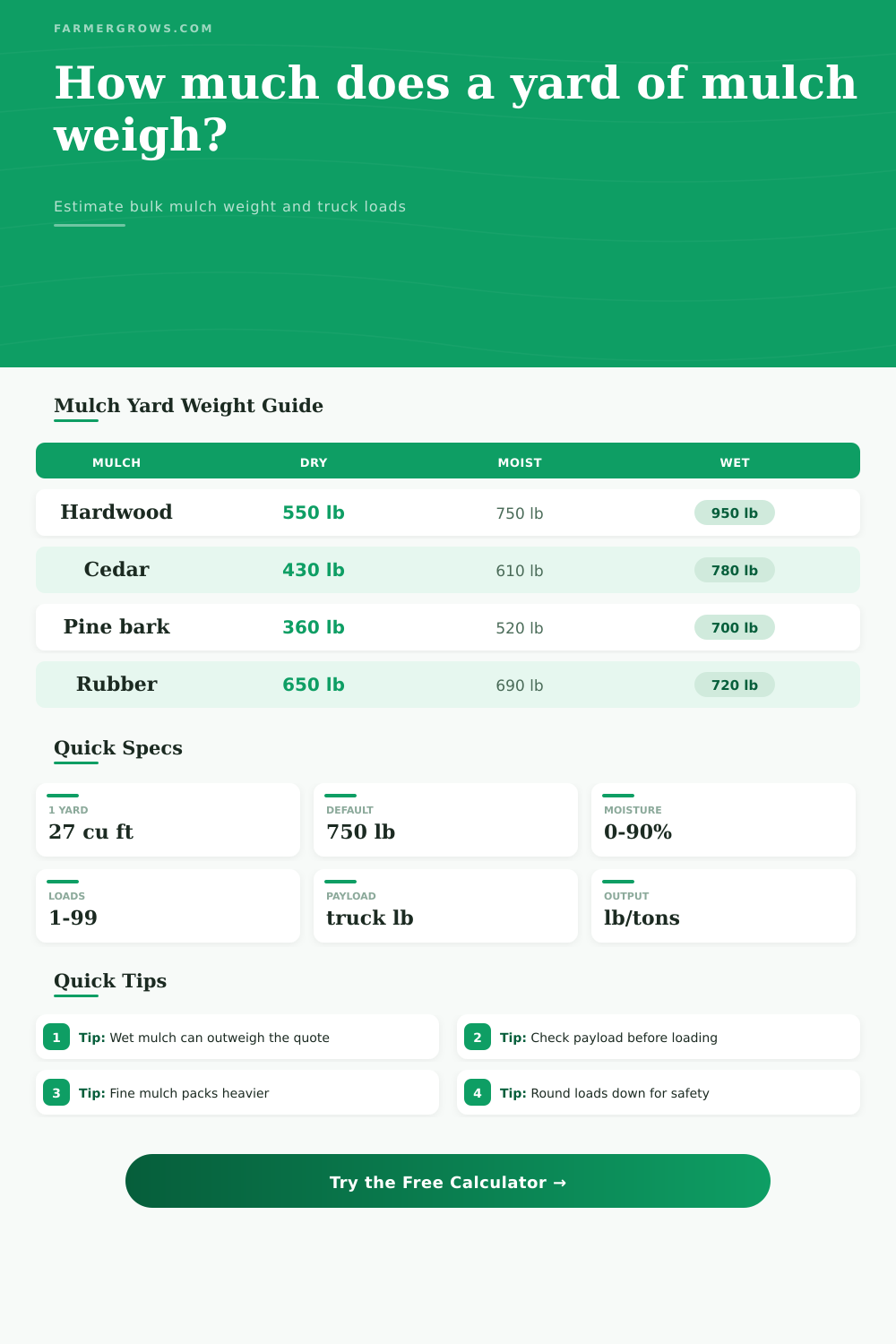
Use these tables to sanity-check a supplier estimate. Actual weight changes with species, grind, age, rainfall, and how tightly the loader packs the truck bed.
| Mulch material | Dry yard | Typical moist yard | Wet yard | Best use |
|---|---|---|---|---|
| Shredded hardwood | 450-600 lb | 650-800 lb | 850-1100 lb | General beds and slopes |
| Cedar mulch | 350-500 lb | 520-650 lb | 700-850 lb | Ornamental beds and paths |
| Pine bark nuggets | 300-450 lb | 470-600 lb | 650-800 lb | Shrub beds and acid-loving plants |
| Cypress mulch | 420-560 lb | 560-720 lb | 750-920 lb | Decorative beds and borders |
| Playground wood chips | 300-450 lb | 430-600 lb | 650-850 lb | Play areas and soft paths |
| Composted mulch fines | 650-850 lb | 850-1050 lb | 1100-1350 lb | Soil-building topdress |
| Moisture condition | Moisture entry | Weight effect | Waterlogged setting | Field clue |
|---|---|---|---|---|
| Dry, covered stockpile | 10-20% | Lightest practical hauling weight | No extra | Dusty or crisp pieces |
| Normal landscape mulch | 25-35% | Matches most bulk-yard quotes | No extra | Cool, springy, not dripping |
| Recently rained on | 40-55% | Adds about 10-25% load weight | Damp or rain-soaked | Dark color and damp floor |
| Wet low pile | 55-75% | Can approach soil-like payloads | Waterlogged pockets | Water squeezes from fines |
| Saturated loader scoop | 75-90% | Use conservative truck limits | Saturated | Standing water or sludge |
| Vehicle or trailer | Common payload | Moist hardwood yards | Wet hardwood yards | Planning note |
|---|---|---|---|---|
| Compact pickup | 900-1200 lb | 1.0-1.5 yd³ | 0.8-1.0 yd³ | Check door sticker before loading |
| Half-ton pickup | 1300-1800 lb | 1.5-2.3 yd³ | 1.1-1.8 yd³ | Leave room for passengers and tools |
| Three-quarter-ton pickup | 2200-3000 lb | 2.8-3.8 yd³ | 2.0-3.0 yd³ | Volume may fill bed before payload |
| One-ton dump bed | 3500-5500 lb | 4.5-7.0 yd³ | 3.2-5.5 yd³ | Confirm axle and dump ratings |
| Small landscape trailer | 2000-3500 lb | 2.5-4.5 yd³ | 1.8-3.5 yd³ | Account for trailer empty weight |
| Adjustment | Light setting | Standard setting | Heavy setting | Why it matters |
|---|---|---|---|---|
| Particle size | Large nuggets, -18% | Standard, 0% | Fine shredded, +14% | Smaller pieces remove air space |
| Compaction | Loose tossed, -8% | Fresh bucket, 0% | Packed bed, +14% | Settling increases pounds per yard |
| Dyed finish | Aged natural, -2% | Natural, 0% | Fresh dyed, +5% | Color processing may add moisture |
| Waterlogging | Light rain, +8% | No extra, 0% | Saturated, +45% | Trapped water can dominate weight |
Payload tip: Bulk mulch often runs out of truck bed volume before payload, but wet fine mulch can reverse that. Use the safe payload result when hauling after rain.
Moisture tip: If the loader bucket leaves wet streaks or water drains from the pile, use both a high moisture percentage and a waterlogged adjustment.
How many times have we all been told by the landscape supply yard, “We’ll bring over a cubic yard of mulch,” and you accept that as a good, solid number? Until you heft a shovel full.
The difference between a dry, fluffy pile and a wet, heavy mess are staggering. It scales from a simple afternoon to a strained back. Homeowners don’t appreciate weight of water. They purchase what they see, not considering the mass they will be hauling.
Why You Need a Mulch Weight Calculator
You still have to put in what material it is, what the approximate moisture content is and what the volume is, but after that, the calculator (above) do the rest. Coefficients and conversions aren’t a guessing game anymore.
Knowing when your truck’s at capacity isn’t rocket science; it’s simply knowing when your truck’s at capacity. It’ll break down the pounds, tons and number of trips your particular vehicle is capable of handling. It accounts for stuff that fluctuates on the fly.
Landscaping is all about equalizers, such as rain. A five-hundred-pound pile of hardwood chips stacked under a tarp weigh five-hundred pounds. Hit that exact same pile with an inch of rain and it jumps easy towards a thousand-pounds. Almost twice as much!
What does the tool do? It lets you handle this. You input a waterloged setting and then select your % of moisture. This mimics real life. There are some wet pockets in here. Edge it a bit more over there. Add up quick. The tables that come with the tool spells this out. They show how far things go from dry to soaked to give you range.
The type of mulch also counts. Shredded hardwood is heavier then pine bark nuggets. Composted fine mulch packs down. It removes voids. The particle size gets accounted for in the mulch calculator. Picking fine shredded mulch increase the weight-per-yard. Large chunk mulch lowers it. It is physics, not opinion. Denser materials has less volume. Therefore, they weigh more, and you’ll notice the effect on your vehicle suspension.
There is a hard limit on truck payload. Every truck has a door jamb sticker that spells out its payload. That’s the number of pounds the frame can carry. Period. Overloading a half-ton pickup with wet mulch can bend the leaf springs. You will ruin the axles. You could get pulled over and ruin your insurance claim.
Enter your truck’s payload rating in the calculator. Then divide your total estimated weight by that number. What do you have? This is your trip count. Two trips? You gotta make two trips. Do not round down. Don’t you dare.
The changing factor is moisture. Dry products are sold by suppliers. Prices are quoted in volumes. Your invoice doesn’t matter to the weather, however. You may recieve hundreds of pounds more if it rains again.
There is a safety buffer input on the tool. That’s smart. Allow an additional ten percent when calculating payloads. Plan for passengers, tools or that surprise rain shower. Better to return for an added trip rather than replacing a bumper.
There is one more layer: dyed mulch. Light as the dye may be, there’s usually water involved. And freshly dyed mulch tend to retain some moisture. This means it’s going to weigh a little bit more than all that faded old brown mulch. That’s why the calculator lets you select a ‘finish’ type. A tiny thing, but it makes a difference when you’re at or near the limit.
Consider the logistics first. Imagine the heap. Is it an airy mass or a matted, compacted block? Change that reality with the compaction slider in the tool. Does it get picked up by a hand shovel or a loader bucket? A settled pile weigh more per yard because it has squeezed out its air. The tool gets that subtlety. Beyond just volume, it’s real weight.
A little math goes a long way. Here’s why: Planning saves money. It saves time. It saves your vehicle. Don’t guess. Run the numbers. Consult your door sticker. Tack on that buffer. Then run out and purchase some mulch. You’ll sleep better knowing you’re not carrying home more then you can manage. The math is easy. The weight is real. The decision is yours. Let’s make it smart.