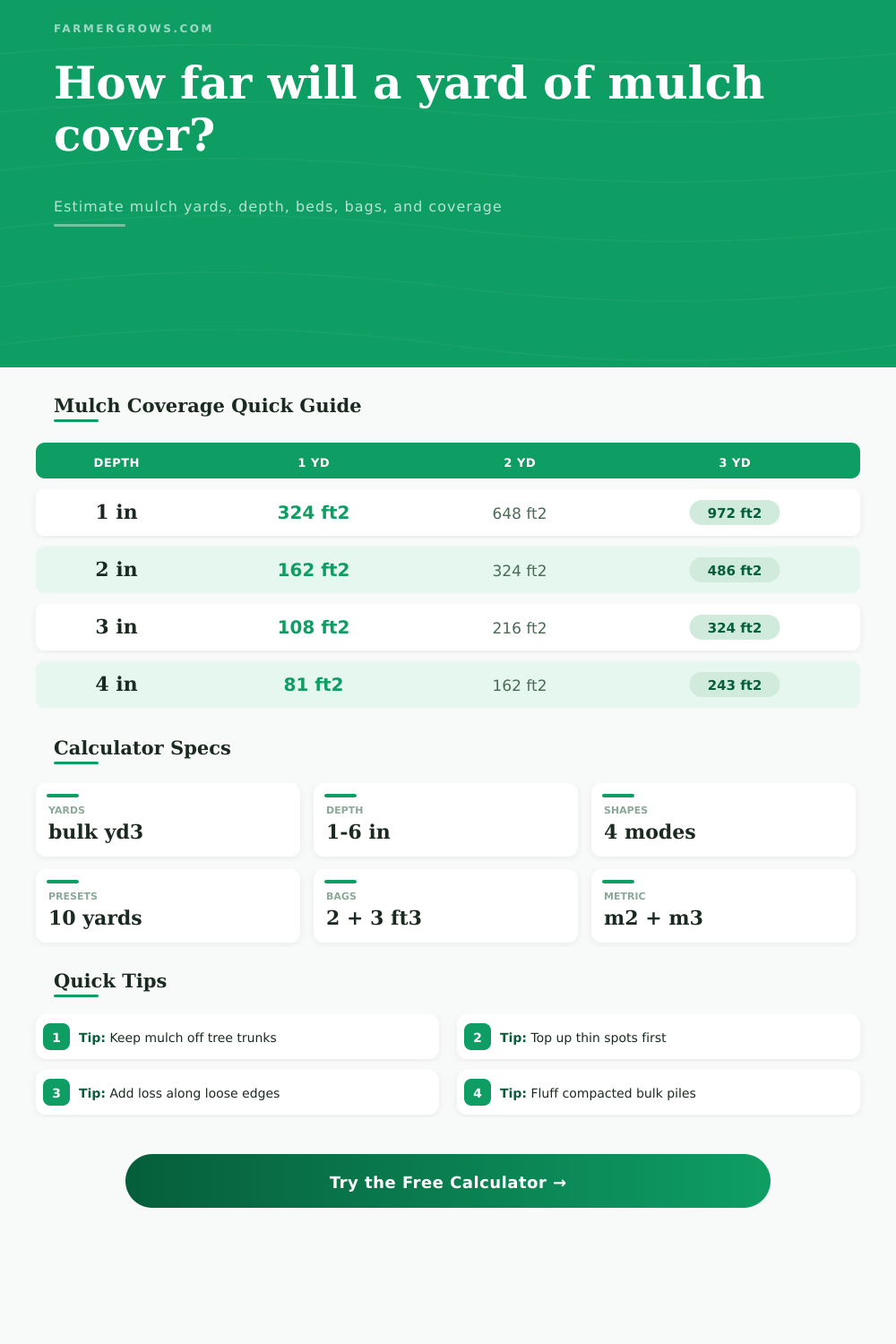
Yard of Mulch Coverage Calculator
Estimate how many square feet a yard of mulch covers, compare that coverage against a specific bed, and adjust for zone type, shape, texture, compaction, overage, edging loss, and refresh depth.
Choose a common yard or garden setup, then tune the dimensions, depth, material texture, loss factors, and refresh layer to match the site.
Mulch Coverage Results
Coverage and bed need will appear here after calculation.
Lower depth leaves room for seasonal planting, hand weeding, and soil warming.
Good all-around depth for moisture hold, weed suppression, and crown visibility.
Keep a bare collar around trunks and calculate ring area minus the open center.
Plan extra edging loss where mulch feathers into turf or driveway edges.
Deeper organic mulch helps smother weeds and handles repeated foot traffic.
Coverage drops sharply at play depth, so compare against local safety guidance.
Use higher edge loss for sliding, washout, and uneven hand spreading.
Use custom when a nursery, landscape plan, or site manager gives a specific layer.
| Finished depth | Coverage per cubic yard | Coverage per 2 cu ft bag | Coverage per 3 cu ft bag | Metric equivalent |
|---|---|---|---|---|
| 1 inch | 324 sq ft | 24 sq ft | 36 sq ft | About 30.1 sq m per yd³ |
| 2 inches | 162 sq ft | 12 sq ft | 18 sq ft | About 15.1 sq m per yd³ |
| 3 inches | 108 sq ft | 8 sq ft | 12 sq ft | About 10.0 sq m per yd³ |
| 4 inches | 81 sq ft | 6 sq ft | 9 sq ft | About 7.5 sq m per yd³ |
| 6 inches | 54 sq ft | 4 sq ft | 6 sq ft | About 5.0 sq m per yd³ |
| Container | Volume | Per cubic yard | Coverage at 3 inches | Use case |
|---|---|---|---|---|
| 1.5 cu ft bag | 0.056 yd³ | 18 bags | 6 sq ft per bag | Small touch-ups and narrow beds |
| 2 cu ft bag | 0.074 yd³ | 13.5 bags | 8 sq ft per bag | Common retail bag size |
| 3 cu ft bag | 0.111 yd³ | 9 bags | 12 sq ft per bag | Larger bark and chip bags |
| Bulk 1 yd³ | 27 cu ft | 1 cubic yard | 108 sq ft per yard | Driveway delivery or trailer load |
| Bulk 5 yd³ | 135 cu ft | 5 cubic yards | 540 sq ft per load | Large beds and yard-wide refreshes |
| Project | Area | Depth | Base yards | 2 cu ft bags |
|---|---|---|---|---|
| Small bed 10 x 20 | 200 sq ft | 3 inches | 1.85 yd³ | 25 bags |
| Tree ring 6 ft diameter | 28 sq ft | 3 inches | 0.26 yd³ | 4 bags |
| Playground 15 x 15 | 225 sq ft | 6 inches | 4.17 yd³ | 57 bags |
| Shrub border 4 x 60 | 240 sq ft | 3 inches | 2.22 yd³ | 30 bags |
| Full yard bed 50 x 50 | 2,500 sq ft | 2 inches | 15.43 yd³ | 209 bags |
| Planning factor | Low value | Typical value | High value | When to increase it |
|---|---|---|---|---|
| Compaction | 0% | 10% | 20% | Damp piles, soft chips, or heavy foot traffic |
| Overage | 5% | 10% | 20% | Irregular beds, hand spreading, or uncertain area |
| Edging loss | 0% | 3% | 10% | Open turf edge, slope, wind, or curb scatter |
| Refresh credit | 0 in | 1 in | 2 in | Only count loose, useful mulch already in the bed |
Mulch coverage is volume divided by depth. A few extra feet along curved edges can change the order by several bags on shallow refresh jobs.
Old mulch that has decomposed into soil does not behave like a loose layer. Rake and inspect before subtracting existing depth from the new spread depth.
It’s amazing how many cubic yards of mulch look bigger then they are until you attempt to relocate them. There’s a mountain of it in the back of the truck and you think there are two cubic yard. Then you spread it out to three inches and it fills just a tiny bit of space. Math says one thing, but your eyeballs lie about what’s really going on.
But this time, the calculator do all the math for you. It converts a cubic yard to number of square feet across your lawn. If you underestimate, you’ll get sparse patches with insufficient mulch to stop weeds. If you overestimate, you end up paying to have excess material hauled away. You want to get it right the first time when spreading.
How to Calculate Mulch Amount Correctly
Depth is where most projects goes off the rails. I heard I should of order three-inch-thick mulch.” Three inches is standard for perennial bed. When they recieve their load of material, they expect it to be three inches thick upon arrival.
No. Mulch will settle. Fibers in mulches becomes compressed by rain or raking, even just sitting out on a dewy morning. What may arrive at three inches thick can compact down to two inches within a week’s time. There is a setting on the tool for this compaction. Remember: target a final depth, not initial thickness.
You can also top up an existing bed. No, you don’t replace all of it. You top up areas where the mulch had broken down and gone back to soil, filling gaps. You enters your current layer into the calculator. Why waste money buying bulk you won’t use?
It’s the little things. When you measure by yard, every inch counts. Volume also depends off shape. How do you measure a rectangular box? Easy. How about a garden bed with walkways and trees and other odd shapes? Not so much. That’s where this tool can helps.
You divide up complicated spaces into basic shapes. If there are odd corner, you count those as triangles. If the space has tree rings, you treat them as circles. The tool allows you to break complex areas into manageable shapes like circles for tree rings or triangles for awkward corners.
When it comes to tree rings, there’s an additional concern: They require keeping the trunk free of mulch (to avoid rot), but maintaining the root zone moisture (so they don’t dry out). So the trick is to figure the area of the ring except for the inner hole. Precise math; no more guesswork. No more mulch touching tree trunks. That’s what separates a pro job from a do-it-yourself mistake.
Most people think of texture in terms of how much area it covers. But what about how much air space there is between pieces? And how tight are the spaces? How do different kinds of texture does this? The table give a guide.
The higher number means there is more airspace between the bits of texture. You can spread it out further and still not make it look like a swamp. Arborist chips has more airspace. It settles quickly. Compost comes from compacted leaves, those settle very fast. For each application, select the texture that best fits the task at hand.
Want a safe place for kids at play? Go with loose but deep chips. Got a walkway for vegetables? Use a thin layer so weed seeds don’t germinate. Adjust your tool accordingly for texture. Understand how the material act instead of just counting bags.
Consider loss factors. Lighter chips blows away in wind. On a slope, mulch rolls right out of the bed and onto the grass. Add a bit of a buffer for scattering and waste. It’s not a matter of padding your budget, it’s recognizing that the real world is messy.
The calculator incorporates practical buffers like this. There is a general percentage for overage. You’ve got plenty of material left over to clean up edges and fill any gaps. You want the final look to be crisp.
If you measure the bed carefully, you get a number you can trust. Order with confidence. What will vanish from the truck bed is the mountain. And it’ll vanish where you want it.
Your landscape will look intentional and tidy. That’s the difference between planning and guessing.