Wood Stove Size Calculator
Estimate the heating output, firebox volume, annual cord use, and practical burn cycle for a wood stove based on your home, climate, layout, and backup heat.
Presets fill the form with typical farm, cabin, and rural home heating scenarios. Adjust any number after loading one.
Your wood stove sizing estimate
Non-catalytic
Typical efficiency
Simple operation, lively flames, and a good fit for steady evening burns with dry wood.
Catalytic
Typical efficiency
Best for long, controlled output where overnight burn length matters more than fast heat.
Hybrid
Typical efficiency
Balances secondary combustion with catalytic cleanup for flexible rural home heating.
Cookstove
Typical efficiency
Useful where cooking and space heat share a room, but output is less even overnight.
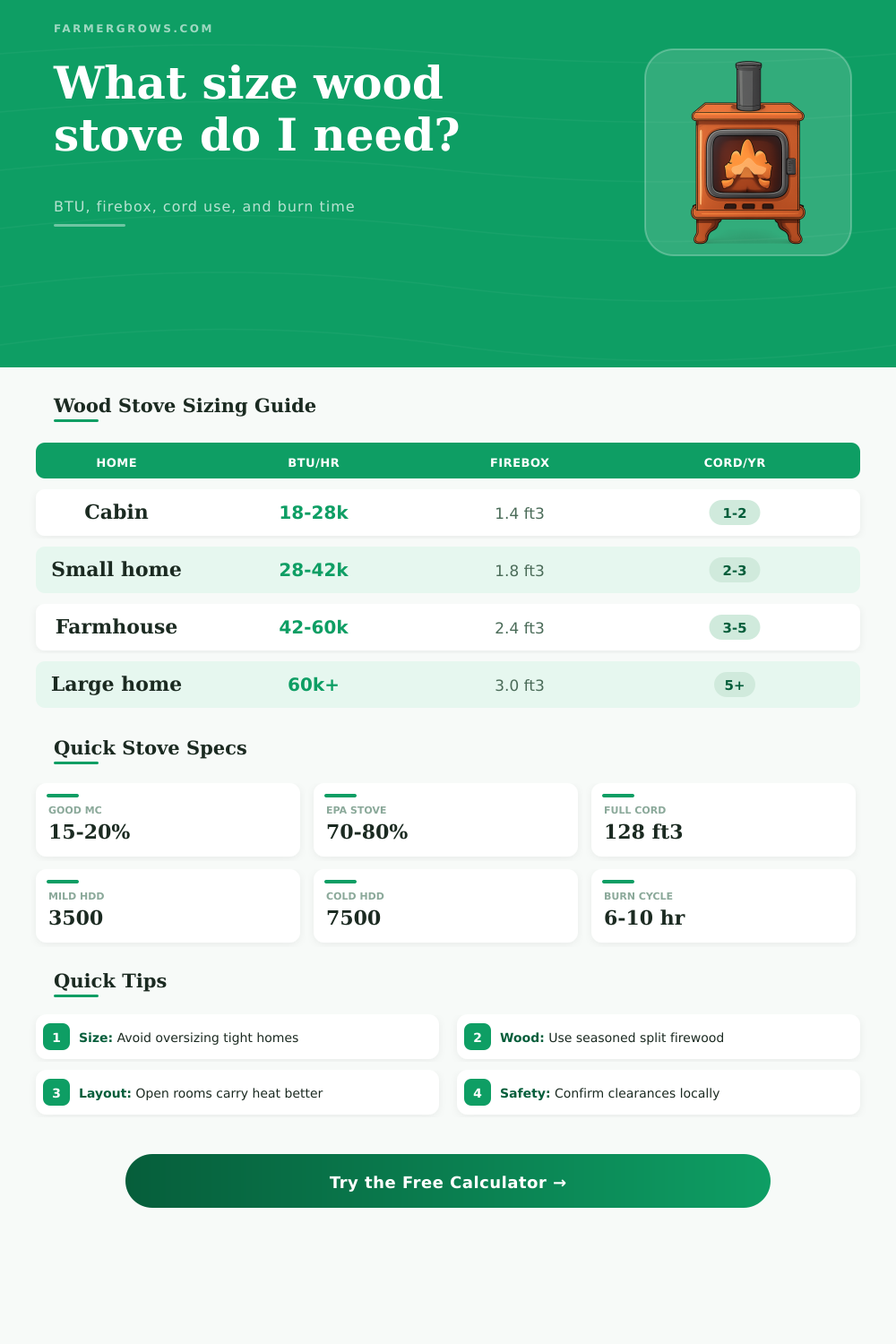
Approximate output ranges for whole-home stove sizing.
| Heated area | Typical load | Firebox | Best fit |
|---|---|---|---|
| 500-900 sq ft | 15,000-28,000 BTU/hr | 1.0-1.6 cu ft | Cabin, shop room |
| 900-1,500 sq ft | 25,000-42,000 BTU/hr | 1.5-2.1 cu ft | Small house |
| 1,500-2,300 sq ft | 38,000-60,000 BTU/hr | 2.0-3.0 cu ft | Average farmhouse |
| 2,300-3,200 sq ft | 55,000-80,000 BTU/hr | 2.8-3.8 cu ft | Large rural home |
Insulation multipliers used by this calculator.
| Envelope | Multiplier | Common signs | Sizing note |
|---|---|---|---|
| Excellent | 0.72 | Air sealed, deep attic | Avoid oversized stoves |
| Good | 0.88 | Weatherstripped, insulated | Moderate output |
| Average | 1.00 | Older but maintained | Use standard range |
| Poor | 1.38 | Drafts, weak insulation | Fix leaks first |
Heating degree days help estimate season-long wood demand.
| Climate | HDD range | Season load | Wood planning |
|---|---|---|---|
| Mild | 2,500-4,000 | Short shoulder season | 1-2 cords often enough |
| Cool | 4,000-5,800 | Regular winter use | 2-4 cords typical |
| Cold | 5,800-7,500 | Daily winter burning | 3-5 cords typical |
| Severe | 7,500-10,000 | Long heating season | 5+ cords possible |
Firewood heat values vary by species and moisture.
| Wood type | MMBTU/cord | Burn style | Use for |
|---|---|---|---|
| Oak / hickory | 24-28 | Long, dense coals | Overnight heat |
| Maple / ash | 20-24 | Steady medium burn | Daily heating |
| Birch / cherry | 18-22 | Medium fast burn | Mixed loads |
| Pine / fir | 15-20 | Fast hot fire | Kindling, mild days |
Selecting a wood stove require considering more than the square footage of you’re house. The square footage of your house dont account for how much heat stay inside the house. Heat can escape through the wall and the ceilings of your house.
Therefore, you must account for heat loss when you are consider which wood stove to purchase. A wood stove sizing tool can compute all the variable needed for the heat output of your house. To use the sizing tool, you must enter information about your house, the heated area, the height of the ceilings, the insulation level in your house, and your climate.
How to Choose the Right Size Wood Stove
By entering these variable into the sizing tool, you can compute what heat output your house will require. The insulation levels in your house are one of the variable that must be entered into the sizing tool. If your house has good insulation, your house will lose less heat to the outside air than a drafty house.
Therefore, the heat output of the wood stove need to be higher for a drafty house than one with good insulation. If you do not account for the insulation levels of your house, you will not be able to ensure that the wood stove can provide your home with enough heat. However, by entering this input into the sizing tool, you can determine the heat output that your house will require.
Another of the variable that you must enter into the sizing tool is your climate. Your climate will affect the amount of heat that your house lose to the outside air. The sizing tool take into account the heating degree days for your climate.
Heating degree days account for how many degree your climate measures the outside air drops below sixty-five degree during a season. The higher the heating degree days for your climate, the more higher the heat output for the wood stove. Areas with severe climate will have heating degree days that are twice those of milder climates.
Therefore, you must account for climate when determining the amount of cord of wood that you will need to burn in your wood stove. Other than climate, the layout of the house and the presence of any backup heat in the house are two other variable that will affect the heat output requirements of the wood stove. Homes with open floor plan will lose less heat to the surrounding areas of the house than those with floor plans that include many small room.
Additionally, if the house includes backup heat source like electric baseboards or furnaces, the wood stove will have to provide less heat to the house. If you do not account for this in your calculation, you will purchase an wood stove that is too large for your heating needs. Other outputs of the sizing tool include the BTU range for your house, the suggested firebox size for the wood stove, the number of cords of wood that you will use annually, and the length of the burn cycle for the stove.
These output will determine the type of wood stove that you will have to purchase for your home. However, other than wood quality, these output cannot change. The quality of the wood that you burn will affect the amount of heat that the wood stove produces.
Hardwoods will produce more heat in a wood stove than softwoods. Additionally, if you burn wet wood in your stove, it will not retain as much heat as dry wood. However, the sizing tool assume that you will use dry wood when computing your output requirement for the stove.
Other than wood quality, another factor that affect the wood stove is the type of wood stove that you will use. For example, non-catalytic wood stoves can be quickly loaded with wood to increase the heat output of the stove. Catalytic wood stoves provide a longer and steadier flame output than non-catalytic wood stoves.
However, catalytic wood stoves take longer to increase the amount of heat that the wood stove outputs. Additionally, hybrid wood stove are somewhere in the middle in terms of how quickly the stove can be loaded with more wood to increase the heat output of the stove. Although this factor does not affect the heat output requirement of your wood stove, the type of wood stove will affect the size of the firebox that is required for your stove.
Other factor outside of the sizing tool include the safety of the wood stove and the requirement for installing the wood stove in your home. The clearances that the wood stove manufacturer require for combustible material in your home are one of the factor that will limit the type of wood stove that you can install in your home. Additionally, the chimney in your home will limit the type of wood stove that can be installed.
Even if the wood stove is the correct size for your house according to the sizing tool, the wood stove may still be too large for the physical space in your home. Before you purchase a wood stove, you will have to check with your local inspector to ensure that the wood stove will comply with your local building code. The tables on the reference page include examples of different house size and insulation level.
While these table are not meant to replace the wood stove sizing calculator, they can give you an idea of the type of heat output requirements that different house may have. The goal of using this calculator is to find a wood stove that match the heat loss of the house. By correctly entering each of the variable and reading each of the output of this tool, you can find a wood stove that will meet your heat requirement for the house without using excessive amount of wood to heat the home.