Garden Topsoil Calculator
Estimate garden topsoil for new beds, raised borders, lawn dressing, shrub islands, and vegetable plots with depth, existing-soil credit, compost blend, density, compaction, overage, bags, bulk yards, and weight.
Measure the finished garden footprint inside edging or bed boards. Use existing soil amendment percent for the share of the final improved profile already supplied by loosened native soil, compost, or reusable screened soil.
Topsoil Estimate
Enter garden size, depth, soil blend, and delivery details to estimate topsoil.
| Topsoil depth | Best garden use | Coverage per cubic yard | Coverage per cubic meter | Field note |
|---|---|---|---|---|
| 1 in | Lawn topdress, low spot feathering | 324 sq ft | 12.0 sq m at 2.5 cm | Rake thinly so grass crowns are not buried |
| 2 in | Lawn repair and shallow seedbed | 162 sq ft | 6.0 sq m at 5 cm | Good for blending into existing surface soil |
| 4 in | Annual bed or grade lift | 81 sq ft | 3.0 sq m at 10 cm | Loosen subsoil before spreading |
| 6 in | General garden refresh | 54 sq ft | 2.0 sq m at 15 cm | Works for many shallow-rooted flowers and herbs |
| 8 to 12 in | Vegetable beds and new borders | 27 to 40.5 sq ft | 1.0 to 1.5 sq m at 30 to 20 cm | Plan compost blend and settling allowance |
| Topsoil type | Typical density | Moisture behavior | Compaction allowance | Best use |
|---|---|---|---|---|
| Screened loam | 2,000 to 2,400 lb/yd³ | Moderate hold and drainage | 10% to 15% | General gardens, beds, lawn repair |
| Sandy loam | 1,700 to 2,100 lb/yd³ | Drains quickly | 8% to 12% | Herbs, bulbs, drainage-sensitive beds |
| Clay loam | 2,300 to 2,700 lb/yd³ | Holds water and nutrients | 15% to 25% | Shrubs when amended and not compacted |
| Compost-rich blend | 1,300 to 1,900 lb/yd³ | Holds moisture, settles more | 15% to 25% | Vegetables, annuals, raised beds |
| Screened fill topsoil | 2,200 to 2,800 lb/yd³ | Variable, often mineral-heavy | 15% to 30% | Grade building before final planting layer |
| Compost share | Topsoil share | Blend character | Use with caution when | Best garden fit |
|---|---|---|---|---|
| 0% to 10% | 90% to 100% | Mostly mineral soil | Soil is already low in organic matter | Lawn topdress, grading, shrub backfill |
| 15% to 20% | 80% to 85% | Balanced garden blend | Drainage is poor or site stays wet | Flowers, herbs, mixed borders |
| 25% to 30% | 70% to 75% | Fertile vegetable mix | Compost is salty or unfinished | Vegetables, annuals, berry rows |
| 35% to 40% | 60% to 65% | Very organic and settling-prone | Planting woody shrubs or trees | Short-season beds with careful drainage |
| Over 40% | Under 60% | Compost-dominant | Permanent beds need mineral structure | Only when a soil test or mix design supports it |
| Garden use | Typical depth | Existing soil credit | Suggested topsoil | Delivery note |
|---|---|---|---|---|
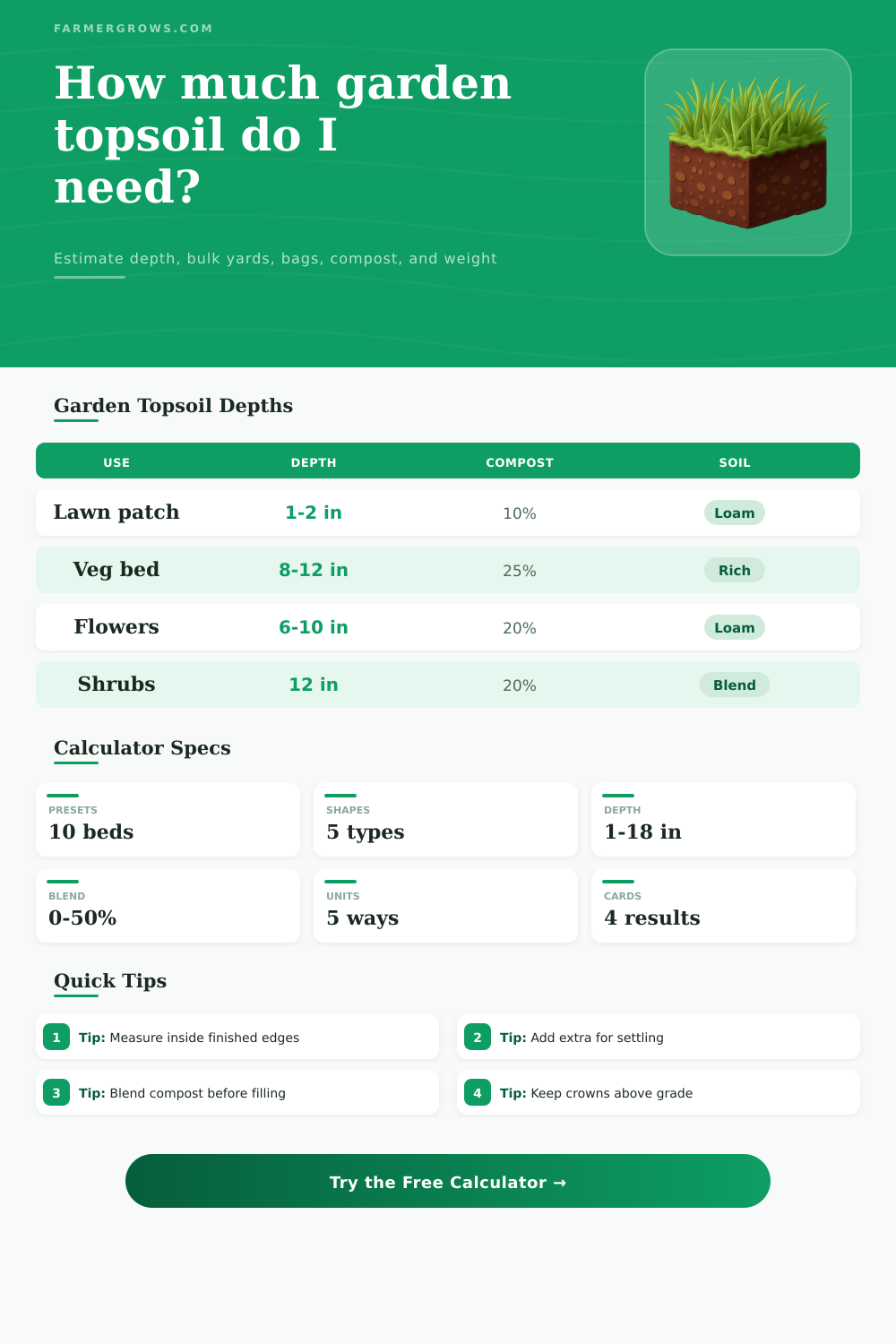
| Vegetable bed rebuild | 8 to 12 in | 10% to 30% | Screened loam with 20% to 30% compost | Bulk yards are usually easier than bags |
| Perennial flower border | 6 to 10 in | 20% to 40% | Loam or sandy loam with moderate compost | Order extra for edging and low pockets |
| Lawn topdressing | 1 to 2 in | 0% to 10% | Fine screened sandy loam | Small bags work for patches; bulk for large lawns |
| Shrub island | 8 to 12 in | 20% to 50% | Mineral loam with compost blended in | Avoid burying root flares with deep soil |
| Raised bed fill | 12 to 18 in | 0% to 20% | Raised bed blend with mineral topsoil | Expect settling after watering and first season |
Before ordering: Check whether your supplier sells loose cubic yards, loader buckets, totes, or bags. Match the delivery unit here so rounding is visible before the truck arrives.
Before spreading: Loosen the old surface, blend compost through the topsoil, water in layers, and keep final grade below crowns, stems, siding, and path edges.
Ordering topsoil for lawn repairs or new bed sounds easy enough: you measure your area, guess the depth, and then worry that company will send too much or too little. No more guessing when you use a calculator, which translates your measurements into real-world order rather than just a hopeful one. The key is knowing what question each input asks.
Beds is never perfect rectangles, so garden shape counts. An oval pollinator patch isn’t the same as circular space surrounding a tree… Especially when you multiply that by depth. And then there’s depth itself, which is hardly ever just one thing. Topdressing a lawn might requires one inch; vegetables typically want eight or even 12 inches of soil in order to root propery.
How to Use the Topsoil Calculator
Most users miss setting about existing soil credit. That’s the native ground that you’ve loosened, or the compost you’ve mixed in. This soil are part of your final profile, so it shouldn’t count against your total. Enter its percentage into the calculator so you don’t get charged for what’s already there.
Similarly, compost share is the inverse: You can enters how much compost you added, which increases structure and fertility, but alters weight and settling characteristics as well. Because of those changes, the tool treats both organic portion and mineral portion differently.
The soil isn’t staying precisely in place, so there will be compaction and overage allowances. It will settled from watering, foot traffic, and the first winter. When ordering, it’s normal to order an additional 10-15% of what you think you need. The tool will calculates this cushion automatically if you select a delivery unit.
Whether you’re getting bags, bulk yards, or something in between like one-yard totes, result displays both the number of units and the volume of each unit. Tables on the page shows common depths of beds for various uses in the garden, and also indicate the impact of soil type on density. A compost-laden mix is lighter-weight by the cubic yard than heavier clay loam, which affects both the truck weight and how much the bed will settle after watering. That’s important, for example, if you’re comparing a lighter sandy loam that drains fast against a deeper bed of richer soil for growing your vegetabels.
But then come the numbers, and so does the true trial. Next, loosen the subsoil, mix in the compost and spread it out to create level surface beneath the plants at path edges and in the beds. Once you give the tool your measurements, it will do the math for you, but not necessarily prepares the beds themselves as an old pro would of.