Raised Garden Bed Compost Calculator
Estimate compost for deep raised beds by combining bed dimensions, number of beds, finished soil depth, existing fill, crop nutrient demand, compost density, and settling allowance.
Measure the inside length and width of each raised bed. Existing fill is the soil already in the bed before adding compost, so the calculator can warn when a topdress will sit above the boards unless you mix deeper or remove soil first.
Raised Bed Compost Results
Compost volume, bag count, bulk yards, weight, and bed headroom will appear here.
| Compost rate | Best use | Equivalent layer in 12 in bed | Raised bed note |
|---|---|---|---|
| 5% to 10% | Annual top-up or low-demand crops | 0.6 to 1.2 in mixed through profile | Good when the bed already has dark, loose soil. |
| 15% to 20% | Standard vegetable bed refresh | 1.8 to 2.4 in mixed through profile | Reliable for greens, roots, peppers, and mixed beds. |
| 25% to 30% | Heavy feeder rebuild | 3.0 to 3.6 in mixed through profile | Use mature compost and avoid burying crowns or stems. |
| 35% to 40% | New poor fill correction | 4.2 to 4.8 in mixed through profile | Check drainage and salinity before using this much compost. |
| Finished soil depth | Suitable crops | Volume for 4 x 8 bed | Compost at 20% |
|---|---|---|---|
| 6 in | Lettuce, radish, shallow herbs | 16.0 cu ft | 3.2 cu ft |
| 10 in | Greens, peas, beans, beets | 26.7 cu ft | 5.3 cu ft |
| 12 in | Carrots, peppers, mixed vegetables | 32.0 cu ft | 6.4 cu ft |
| 18 in | Tomatoes, cucumbers, deep roots | 48.0 cu ft | 9.6 cu ft |
| 24 in | Asparagus, berries, deep perennial beds | 64.0 cu ft | 12.8 cu ft |
| Demand group | Crop examples | Calculator factor | Compost planning note |
|---|---|---|---|
| Low | Herbs, peas, beans, mature strawberries | 0.85 x target rate | Too much compost can push soft growth at the expense of flavor or flowering. |
| Medium | Lettuce, spinach, carrots, beets, onions | 1.00 x target rate | Use the entered compost percentage as the baseline for mixed beds. |
| High | Tomatoes, peppers, cucumbers, eggplant | 1.15 x target rate | Good compost helps moisture and nutrients, but fruiting crops may still need balanced feeding. |
| Very high | Corn, squash, melons, cabbage, broccoli | 1.25 x target rate | Confirm compost maturity and supplement based on soil test if production is intensive. |
| Compost package | Volume | Amount per cubic yard | Coverage at 2 in depth |
|---|---|---|---|
| Small bag | 1 cu ft | 27 bags per yd3 | 6 sq ft |
| Standard bag | 1.5 cu ft | 18 bags per yd3 | 9 sq ft |
| Large bag | 2 cu ft | 13.5 bags per yd3 | 12 sq ft |
| Contractor bag | 3 cu ft | 9 bags per yd3 | 18 sq ft |
| Bulk delivery | 1 cubic yard | 27 cu ft | 162 sq ft |
Headroom tip: If the calculator reports more compost than the open space above your existing fill, fork the compost into the top 6 to 10 inches or remove some tired soil before topdressing.
Maturity tip: Use compost that smells earthy, not sour or ammonia-like. Unfinished compost can steal nitrogen, heat the root zone, or introduce salts into a confined raised bed.
When’s the last time you calculated just the correct volume of compost to topdress a raised bed? Sounds easy enough … until you attempt to do the math. Obviously it must contain more organic matter than what came with the lumber, but by exactly how much? More than a fast guess, it requires: The calculator at left will do the math for you if you plug in the bed dimensions; desired finished soil depth atop the lumber; and existing amount of material on hand.
The difference is between measuring your future finished-bed depth and measuring what remains unfilled at this moment. A lot of people just stand on boards and figure out their height, which equals “the amount I should of buy.” They really want to know the difference between current thickness and desired thickness once everything has settled and crops has grown. This tells them how much more need to be ordered. The calculator calculates the difference, so you know exactly how much to order.
How to Measure Compost for Raised Beds
There is also little choices that make big differences in compost percentage. Most mixed vegetable beds does fine with a 20 percent goal. Squashes and tomatoes takes up more potassium and nitrogen during their growing seasons, so they benefit from a somewhat higher share in the same bed. Depending on your choice of crop demand level, the tool will adjust the base percentage to match.
It also adds an allowance for the finished compost to settle. This ensures the order still fits into the bed even after it has been watered and settles from microbial action for a week or two. Now let’s get to the density of the material in question and its bag size: Screened green compost usualy weighs around forty-four pounds per cubic foot, while aged manure compost tend to be a bit heavier.
For large-scale work, ordering bulk by the cubic yard will save you some money; for topping up a single bed’s layer, or working with very small areas like a little balcony bed, buying by two-cubic-foot bag might make sense. Since both methods gives you a result, you can compare cost and labor side-by-side without needing to do more math.
The second question is how much deeper I have to mix, or if I can just topdress. The calculator flags when there is not enough space between the existing soil and the top of the boxes to hold the compost. If so, take out some of the spent soil first (or fork in some fresh soil to the top six or even 10 inches). Don’t let surface of the finished thing be higher than the boards. If it is, the soil will wash over the edges and spill off in heavy rain.
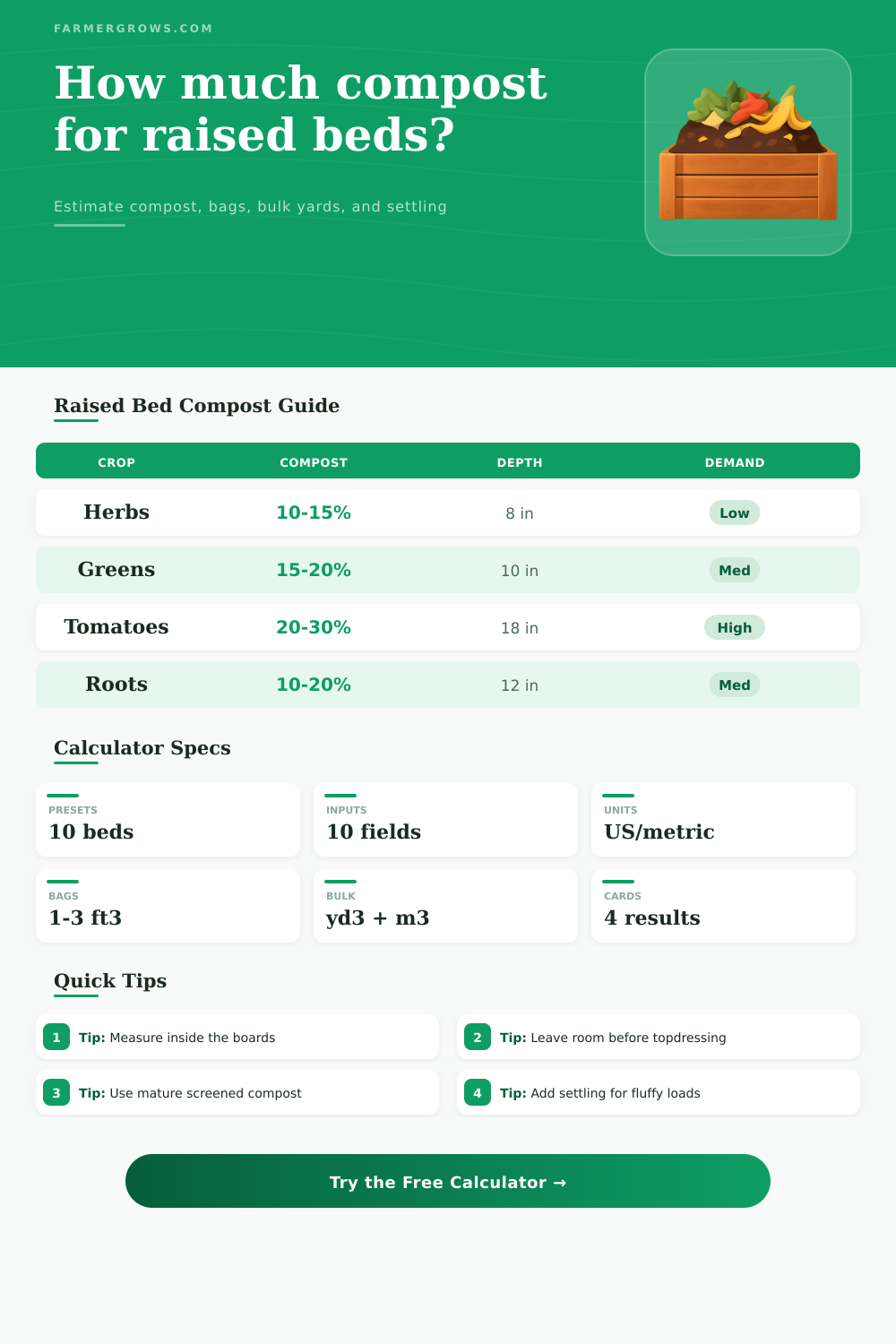
At the top of the page, the rate tables provides a guideline for average rates for various bed depths and types of crops. Ultimately, it’s up to you and your available time and crop. For example, do I need to water an 18-inch-deep bed of quick-to-mature radish and lettuces? No. An 18- or 24-inch-deep one for my berry bed or my asparagus will do just fine.)
As long as the compost is fully matured and not too coarse to mix in evenly, adding it helps regardless of how deep the bed is. If you factor in the settling that happens with any substrate, remember that most people under-estimate just how large a bed will need to be. It’s usually easier to have some left over when ordering and add more as needed later rather than run out halfway through the season.
The calculator spits out the figures, but it’s up to you to decide how deep you want to go. How frequently should I refresh the top layer? Is a more expensive mix worth what I get back from the crops growing here?