Wood Chips Composting Time Calculator
Estimate how long wood chips need to age into garden-safe mulch or screened compost, including nitrogen amendment, water demand, turning interval, heat potential, shrinkage, and coarse-chip return.
Fresh wood chips are carbon-heavy and fungal, so they compost differently from grass, food scraps, or finished compost. This tool estimates both the shorter wait for aged mulch and the longer wait for soil-blend compost based on chip size, pile volume, nitrogen, moisture, turning, and season.
Wood Chip Composting Estimate
Your calculated pile timing, nitrogen plan, water target, and screened yield will appear here.
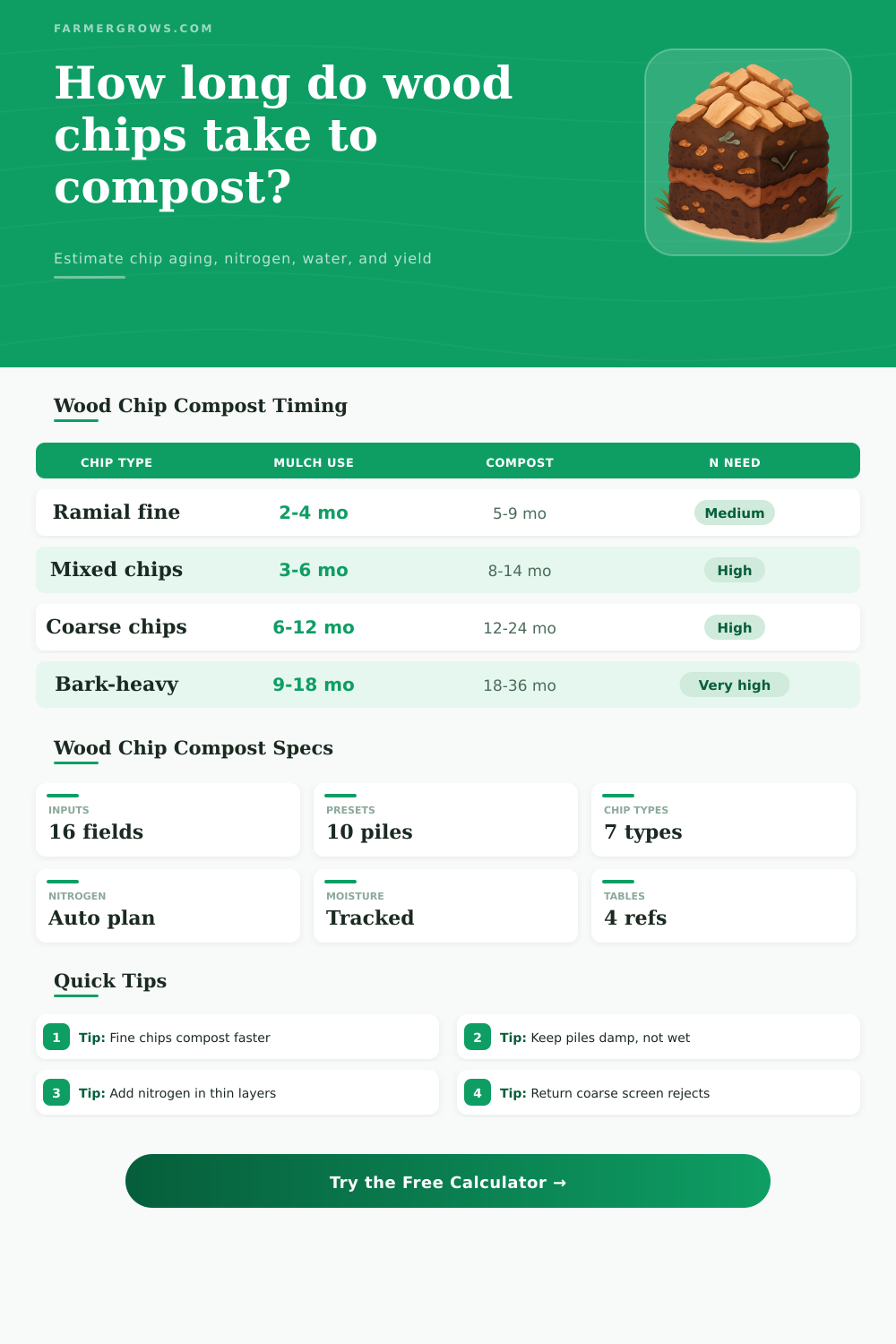
| Chip or mix | Aged mulch timing | Screened compost timing | Best management |
|---|---|---|---|
| Fine ramial chips with leaves | 2 to 4 months | 5 to 9 months | Keep moist, turn every 1 to 2 weeks, add light nitrogen. |
| Fresh mixed arborist chips | 3 to 6 months | 8 to 14 months | Layer with manure, grass, leaves, or compost; screen at finish. |
| Coarse branch chips | 6 to 12 months | 12 to 24 months | Use as mulch first or return coarse screen rejects to a new pile. |
| Bark-heavy or dyed-free landscape chips | 9 to 18 months | 18 to 36 months | Age as a fungal pile; expect slow darkening and high coarse fraction. |
| Sawdust or fine shavings | 2 to 5 months | 6 to 12 months | Blend carefully with bulky material so it does not seal into wet layers. |
| Nitrogen source | Light boost per cu yd chips | Hot blend per cu yd chips | Wood-chip note |
|---|---|---|---|
| Fresh grass clippings | 0.20 cu yd | 0.45 cu yd | Mix in thin layers so grass does not mat or sour. |
| Herbivore manure | 0.12 cu yd | 0.30 cu yd | Good all-purpose activator if herbicide contamination is not a concern. |
| Composted poultry litter | 0.04 cu yd | 0.12 cu yd | Strong source; avoid overuse near fresh plant roots. |
| Alfalfa meal or pellets | 6 lb | 14 lb | Useful when no green material is available. |
| Coffee grounds | 0.10 cu yd | 0.25 cu yd | Blend with coarse chips for airflow and moisture balance. |
| Pile condition | Heat potential | Water target | Management advice |
|---|---|---|---|
| Under 0.5 cu yd | Low | Damp but airy | Expect slow fungal aging; add finished compost and keep covered. |
| 1 to 5 cu yd | Best range | 8 to 20 gal per dry cu yd | Large enough to heat, small enough to turn with a fork or loader. |
| Over 10 cu yd | High core heat | Water in lifts | Build in layers and check for dry pockets inside the pile. |
| Sealed tarp or soggy base | Uneven | Drain before adding | Open the sides, fluff the pile, and add dry coarse material. |
| Target use | Ready signs | Wait if you see | Screening need |
|---|---|---|---|
| Tree or path mulch | Darkened chips, earthy smell, no sour odor | Fresh resin smell or pale raw chips | Usually none |
| Established bed mulch | Cool pile, fungal threads, partly broken edges | Ammonia odor, heating core, slimy layers | Optional coarse screen |
| Soil amendment | Crumbly fines, low visible wood, stable temperature | Large pale chunks or active heat after turning | Recommended |
| Potting blend ingredient | Fine screened, mature, no heat rebound | Any sour smell or fresh wood texture | Fine screen required |
Build in lifts: Wet each 6 to 10 inch layer as you build. A hose on the outside of a finished chip pile often leaves the center dry.
Use nitrogen carefully: Wood chips need nitrogen to compost quickly, but strong sources should be mixed evenly to avoid ammonia pockets and root-burning hot spots.
Screen, then recycle: Coarse pieces are not failures. Return them to the next chip pile as fungal starter and structure.
Avoid unsafe chips: Do not compost painted, pressure-treated, glued, or unknown construction wood for food gardens.
It feels like magic, but it is realy just biology playing out on a slower timeline: watching wood chips transform into dark, crumbly earth are deeply satisfying. Why not apply freshly chipped arborist debris as instant soil improver? Fungi, not bacteria, drive the pace of composting wood. Learn what composts best for potting soil versus mulch for pathways, and never smother your seedling under a layer of raw sawdust-smelling material again.
The most difficult part is carbon content. When applied direct, wood chips steals nitrogen from the soil because the microbes use the chips’ stored energy. Enter your chip type (or other pile component) and desired pile size into the calculator, which do the math for you. If you want balanced carbon, it will tell you exactly how much manure, or green waste, you’ll require to offset the carbon.
How to Compost Wood Chips
People tend to underestimate this ratio. They toss a bit of grass clippings onto their heap and hope for the best, and then wonder why things don’t heat up quickly. They don’t realize that thick branches takes longer to decompose then do fine twiggy ones. The calculator helps by tweaking the timeline based off the texture. A mix of fine chips and leaves could be done in less than nine months. Thick bark might take two years or even more. That’s important when you’re planning crop rotations.
Moisture management is where most pile fail. It should not be to wet (like a swamp) or too dry (like tinder). Aim for the consistency of a wrung-out sponge. Particularly if your heap is located in full sun, the outer layer can become very dry and create a crust. Regular turns redistributes moisture from the inside outward and bring air into center of the pile. Depending on the season you begin, and the exposure of the heap, the calculator figures out when to turn next.
Winter months slows things down, while warmer seasons accelerate the rate of decomposition. It is not just about time but about the conditions that keep microbes happy and working as they breathe and eat.
Another source of trouble is screening. Does your compost has to be like sifted dust? No. Depending on your use; whether for path mulch, for example; the compost may screen out at an earlier stage and still serve well, with some bigger chunks left for structure. But the big woody things don’t belongs there if it’s going to get mixed into vegetable beds, or into potting soil, for instance.
Expect some shrinkage, not just from moisture loss but because settling occurs; you’ll end up with less than what went in, so take that into account when figuring out how much to make. The yield estimate will help you with that planning.
What type of Nitrogen source? These differ greatly: Some (like manures) heat up fast but need to be well-composted first, so you don’t spread weed seed or pathogens. Others (such as coffee grounds) works gently but also tend to hold onto moisture. Thick layers of grass clippings can go anaerobic and mat, smelling awful. A chart in the tables on the page explain it all simply: Which amendments speed what part of the process along?
Speeding it up means hotter compost and more turning and checking; taking longer but needing less attention is the fungal, low-work side. You either spend more time at the start or more patience later; it is a trade-off between time and patience. Composting wood chips is a process that’s all about paying attention. Believe your nose more than the calendar. Sweet and earthy = good. Ammonia-heavy or sour = time to tweak the moisture or nitrogen levels.
And while the calculator gives you a decent place to start, there will be variables, depending on where you live and which woods end up in your heap, that any model would of fall short of predicting. Proceed slowly if uncertain. Make a small pile first so you build some confidence working at that scale. Making arborist-sized drops requires a promise of scale.
But when it softens into easy-to-crumble darkness between your fingers, you’ll know you’ve got it. It’s worth the wait, the turning, and all the time in between.