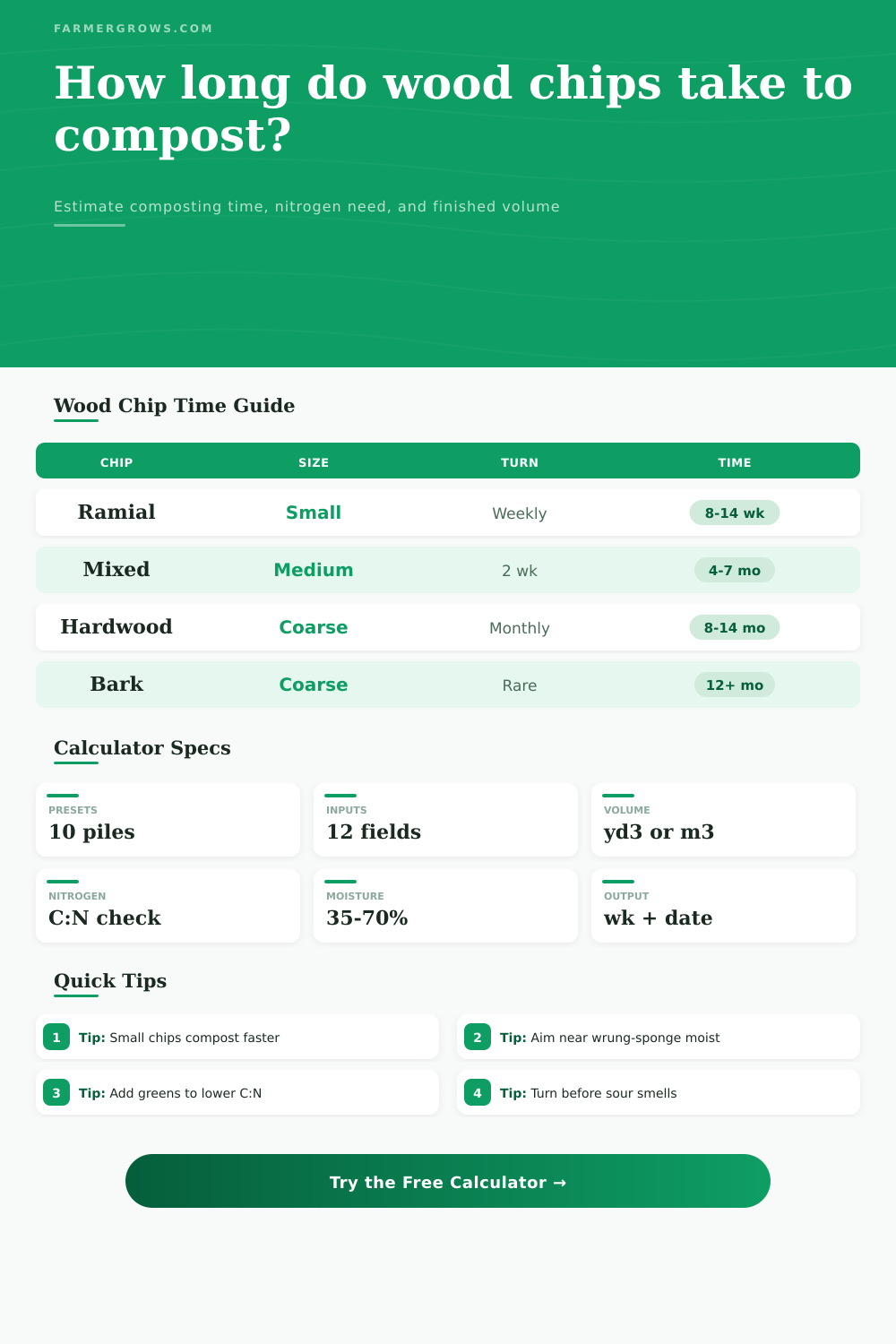
Wood Chip Composting Time Calculator
Estimate how many weeks wood chips need to become usable compost from pile volume, chip size, species mix, nitrogen balance, moisture, turning frequency, season, and finish target.
Choose a real composting setup, then adjust the chip mix, moisture, dimensions, nitrogen source, and turning schedule to match your pile.
Wood Chip Composting Estimate
Adjust the pile details and calculate to estimate composting time.
Best for small chips, a 25:1 to 35:1 blend, good moisture, and weekly turning once heat drops.
Fits typical arborist chips with greens or manure, moderate turning, and seasonal temperature swings.
Works well for tree mulch compost where fungi, moisture, and patience matter more than hot composting.
Coarse bark or trunk chips can sit as a slow carbon pile, then be screened for finished fractions.
| Wood chip feedstock | Typical starting C:N | Base composting time | Best use when partly finished |
|---|---|---|---|
| Ramial branch chips with leaves | 50:1 to 80:1 | 10 to 18 weeks when amended | Garden topdress, orchard mulch, fungal compost |
| Mixed arborist chips | 80:1 to 130:1 | 4 to 8 months with greens | Perennial mulch, compost ingredient, bed pathways |
| Hardwood trunk chips | 130:1 to 180:1 | 8 to 14 months in managed piles | Tree rings, paths, rough screening material |
| Softwood or conifer chips | 140:1 to 200:1 | 9 to 16 months with nitrogen | Acid-tolerant shrub mulch, slow fungal compost |
| Bark and landscape chips | 180:1 to 300:1 | 12 to 24 months for compost texture | Long-lasting mulch, path base, carbon bulking |
| Sawdust and fine shavings | 200:1 to 500:1 | 12+ months unless heavily amended | Blend sparingly with manure or food scraps |
| Nitrogen source | Typical C:N | Fast-start volume share | Handling note |
|---|---|---|---|
| Fresh grass clippings or green weeds | 12:1 to 20:1 | 20% to 45% of chip volume | Mix thinly so wet mats do not seal air out |
| Coffee grounds and food scraps | 15:1 to 25:1 | 10% to 30% of chip volume | Bury well to reduce odors and pests |
| Poultry litter or chicken bedding | 6:1 to 12:1 | 5% to 20% of chip volume | Powerful nitrogen source; avoid overdoing it |
| Horse manure and bedding | 25:1 to 45:1 | 25% to 70% of chip volume | Often already mixed with woody bedding |
| Cattle manure or dairy pack | 18:1 to 35:1 | 15% to 45% of chip volume | Good microbial inoculant when well distributed |
| Measured urea or high-N meal | Near 1:1 to 8:1 | Small measured dose only | Dissolve or distribute evenly to avoid hot pockets |
| Moisture or turning condition | Composting effect | Field cue | Adjustment |
|---|---|---|---|
| 40% to 50% moisture | Moderate, may run cool | Feels damp but does not glisten | Add water while turning dry pockets |
| 50% to 60% moisture | Fast aerobic range | Wrung sponge feel, few drops when squeezed | Maintain with cover or watering |
| Over 65% moisture | Oxygen drops and odors rise | Water drips, sour smell, compacted texture | Add dry chips and turn for air |
| Weekly turning | Fastest practical backyard pace | Steam fades, center cools, outer chips dry | Move outside material to the hot center |
| Monthly turning | Slower but workable | Patchy heating and uneven breakdown | Expect longer curing and screening time |
| Static pile | Fungal, slow, low labor | White threads, earthy smell, few hot cycles | Keep shaded and moist for long aging |
| Starting pile volume | Heat potential | Expected shrinkage | Management note |
|---|---|---|---|
| Under 1 yd³ / 0.76 m³ | Low | 25% to 40% | Best as a slow aging bin or add to a larger pile |
| 1 to 3 yd³ / 0.76 to 2.3 m³ | Good | 35% to 50% | Backyard sweet spot for active wood-chip compost |
| 3 to 10 yd³ / 2.3 to 7.6 m³ | Strong | 45% to 60% | Windrow or loader-turn pile with reliable heating |
| Over 10 yd³ / 7.6 m³ | Very strong | 50% to 65% | Monitor heat, moisture, and oxygen in the core |
Balance carbon before chasing heat. Wood chips are carbon-heavy, so the fastest piles usually contain enough greens, manure, coffee grounds, or measured nitrogen to move the blend toward roughly 25:1 to 35:1.
Judge finished compost by behavior. Ready wood-chip compost should smell earthy, stop reheating after turning, darken noticeably, and contain only a manageable amount of oversized pieces for screening.
Three months later: You keep staring at all those wood chips and think: Nothing’s happening in there. What’s going wrong?
This is what makes people quit on making compost from wood chips before they’ve given it a chance to get going: Nothing changes visibly. The pile just sits there looking like the day the arborist deliver it. But a wood chip isn’t a leaf mulch. It’s a densely structured piece of carbon designed to last, something that needs special conditions (conditions most backyarders don’t unwittingly provide) in order to break down.
Why Your Wood Chip Compost Is Not Working
Use the calculator above: once you enter your pile size, moisture content, and any other ingredient that contain nitrogen, the calculator will do the math for you. But knowing why the variables matter is what really converts waste into soil.
Everyone assumes that piling up some wood chips will do the trick. Nope. As always, the biggest problem is the C:N (carbon to nitrogen) ratio. Wood chips from raw wood are very high in carbon… Often sitting at a ratio of one hundred to one or higher. That means the wood needs nitrogen for microorganisms to break down the carbon, but if there’s no nitrogen, nothing happens; the breakdown slows to a crawl. Nitrogen is like the fuel that powers the carbon engine. No nitrogen? No heat. No life in the microbes. Stuck chips. That’s why all those recommendations to add manures or grass clippings or even coffee grounds aren’t optional, they’re essential to get things moving fast. With this tool, you can figure out how much of those so-called green ingredient you’ll need to reach that sweet spot where biology goes haywire.
Moisture is the other frequent cause of compost project failure. A pile may appear moist on the surface but be as dry as a bone inside (which happens if wood chips are used; they don’t absorb water well). You want something between fifty and sixty percent moisture (like a wrung out sponge). Less than that, and microbial action slows way down. More than that, and things get anaerobic, smelling foul and producing methane different than compost. Here’s where season comes into play again. Starting a pile in the humid spring, for instance, versus in the dry heat of high summer, affects the internal balance and causes varying rates of evaporation each day.
How big should your compost be? Surprisingly enough, this is an important factor when deciding if your heap will heat up. Piles less than one cubic yard are typically not hot enough (meaning they don’t rapidly break down lignin). This is because these small heaps aren’t able to retain heat well; they lose heat into the air around them before the decomposing organisms can produce more of their own. In contrast, larger heaps retains heat better, making them ideal environments for decomposition (especially anything more than three cubic yards). The catch: Large heaps take longer to aerate and turn, which means more work on your part. You’ll need to weigh size versus effort and go with what makes sense based off your tools and body.
Frequent turning gets confused with a job; it’s actually your friend. By bringing air into the mix, turning is the last component of this aerobic equation. If there’s no oxygen, all those lovely thermophilic bacteria will die out and be overgrown by their cooler, slower decomposing cousins. Yes, you can go many months without turning at all, but that will certainly slow things down. The prediction above assumes what level of “turning frequency” you choose (daily, weekly, whatever), and therefore gives you a reasonable timetable instead of a best-case scenario.
So here’s how it works: The end result won’t resemble the beginning ingredients. Depending on what you started with, there may be a big reduction in volume (sometimes as much as half of the original). But don’t worry; that is a good sign. The pile has shrunk because the air spaces dissapears. It is all settling down into an earthy, compact mass of black gold. After six months, if your heap remains light and fluffy, then it’s not working right. Most likely it’s too cold, too dry, or lacks nitrogen. Inserting a long prong into the heap will reveal whether it’s got any life left in it.
IT’S A gardening task that tests the limits of your patience: composting wood chips. It’s about planning ahead, and it takes time (you can’t hurry Mother Nature). If you get the balance correct, it rewards you with a stable, rich amendment. This improves soil structure and helps it hold nutrients and water better than even leaf mold can alone. In fact, over time, the chips degrade into that beautiful humus that holds onto nutrients and water so well. It is worth the wait.
All it takes is feeding the heap the proper ingredients, and providing it oxygen (a.k.a. It needs enough “air” to breathe. The basics: Start with that; then balance the carbon with nitrogen; don’t let it dry out; and let time take the rest of the load off. Your soil will reward you for the effort with that dark, fertile gold made from those stubborn chips.
You should of seen how much better it works once it gets going. This moddern process is naturaly the best way to make soil.