Winter Wheat Seed Per Acre Calculator
Estimate winter wheat seed per acre from acres, planting date, target seeds per square foot, seed size, germination, field emergence, row spacing, drill calibration, purpose, and tillering adjustment.
Choose a starting point for common winter wheat jobs, then adjust the date, seed lot, drill setup, acreage, and tillering expectation for your field.
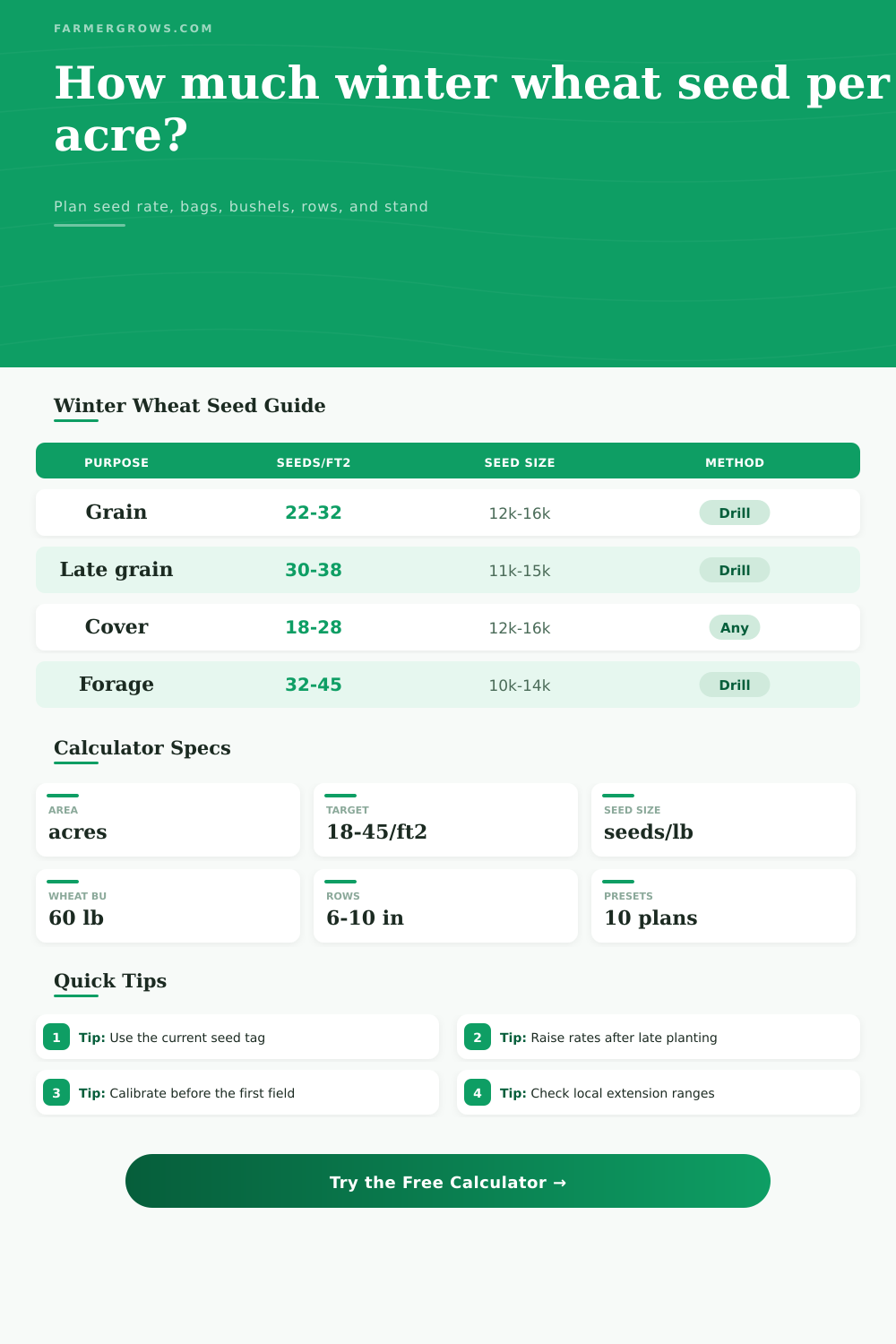
Grain fields usually target a final stand, then adjust seed pounds for seed size, germination, emergence, and planting date.
Late planting gives less fall tillering time, so the calculator can add seed through both the date and tillering inputs.
Cover crop wheat may use a lighter stand when drilled early, or a heavier stand when broadcast into residue or planted late.
Grazing or forage plans often use more seeds per square foot to build fall canopy and recover after clipping or grazing.
Winter wheat seeding plan
Enter field details to estimate the planting rate.
| Winter wheat use | Typical live seed target | When to raise target | Calculator preset | Field note |
|---|---|---|---|---|
| Timely grain drilling | 22 to 30 seeds/ft² | Low emergence, rough seedbed, low tillering | 28 seeds/ft² | Good seed-to-soil contact keeps lb/ac lower. |
| Late-planted grain | 30 to 38 seeds/ft² | After ideal window or after double crop harvest | 34 seeds/ft² | Less fall tillering means the main stem count matters more. |
| Cover crop wheat | 18 to 28 seeds/ft² | Broadcasting, heavy residue, or quick canopy goal | 24 seeds/ft² | Soil cover may not require the same stand as grain harvest. |
| Forage or grazing | 32 to 45 seeds/ft² | Fall grazing, clipping, or fast canopy desired | 38 seeds/ft² | Higher density supports early biomass but needs fertility and moisture. |
| Dual-purpose wheat | 34 to 42 seeds/ft² | Grazing before grain recovery | 36 seeds/ft² | Grazing plans often balance forage demand against spring grain recovery. |
| Seed size class | Seeds per lb | Approx lb/ac at 28 seeds/ft² | Approx bu/ac | Why it matters |
|---|---|---|---|---|
| Large seed | 10,000 | 122 lb/ac before loss correction | 2.03 bu/ac | Large kernels need more pounds for the same plant count. |
| Medium-large seed | 12,000 | 102 lb/ac before loss correction | 1.69 bu/ac | Common cleaned seed lot range for many varieties. |
| Medium seed | 14,500 | 84 lb/ac before loss correction | 1.40 bu/ac | Default calculator seed size for a typical wheat lot. |
| Small seed | 16,000 | 76 lb/ac before loss correction | 1.27 bu/ac | More seeds per pound reduce pounds but not needed seeds. |
| Very small seed | 18,000 | 68 lb/ac before loss correction | 1.13 bu/ac | Confirm seed quality because size does not guarantee vigor. |
Base formula before corrections: lb/ac = target seeds per ft² x 43,560 / seeds per lb.
| Calculator signal | Planting date pattern | Date factor | Tillering choice | How to use it |
|---|---|---|---|---|
| Early | Before Sept 15 | 0.96x | Strong tillering | Use only where early planting is locally recommended and disease or insect risk is managed. |
| Timely | Sept 15 to Oct 10 | 1.00x | Normal | Good default when wheat has time to emerge, root, and tiller before winter. |
| Late | Oct 11 to Oct 31 | 1.10x | Weak tillering | Add seed because fewer fall tillers develop before cold weather. |
| Very late | Nov 1 or later | 1.20x | Very weak | Use a local cutoff date and consider yield risk before increasing seed alone. |
| Dormant risk | Cold soil window | 1.25x | Very weak | Only suitable where dormant seeding is an accepted local practice. |
| Check point | Field calculation | Typical range | Adjustment input | Practical cue |
|---|---|---|---|---|
| Drill chart | Set close to target lb/ac | Varies by drill | 0% to start | Charts assume standard seed; always verify with actual wheat. |
| Catch test | Weigh seed from openers | Within 5% | 0% to 5% | If catches run low, add a positive calibration adjustment. |
| Row-foot count | Seeds per row foot | Often 12 to 28 | Uses row spacing | Helpful for checking whether openers are flowing evenly. |
| Field emergence | Stand count after emergence | 70% to 90% | Emergence % | Low emergence increases the required bulk seed per acre. |
| Bag rounding | Total lb / unit size | Whole units | Bag size | Rounding up shows extra seed after ordering whole bags or totes. |
Calibrate with the seed lot going in the drill. Wheat seed size, treatment, test weight, and flow can vary enough that drill charts are only a starting point. Catch seed from several openers and compare to the calculator target before planting the whole field.
Treat late planting as a stand problem, not just a pounds problem. Raising lb/ac helps compensate for fewer fall tillers, but planting depth, firm seed-to-soil contact, fertility, and local cutoff dates still decide establishment.
It’s an unforgiving window: Your calendar. Your soil. Frost’s not far off. You need those roots down before it come. Managing that risk (a.k.a., getting the seed rate just right) means covering the ground and getting the roots to take hold before then.
Oversow, and you’ll be wasting money and crowding out your own plants. Undersow a marginal field and you’re inviting weed while leaving yield on table. Crowded stands don’t help your springtime stand strength, either.
How to Use the Seed Calculator
So how do you do all this? The calculator above do it for you by asking about your specific field conditions and seed lot, saving you the conversion and coefficient guesswork.
But before we can talk about any good planting plan, we must first discuss the target stand. Most farm experts recommend twenty-two to thirty live plant per square foot for grain production. Why? This density is necessary to quickly fill canopy and provides enough tillers to sustain a heavy head set in June.
But here’s the catch: In order to hit that target, you have to know how much seed to plant to achieve it. And this is why the seed tag will be your most valuable piece of paper. Not all seeds are equal by bag or crop. Some has way more kernels per pound than others. The big ones tend to be larger and plumper while the little ones may be shrunken and shriveled up. If you buy a generic bushel weight without checking how many seeds is in each pound, you’re probably going to miss out.
With the tool, you can input your seeds per pound right off of the tag. It will account for your germination percentage and expected rate of field emergence. Why? Because germination in the lab is a result of perfectly controlled conditions; field emergence is what happens once you get it out in real life with compaction and residue and perhaps a bit of pest pressure. Adjusting for emergence means you are buying what the final stand is, rather than just buying initial germination.
There’s also an element of timing. The earlier you plant, the longer the wheat has to tiller. These fall tillers are our backup for next year’s yield. The later you plant, the more the plant rely on the main stem. If you plant late, there isn’t enough growing degree days left to allow for any additional branches. When you plant around mid-October or beyond, penalty is severe. You should of used more seed to make up for the reduced branching potential.
To adjust for this, the calculator allows you to adjust the target based off your planting date and expected tillering conditions. A small thing, but it makes a difference when you’re trying to salvage a late season.
The weak link in the chain for most is their drill calibration. The charts on the side of the drill help get you off to a rough start. But assume a normal seed which likely doesn’t match what’s in your load. Before you begin planting catch some seed out of the openers and weigh it. Then you can adjust for this in the calculator if your drill is under delivering by say ten percent. That adds the adjustment back into your total lbs and bags needed. This ensures you don’t come up short halfway through the field.
But you may be growing the plants not for headcount but for forage or cover crops. For those purposes, maybe emphasis isn’t on heads as much as on biomass. So there are other goals, and the presets on the page represent that. If the goal is a dense mat of something to graze on (a forage stand), perhaps you’d want 40 seedlings per square foot. Left to grow alone in an early planting, maybe less would be enough to get the job done, such as for a cover crop. The table on the page spells that out: How does the target change with purpose?
The bottom line is this: preparing and knowing how to plan means balancing your preparation against the odds. Winter can’t be controlled, but the number of seeds that germinate can. Calibrate the drill, fiddle with the date and seed tag, then go out and plant it. The math is only as good as the seed-to-soil contact you get in the ground.