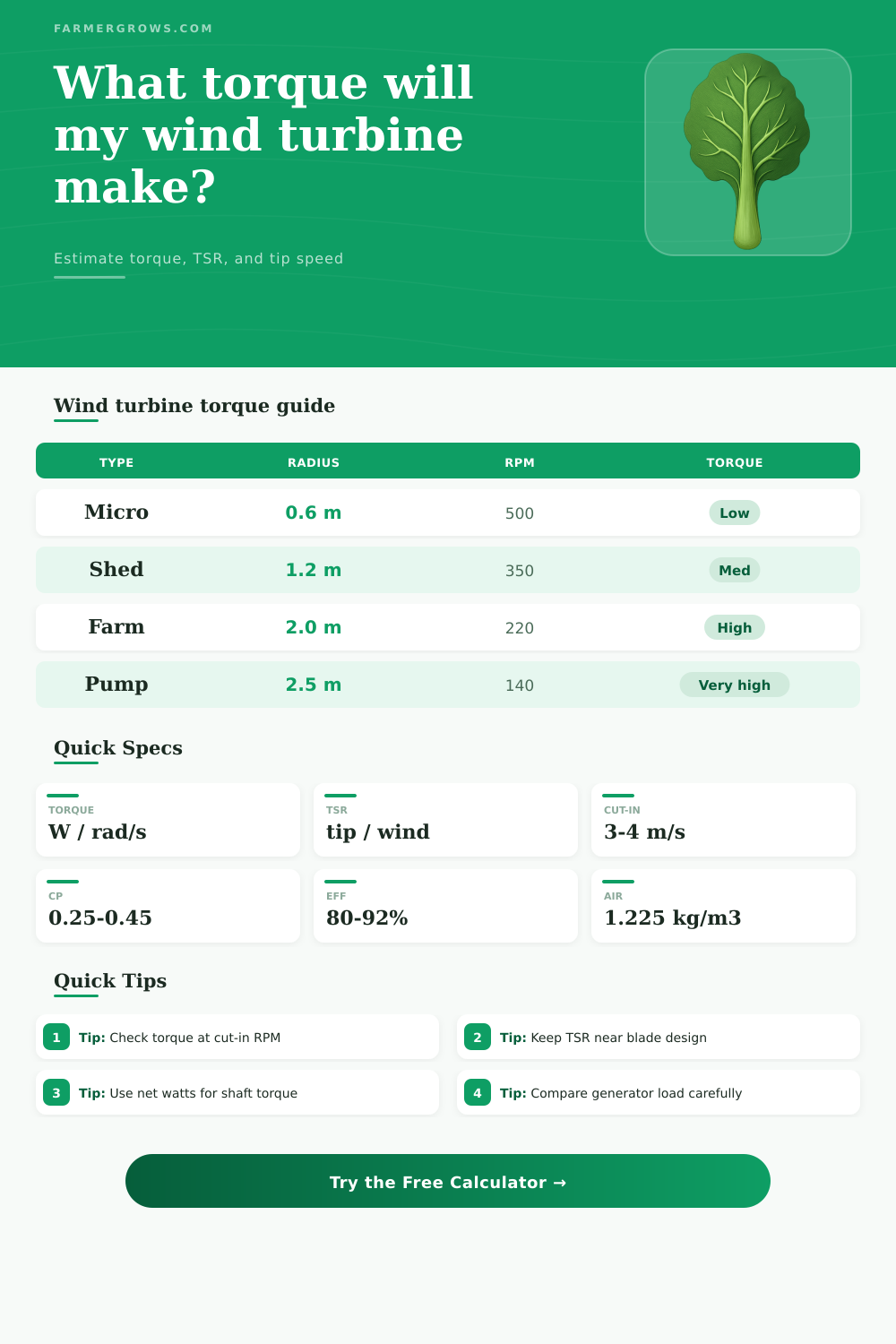
Wind Turbine Torque Calculator
Estimate shaft torque from rotor power, RPM, blade radius, wind speed, power coefficient, drivetrain efficiency, generator load, and cut-in behavior. The calculator also reports tip speed and tip speed ratio.
Choose a farm-scale turbine scenario, then adjust the radius, RPM, Cp, efficiency, wind speed, generator load, and cut-in mode for your machine.
Torque and Rotor Results
Torque uses net shaft watts divided by angular velocity. Tip speed ratio uses blade tip speed divided by wind speed.
| Rotor style | Typical TSR | Typical Cp | Torque behavior |
|---|---|---|---|
| 3-blade lift rotor | 5 to 8 | 0.25 to 0.45 | Balanced RPM and torque for battery charging |
| 2-blade fast rotor | 7 to 10 | 0.25 to 0.42 | Higher speed, lower torque at the same power |
| Multi-blade pump rotor | 1 to 3 | 0.15 to 0.30 | High starting torque for mechanical pumping |
| Savonius drag rotor | 0.7 to 1.2 | 0.08 to 0.18 | Slow, simple, and torque-heavy at low speed |
| Custom experimental rotor | User set | User set | Use measured RPM and Cp when available |
| Step | Formula | Units | Calculator use |
|---|---|---|---|
| Swept area | pi x radius² | m² | Rotor disk area catching the wind |
| Wind power | 0.5 x air x area x wind³ | W | Power passing through the rotor disk |
| Rotor power | wind power x Cp | W | Aerodynamic power captured by blades |
| Shaft power | rotor power x efficiency | W | Power after drivetrain and electrical losses |
| Angular velocity | RPM x 2 pi / 60 | rad/s | Rotor speed for torque conversion |
| Torque | shaft watts / rad/s | N m | Main output for shaft, hub, and generator load |
| Blade radius | Wind speed | RPM for TSR 5 | RPM for TSR 7 |
|---|---|---|---|
| 0.75 m | 6 m/s | 382 RPM | 535 RPM |
| 1.25 m | 7 m/s | 267 RPM | 374 RPM |
| 1.80 m | 8 m/s | 212 RPM | 297 RPM |
| 2.50 m | 8 m/s | 153 RPM | 214 RPM |
| 3.00 m | 10 m/s | 159 RPM | 223 RPM |
| Load condition | What it means | Torque effect | Planning note |
|---|---|---|---|
| Below cut-in | Generator voltage is not useful yet | Low electrical torque | Rotor may spin but output stays small |
| Matched load | Load watts are below net shaft watts | Stable torque demand | Best region for charging and control |
| Heavy load | Load watts exceed available shaft watts | Rotor slows or stalls | Reduce load or wait for higher wind |
| Dump load | Controller diverts excess power | Raises braking torque | Check hub and tower hardware margin |
| Brake load | Electrical or mechanical stopping force | High torque at low RPM | Use a conservative allowance factor |
When installing wind power on a farm, it is necessary to ensure that the rotor produces enough torque to work with the generator that you plan to use. The torque of a rotor is the measure of the turning force that the rotor produces. The torque of a rotor will determine the amount of load that the rotor can perform before the rotor blades slow down.
If the torque that the rotor produces is too low for the generator that you are to install on the farm, then the electrical system will not charge. However, if the torque is high enough, the electrical system will charge effectivly. Therefore, the torque of the rotor is a factor to consider when purchasing both the rotor and the generator.
How to Calculate Rotor Torque and Match It to a Generator
In order to calculate the torque of a rotor, several steps and variables must be considered. The first step is to determine the available power in the moving air. A power coefficient multiplies the power that is available from the moving air.
This coefficient is a number that determines how effectively the blades of the rotor will capture the available energy from the moving air. After the multiplication of the power and the power coefficient, the losses of the drivetrain and the electrical system are subtracted. Finally, the resulting number of shaft power is divided by the angular velocity of the rotor.
The result of this calculation is the torque of the rotor, which is measured in the unit of newton meter. This value of torque will allow the machine to determine if the rotor will effectively turn the generator, and it will provide a more accurate reading of the expected torque than the generator datasheet alone. The radius of the rotor is one of the primary factor in the calculation of the torque of the rotor.
The radius of the rotor is one of the factors that affects the performance of the rotor more than many individuals may expect. A larger radius will cause the rotor to sweep a larger area of the available air movements, which will produce more raw power by the rotor. Additionally, the larger the radius of the rotor, the more force is required to turn the blades of the rotor.
For instance, a two-meter radius of the rotor will produce more torque than a one-meter radius of the rotor, assuming both have the same revolutions per minute (RPM). Because the two-meter radius of the rotor creates more torque, it will require a sturdier tower and generator to handle the forces created by those blades. Another important variable in the calculation of the torque of the rotor is the tip speed ratio (TSR).
The tip speed ratio is a number that compares the speed of the tips of the rotor blades to the speed of the available wind. The three-blade farm rotors typically has a tip speed ratio between five and eight. If the tip speed ratio is outside of this range, it can indicate that either the rotor is experiencing too much load from the generator, or that the rotor is not effectively capturing the energy from the available wind.
The TSR will be reported alongside the calculated torque of the rotor. Another factor is the cut-in of the rotor blades. It is possible that the rotor may appear to have a sufficient amount of torque, but the generator may not be able to reach the voltage that is required to provide current to the battery.
If the wind is too strong to turn the blades of the rotor, yet not strong enough to reach the voltage threshold of the generator, the generator will produce a torque value of zero. Therefore, both the wind speed and RPM threshold of the generator should be checked to ensure that the machine will produce power on average each day. Another of the necessities in the design of wind turbines is matching the load of the generator to the torque of the rotor.
The calculation of the torque of the rotor indicates the amount of load that is placed upon the rotor. If the load of the generator is too light for the torque of the rotor, the rotor will tend to accelerate. If the load of the generator is too heavy for the torque of the rotor, the rotor will slow down, the power coefficient will drop, and there will be insufficient torque to meet the demands of the generator.
The load margin indicates whether or not the generator is within the available shaft power of the rotor, or if it may stall. It is important to consider the variable of wind speed in the calculation of the torque of the rotor. The wind speed is not steady, and the variability of the wind can have a major impact upon the performance of the rotor.
For instance, if the wind speed doubles, the power that is available to the rotor will increase by eight times. Because the rotor will begin to accelerate due to the increased wind speed, the generator will experience an increase in the torque that it is required to produce. The increased torque may require the implementation of a controller for the generator that can divert the power to a dump load.
A safety margin that the calculations provide in excess of the calculated torque will allow the system to handle these increased variables. There are different styles of rotors that can be produced, each with different amounts of torque and rotational speed. For instance, rotors that have multiple blades will tend to have a slower rate of rotation yet produce an increased amount of starting torque.
This is beneficial for applications that require alot of starting torque, such as mechanical pumps. However, rotors that have two or three blades that are of the lift class will rotate at a faster rate and produce less torque. Lift style rotors are often used in conjunction with permanent-magnet alternators.
Savonius rotors, which are of the drag style, also produce a great amount of starting torque when rotating slowly. However, Savonius rotors have low efficiency in producing power. Each of these types of rotors can be purchased, but its important to ensure that the rotor that is purchased will perform the job that is required of it.
The power that the rotor produces also varies according to the density of the air. The air density decreases with increasing altitude and increases with increasing temperature of the air. For instance, if the turbine is to be placed on a high plain, it may not be able to produce the same amount of power as if it is placed at sea level.
Many individuals will overlook air density in the initial construction of their wind turbines. However, if the air density is overlooked, the turbines will not perform as well on high plains. Therefore, the density of the air should be adjusted in the initial calculator to produce accurate results.
Another of the factors in the performance of the rotor is the efficiency of the drivetrain of the machine. Many of the components of the drivetrain, such as bearings, belts, gearboxes, and rectifiers each can produce a percentage loss of the available power. For instance, an 88 percent efficient drivetrain will cause the rotor to lose 12 percent of the power created before it is distributed to the generator.
A more efficient drivetrain will allow the generator to be of a lighter construction. However, if the generator is constructed to be extremely close to the shaft power that is calculated for the rotor, any losses in the drivetrain can cause the system to be marginal at best. Finally, in addition to the considerations that are discussed and calculated within the system, additional consideration of maintenance of the system must be made.
For instance, the allowance for high torque will account for gusts of wind and measurement errors. However, high torque does not eliminate the need for braking hardware and engineering of the supporting tower. Dump loads, furling mechanisms, and mechanical brakes must be sized according to the maximum amount of torque that the rotor can produce.
For instance, matching the torque curve of the rotor to the requirements of the generator will ensure that the system will effectively charge the battery.