Wind Turbine Blade Tip Speed Calculator
Check blade tip speed, tip speed ratio, target RPM, noise-limit RPM, blade-pass frequency, and whether the current wind is inside the turbine operating window.
Use the rotor diameter and RPM you can measure at the hub. The calculator converts units internally, then compares actual TSR against your target and caps RPM using the blade-tip noise limit.
Good torque for mechanical pumping, with low tip speed and more blade area in the wind.
Common farm-scale electric rotor range when blade shape and RPM control are matched well.
Often runs faster for the same wind, so noise and overspeed margins deserve a close look.
Usually lower TSR than fast horizontal rotors, with site turbulence affecting RPM stability.
Blade Tip Speed Results
Rotor speed is being checked against target TSR, noise cap, and operating wind limits.
| Rotor style | Common TSR range | Best fit | Calculator cue |
|---|---|---|---|
| Multi-blade water pump | 1 to 3 | High starting torque | Low RPM can still be correct. |
| Savonius vertical axis | 0.8 to 1.5 | Simple drag rotor | Do not chase high TSR numbers. |
| Darrieus vertical axis | 3 to 5 | Lift-type VAWT | Moderate target TSR is typical. |
| Three-blade electric HAWT | 6 to 8 | Small farm power | Target RPM usually follows this band. |
| Two-blade fast HAWT | 7 to 10 | Fast electric rotor | Noise cap may become the limit. |
| Tip speed | Equivalent | Likely character | Field note |
|---|---|---|---|
| Under 30 m/s | Under 67 mph | Quiet and slow | Often acceptable for training rotors and pump rotors. |
| 30 to 60 m/s | 67 to 134 mph | Normal small turbine range | Check TSR so the rotor is not stalled or oversped. |
| 60 to 80 m/s | 134 to 179 mph | Fast and audible | Use careful balance, controls, and tower clearance. |
| Over 80 m/s | Over 179 mph | Noise-sensitive | Consider furling, braking, or a lower RPM setpoint. |
| Rotor diameter | RPM | Tip speed | Use case |
|---|---|---|---|
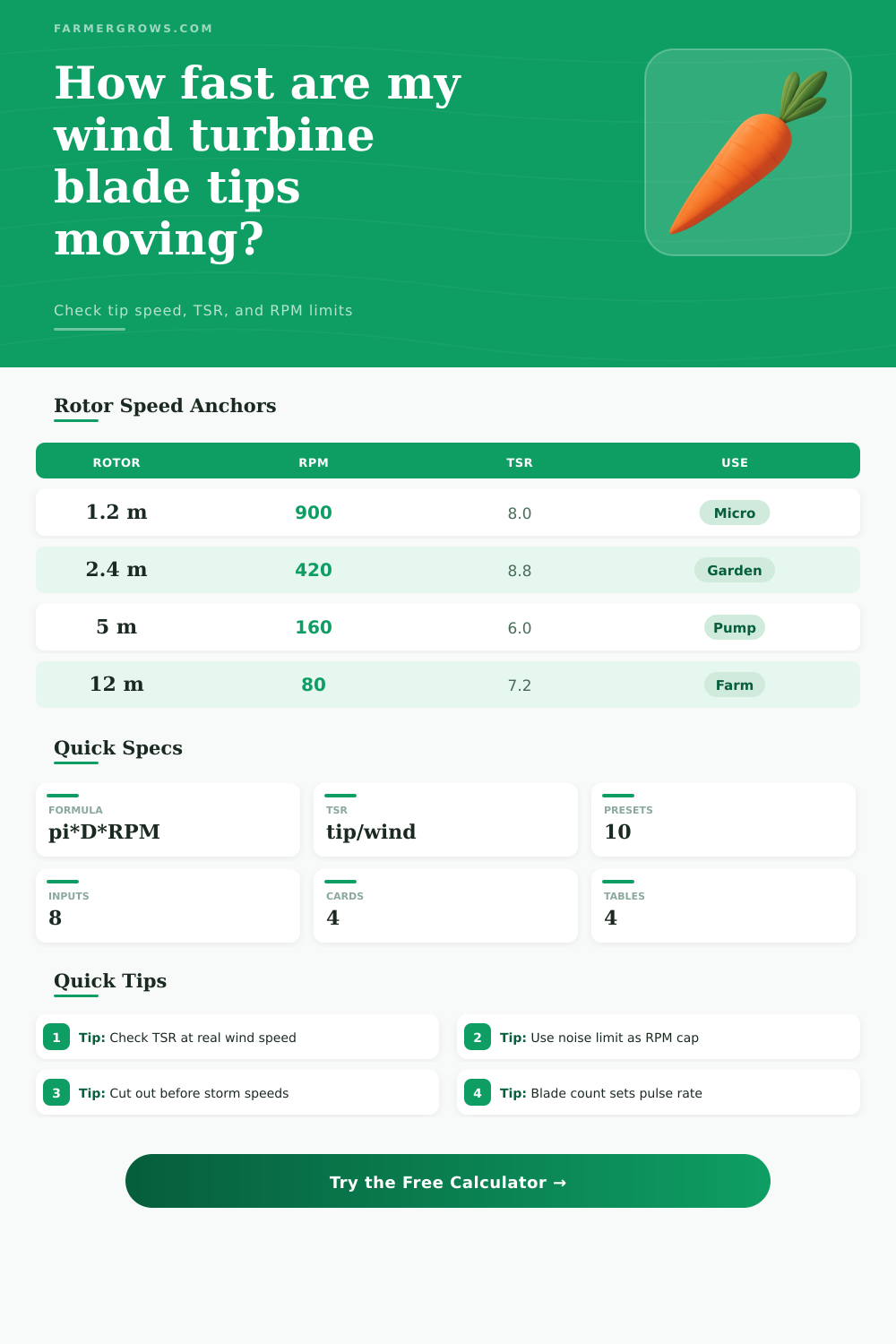
| 1.2 m | 900 rpm | 56.5 m/s | Small bench or rooftop test rotor. |
| 2.4 m | 420 rpm | 52.8 m/s | Garden or battery-charging turbine. |
| 5 m | 160 rpm | 41.9 m/s | Water pump or low-speed farm rotor. |
| 12 m | 80 rpm | 50.3 m/s | Farm-scale three-blade turbine. |
| 18 m | 45 rpm | 42.4 m/s | Large field rotor with lower shaft speed. |
| Wind condition | Typical value | Controller action | Calculator check |
|---|---|---|---|
| Below cut-in | 0 to 3 m/s | Wait or idle | TSR may look unstable at very low wind. |
| Normal production | 4 to 12 m/s | Track target TSR | Use target RPM result as a setpoint clue. |
| Strong wind | 12 to 20 m/s | Limit RPM | Noise cap RPM becomes important. |
| Cut-out range | 20 to 25 m/s | Furl or brake | Rotor should leave normal operation. |
Compare actual TSR to the blade design target before changing generator load or pitch.
Use the noise-limit RPM as a practical overspeed alarm, especially near homes or barns.
The calculation links rotor diameter, RPM, and wind speed so small wind turbine checks stay grounded in measurable tip speed, TSR, and operating wind limits.
The speed of the blades tips of a wind turbine is a critical element of the machines’ loudness and efficiency. The speed of the blade tips is important to the machine for another reason, too: the speed of the turbine blade tips affect whether the machine remains intact. In order to understand wind turbines, it is first important to understand the relationship between the rotor diameter, the revolutions per minute (RPM) of the blades, and the wind speed.
The diameter of the rotor sets the scale of the machine and determine the speed at which the blade tips travel. Machines with small rotor can achieve many RPMs, but large farm turbines have a set speed so that they remain in the same speed range as the smaller machines. The wind has the potential to move the tip of the blade of a twelve meter turbine to 80 meters per second.
How Blade Tip Speed Affects Wind Turbine Noise, Power and Safety
Therefore, the builders will establish the RPM limits of the turbines according to the size of the machines that are to be built. The tip speed ratio of a turbine (TSR) is a value that represents the number of times faster that the tip of the blade travels than the wind. Most three bladed turbines will have a TSR between six and eight.
If the TSR ratio is below six, the blades will experience less lift and more drag. If the ratio is above eight, the blades will lose power because they are traveling more fast than the wind. The actual TSR of a machine should be as close to the desined value as possible for it to function at the intended efficiency.
If not, the load on the generator will need to be adjusted or its rotor change. The noise limitation of a machine is established according to the speed of its blade tips. The faster a blade tip moves, the louder a turbine becomes.
Most small machines are limited to tip speeds of between sixty and eighty meters per second to ensure that neighbors do not hear the turbine. This limitation in tip speed will allow the builders to decide when to add furling or when to adjust the load that is applied to the machine. Such a calculation will allow builders to determine at what speed the turbine is nearing its noise limit.
Wind will move through a certain range of speeds, and the speed of the wind will determine the amount of power that the rotor will produce. Below a certain threshold of wind speed, the rotor will produce little power. However, if the wind speed is too fast for the turbine, the rotor will be damaged unless it utilizes a brake system or furling.
The operator of the machine will desire for the rotor to remain at its target TSR while the wind speed change. A calculator can help the builder to determine whether or not the machine will remain in its wind speed window based off the rotor diameter and the RPM of the blades. Additionally, the number of blades of a machine will change the blade-pass frequency, which is the pulsing sound that the blades can make as they pass the tower.
More blades will create more instances of the blade-pass frequency, so the number of blades will change the sound of the machine when it is running. The target TSR for any machine will be different than the other machines, and each manufacturer will utilize a different target tip speed ratio. Machines with many blades, such as farm pumps, will use low tip speed ratios because the pumps require a large amount of starting torque.
Fast two-blade turbines are used for other industries that have a higher target tip speed ratio because they require the increase in electrical efficiency. However, two blade turbines will have less margin for error with noise and overspeeding the blades. Vertical-axis machines will have a low target tip speed ratio because their vertical geometry creates more lift than drag.
The wind that the machine creates by the rotation of the machine is not always steady. The wind can be turbulent caused by trees or building. These turbulence spots create spikes in the speed of the wind, which allows for higher speeds of the blade tips for a few seconds.
During these few seconds, the machine can exceed its limits of noise or structural components, especially if the controller for the machine does not react quick. Therefore, the builders will monitor both average wind speed and gust factor. The geometry of a machine allow it to move through the air by sweeping the amount of wind that is in that area.
The diameter of the rotor will impact the speed of the tip. The larger the rotor, the more wind it can catch. However, a large rotor will also increase the speed of the tip of the blade.
Therefore, builders must find a balance in the size of the rotor for a machine. Small turbines create many problems when the individuals have a mismatch between the expectations of the machines and their components. For instance, the installation of a fast rotating machine in a residential area may create noise complaints when the wind speeds increases.
Additionally, the target TSR for the turbine may be established without considering the capability of the generator to absorb that much load. Issues can be eliminated by ensuring that the tip speed of the blades and the tip speed ratio are within the limits established for small wind turbines according to the wind window. Using numbers will help builders understand how fast or slow the blades of a machine will move.
In understanding the components of a turbine, it is helpful for the individuals to understand that the tip of the blade of a wind turbine is the fastest moving component of the machine. Additionally, the speed of that blade tip will have an impact upon the loading and noise of the machine. Therefore, keeping the speed of the tip of the blade in view will help the individual to understand the function of the wind turbine.
You should of looked at the tip speed to ensure its correct.