Wind Turbine Power Calculator
Estimate turbine power from rotor diameter, wind speed, air density, Cp, generator efficiency, cut-speed limits, tower exposure, storage loss, wind hours, and turbine count.
Choose a field scenario, then adjust the turbine, wind, density, cut-speed, storage, and count assumptions for the actual farm site.
Wind Turbine Power Results
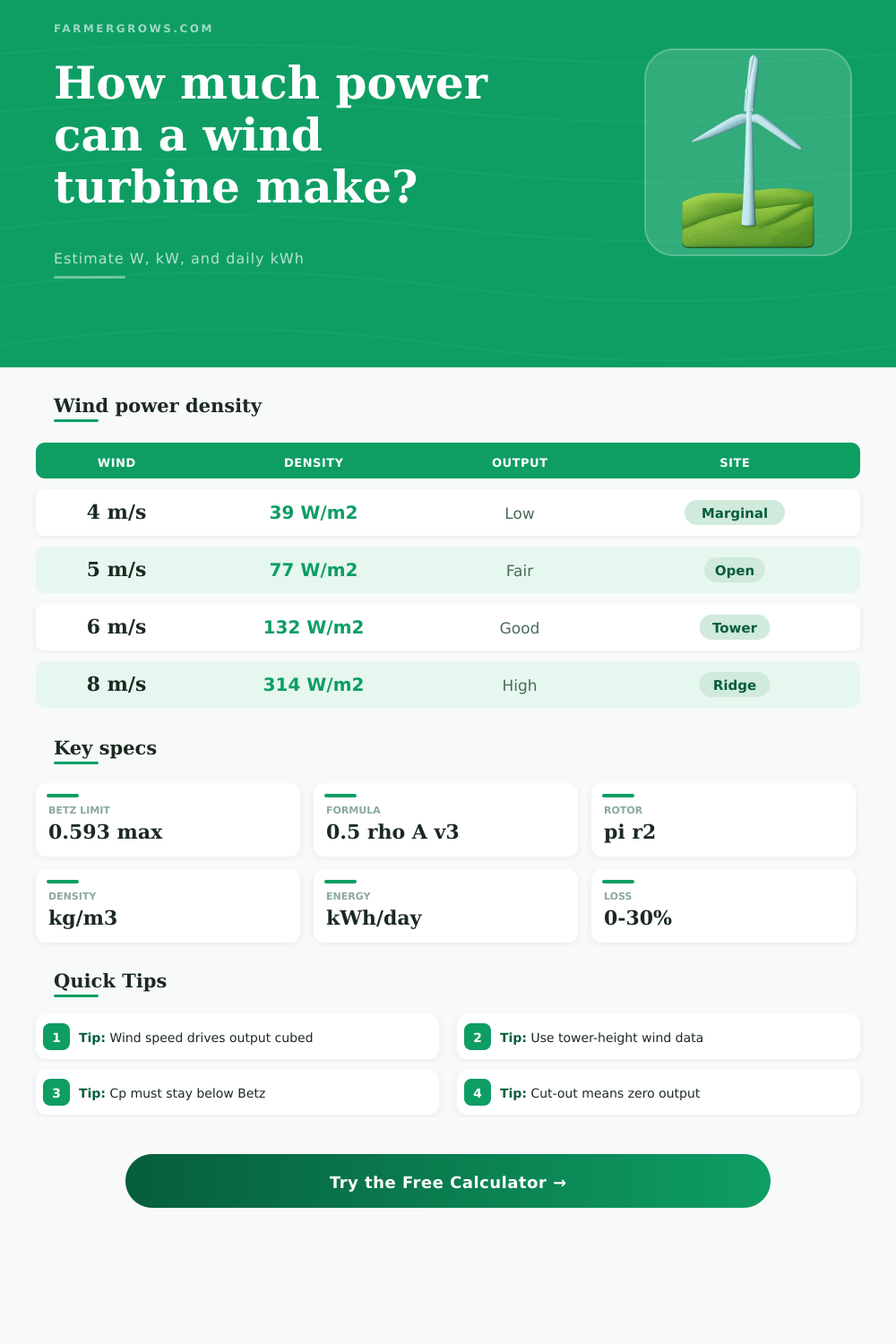
Results use P = 0.5 x rho x A x v3 x Cp x efficiency, with cut-in, rated, cut-out, exposure, battery loss, and turbine count applied.
| Wind speed at rotor | Raw power density at 1.225 kg/m3 | Typical turbine output density at Cp 0.35 and 85% | Planning meaning |
|---|---|---|---|
| 3 m/s | 17 W/m2 | 5 W/m2 | Near cut-in for many small turbines |
| 4 m/s | 39 W/m2 | 12 W/m2 | Marginal unless loads are very small |
| 5 m/s | 77 W/m2 | 23 W/m2 | Useful for battery charging at clean sites |
| 6 m/s | 132 W/m2 | 39 W/m2 | Good small-wind planning speed |
| 8 m/s | 314 W/m2 | 93 W/m2 | Strong site with much higher energy potential |
| 10 m/s | 613 W/m2 | 182 W/m2 | Approaching rated output for many turbines |
| Coefficient or loss | Common planning range | Formula role | Practical note |
|---|---|---|---|
| Betz limit | Cp 0.593 maximum | Upper physics limit | No rotor can extract all wind energy |
| Small turbine Cp | 0.25 to 0.42 | Multiplies raw wind power | Blade design, tip-speed ratio, and control matter |
| High-performance rotor Cp | 0.42 to 0.50 | Still below Betz | Use only when manufacturer data supports it |
| Generator and controller | 75% to 92% | Electrical conversion multiplier | Heat, rectifier, wiring, and charge losses reduce watts |
| Battery and inverter loss | 8% to 30% | Applied after array power | Use a higher value for battery plus AC inverter loads |
| Site condition | Approx air density | Power change vs sea level | Calculator input guidance |
|---|---|---|---|
| Sea level, 15 C | 1.225 kg/m3 | Baseline | Use standard density for cool coastal farms |
| 2,000 ft, 15 C | 1.154 kg/m3 | About 6% lower | Enter altitude for inland valleys |
| 5,000 ft, 15 C | 1.056 kg/m3 | About 14% lower | High farms need more rotor area for equal watts |
| Hot summer air, 35 C | Lower than cool air | Several percent lower | Use seasonal temperature for irrigation loads |
| Cold winter air, 0 C | Higher than warm air | Several percent higher | Useful for winter wind estimates |
| Setting | Typical value | How the calculator treats it | Farm planning note |
|---|---|---|---|
| Cut-in wind speed | 2.5 to 4 m/s | Below this, power is zero | Low cut-in helps trickle charging but does not guarantee useful kWh |
| Rated wind speed | 10 to 13 m/s | Caps output at rated-speed power | Rated output happens only during stronger wind periods |
| Cut-out wind speed | 20 to 30 m/s | At this speed, power is zero | Shutdown protects the turbine during storms |
| Rooftop turbulence | 0.80 speed factor | Reduces wind before v3 | Turbulent sites can lose much more than they appear to |
| Ridge or coastal exposure | 1.15 speed factor | Increases wind before v3 | Clean exposure can strongly improve output |
Wind turbine sizing are a complex process due to the various variable that affect the amount of electricity that a wind turbine can produce. Wind turbine produce electricity when the wind blows across the blade of the turbine. However, the amount of electricity produced by the wind turbine depend on the wind speed, the size of the rotor of the turbine, the density of the air, and the location of the wind turbine.
An understanding of the impact of each of these variable on the electrical output of a wind turbine will allow an individual to size a wind turbine to meet their specific needs. The wind speed at which the turbine is exposed to the wind is one of the primary factor that determine the amount of electricity that a wind turbine can produce. The power that the turbine produce is proportional to the cube of the wind speed.
How to Size a Wind Turbine
This indicate that the increase in wind speed will result in a much higher production of watts compared to the small increase in the wind speed. However, trees or buildings that induce turbulence in the wind can significant reduced wind speed. In this case, the placement of a wind turbine in an area with clean and uninterrupted wind flow will allow the wind turbine to produce more electricity.
The size of the rotor of a wind turbine will also significant impact the amount of electricity that it produce. The area of the rotor of the turbine will determine the amount of wind that the wind turbine can capture. The area of the rotor increase with the square of the radius of the turbine blade.
Thus, the length of the blade will significantly impact the area of the rotor. However, if the area of the rotor is too large for the available wind speed at which the turbine can turn its blade, then the increased size of the rotor will not allow the turbine to effectively produce the amount of electricity that may be required for the farms operations. However, a rotor diameter and the average wind speed can be entered into a calculation to determine the amount of electricity that the turbine can produce.
The density of the air will impact the amount of power that can be produced by the wind turbine. Dense air has a higher mass than the less dense warm air. Therefore, a wind turbine will produce more electricity when the air is denser and colder than when the air is warm.
The density of the air also change with the altitude of the location of the wind turbine. A wind turbine located at a high altitude will have less air density than one located at sea level. Thus, the less dense air will result in the production of less electricity by the wind turbine.
The power coefficient of the rotor and the efficiency of the generator will impact the electricity output of a wind turbine. The power coefficient will indicate the efficiency of the rotor in capturing the energy in the wind. The theoretical maximum limit for the power coefficient is the Betz limit, which indicate the maximum amount of energy that a rotor can extract from the wind without significant impeding the wind.
However, the blades and the control system of the wind turbine will always be below the Betz limit. Furthermore, the electricity output by a wind turbine will be less than the kinetic energy of the wind due to the inefficiency of the generator of the turbine. The cut-in, rated, and the cut-out speed of the wind turbine will impact the operation of the turbine.
The turbine will not produce electricity when the wind speed is below the cut-in speed of the wind turbine. Once the wind speed reach the rated speed, the turbine will produce a consistent amount of electricity. However, once the wind speed reach the cut-out speed, the turbine will stop its operation to not sustain damage to the components of the turbine due to the high speed of the wind.
The exposure of the turbine to the wind and the number of productive hour that the wind turbine will operate each day will have an impact on the amount of electricity that will be produced by the turbine each day. The site exposure of a wind turbine will determine the impact of the surrounding environment of the turbine on the speed of the wind that the turbine can produce. For example, an open field will have better site exposure than a rooftop.
The number of daily productive hours for a turbine will allow the turbine to produce a consistent amount of electricity based on the amount of time that the wind will be at the average wind speed for the area. These parameter must also be considered when sizing a wind turbine for a farm. Many people make mistake when sizing the amount of wind turbines that a farm will require.
One of the mistake that many people make is in measuring the wind speed at ground level rather than at the height of the blades of the turbine. The wind speed at ground level will always be lower than the speed at which the blades of the turbine will turn due to the friction between the ground and the air. Another mistake is to ignore the impact that trees and buildings have on the wind speed by ignoring the turbulence that they will create in the operation of the wind turbine.
The rotor size of a turbine that is sized without considering this factor will be too large for the available wind at the site of the turbine installation. However, correctly measuring the wind and considering the site-specific factor that may impact the performance of the wind turbine can avoid these mistake. Several scenario can be considered before the purchase of a wind turbine for a farm.
For instance, changing the size of the rotors or the height of the turbine tower can have an impact on the amount of electricity that will be produced by the turbine each day. These scenario can be simulated and used to compare the different option for the farm to determine which will prove to be the most efficient option for the farms needs. A wind turbine that is sized according to the actual wind speed at which the farm is located and according to the electrical load that must be supplied to the farm will produce the most electricity.