
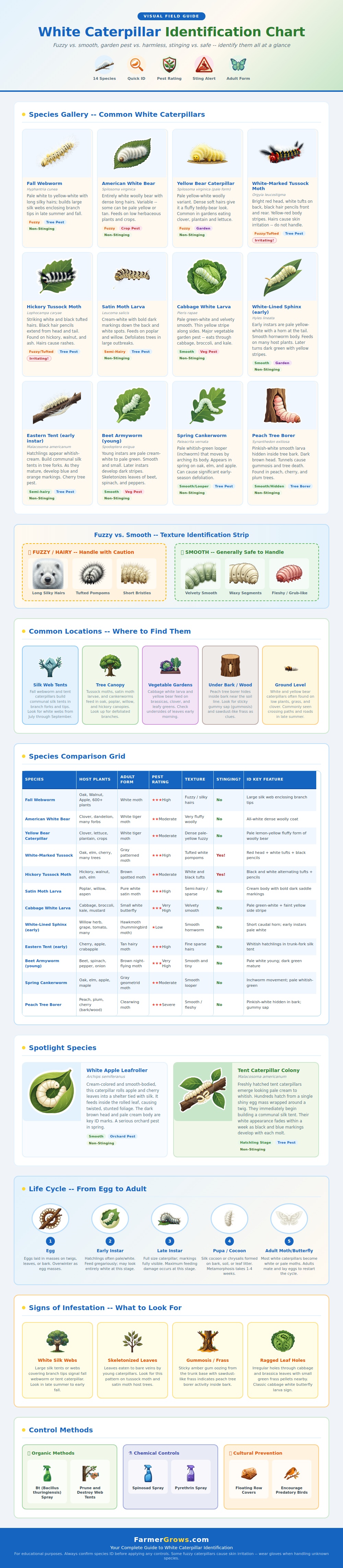
You have a white caterpillar in your garden. It’s enough to make you panic right off: Is it some harmful pest destined to chew up your broccoli crop? Or is it just harmless fluff? Or, oh my gosh, will it sting me if I try to pick it up?
The reason we’re confused: White doesn’t mean one thing, but many things; sometimes smooth and velvet, other times covered with tight, wooly hairs, still others sporting tufts of hair to tell us to keep our distance. To get sorted on them, well, you have to see beyond the color to the details of texture and context, the part of garden where it was hanging out.
How to Identify White Caterpillars in Your Garden
This is your first line of defense: the chart above divide them into those with smooth bodies and those that are fuzzy. Most fuzzy species. Those little woolly bears (are to be treated with caution); they may have urticating hairs that will send your skin itching mad. Many hairy white larvae, particularly the tussock moths, possess urticating hairs that cause severe skin irritation.
Smooth-skinned white larvae, including larval form of cabbage whites, is usually OK for us to pick up and pluck (offhand) if we must. They don’t inject anything into our skin. This means you might only need to reach for a pair of tweezers instead of spending a few minutes putting on gloves.
For instance: If it’s a white grub under the peach tree’s bark, it’s likely a borer, which is a serious structural threat to the plant. Those won’t be crawling around on the leaves; what you’ll notice first is the sawdust-like frass (the word for insect poop) at the soil line, and maybe also sticky amber sap oozing from the trunk base. It’s damage happening silently inside wood.
But if in late summer you find large silk webs encasing the tips of branches, you have either tent caterpillars or fall webworms, both social feeders who makes their own communal shelters. They’re stripping branches clean from the outside in. Knowing the nature of the webbing will help you target the control method. In many cases pruning off the tents, before they spread, is more effective than spraying.
The most obvious culprit in vegetable gardens is the smooth white larvae that eat their way through brassicas. A classic one: Cabbage white butterfly larva will begin as pale and nearly see-through creatures with a hint of yellow down the center of their body. It develops a faint yellow stripe along its side. They love to chomp away on broccoli, kale, cabbage. They are tiny and tend to hide under leaves.
Because of this, your best tool is staying watchful and inspecting them regularly. Physical barriers like row covers is great for this pest; they prevent the adult butterflies from laying eggs in the first place. Better to try to stop them than to chase after larvae when they’ve already caused some damage.
Also, many white caterpillars are paler at hatching. Species such as beetle armyworm and even the Eastern Tent Caterpillar have whitish-cream young; the darker patterns forms later in their development. So an ID guide must consider not only adults, but stages in between (life-stages that don’t always look alike!).
That’s why the chart shows you the progression, egg-to-pupa-to-moth… And why understanding it matters so much to timing your actions properly. Breaking the reproductive cycle is more effective if tackled with eggs early in spring, or cocoons later in fall, different than by targeting older caterpillars.
So in the end: white caterpillars are all just about reading the clues, what nature is showing us to help us out. Get a sense of safety from looking at the hair. The hint is that it’s either fine and feathery, or coarse (see above). Read the environment and guess the species. Observe any hints that come with them (a web), a trail of frass, some sap oozing out…
Then as you learn what each clue means, the white caterpillar mystery begins to evaporate. You no longer see a generic menace; you begin to see individual organism doing something you can predict they’ll do next. And suddenly this becomes less of a garden panic moment then simply a job to manage.
Keep your brassicas covered. Otherwise, respect those hairs and observe the trees. The peace of mind you recieve will be worth the effort of paying closer attention.