
Why should your tomatoes be sitting idle in the ground while next-door’s are growing happily? You had the same fertilizer; you both planted on the same weekend. They waited; you relied on the calendar on your phone.
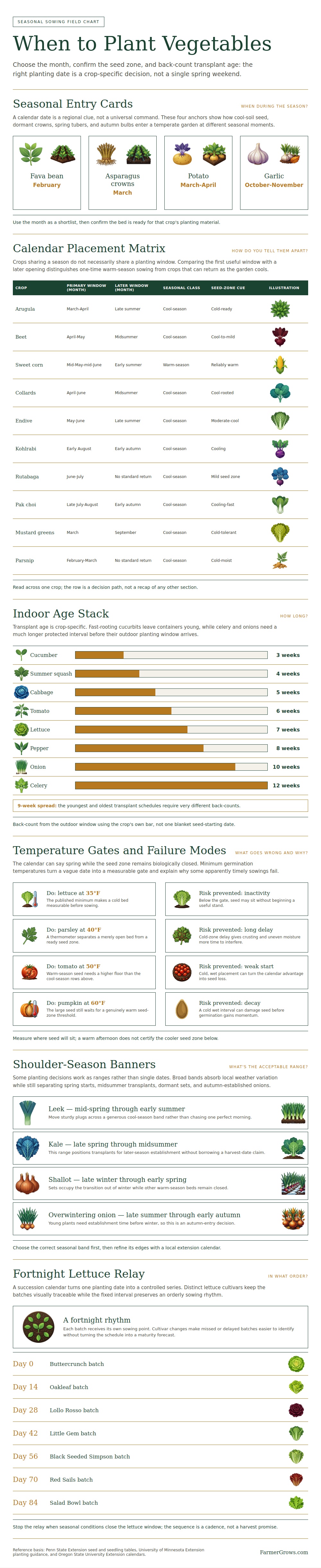
The truth: When it comes to planting veggies, temperature of the soil matter more than the date on the almanac. As the chart shows, planting by the calendar date is a regional clue, not a rule for everyone. It makes you stop thinking in terms of spring weekends and begin thinking in terms of biological readiness.
Plant by Soil Temperature, Not the Calendar
The thing about crops: They come into the garden on various schedules through the season, so there is no “one-size-fits-all” approach. A garlic bulb isn’t treated like a potato tuber. One prefers a cold shock later in the winter to set roots and wait out until spring, while the other need the ground to be thawed and warm first.
The infographic shows how things are divided into two categories. These is early cool-soil seeds versus bulbs and dormant crowns for fall planting. Why? Because you don’t want to force a warm-season crop into a still-cold bed. Match its thermal requirements to what’s realy happening in your particular microclimate, which may or may not be what the prediction says for your zip code.
OKAY, so you know the season starts when? Now, when do you start? That’s where many novice stumble, thinking you start every seed on exact same day.
In fact, there is a wide range of transplant age, from six weeks to 12 (as you can see on the visual guide). That’s a huge gap. Starting your cucumber seeds along with your celery aren’t going to work. By the time the celery gets ready, the poor roots on the cucumber plant will be bound up and already suffering.
Back-count from your local outdoor planting date, and count according to the crop’s interval. It is an easy math puzzle, but the price of not doing so are limp, straggly transplants who won’t stand much chance when moved outside.
The last check before you plant seeds is temperature. Spring may appear on a calendar, but ground remains unready, and therefore too slow to help. Some seeds, such as lettuce, will tolerate a chilly thirty-five degrees. Others, like tomatoes, requires that the soil reach at least fifty degrees.
Planting tomato seeds into cold and wet soil mean they will rot. The chart highlights this danger by associating minimums with their potential failure mode (weak starts; seed rot).
Don’t assume “Oh, today was nice and warm” just because you felt a bit of warmth against your face. Remember, the seed is actualy sitting a few inches underground. Don’t rely on feeling warm air on your face. A warm afternoon doesn’t mean there is a ready seed zone.
Others are ranges (or at least wide windows) of dates that allow for adjustments. Kale and leeks can be shifted around a big window of time; push things forward if there’s an early heatwave, back if there’s a late frost. Gardeners rejoice: this means if you’re off by a week or even two in timing the perfect day, you’re okay.
With fast crops such as lettuce you can sow in successions, a small amount every couple of weeks, and have a constant supply without overrunning your space. It’s all about working with nature, not against her.
By reading the soil, not just the calendar, you remove much of the guesswork from gardening. No more hoping; now it’s about taking action based off information. Getting it right means the difference between a compost pile and a thriving garden.
The correct planting date vary among crops.