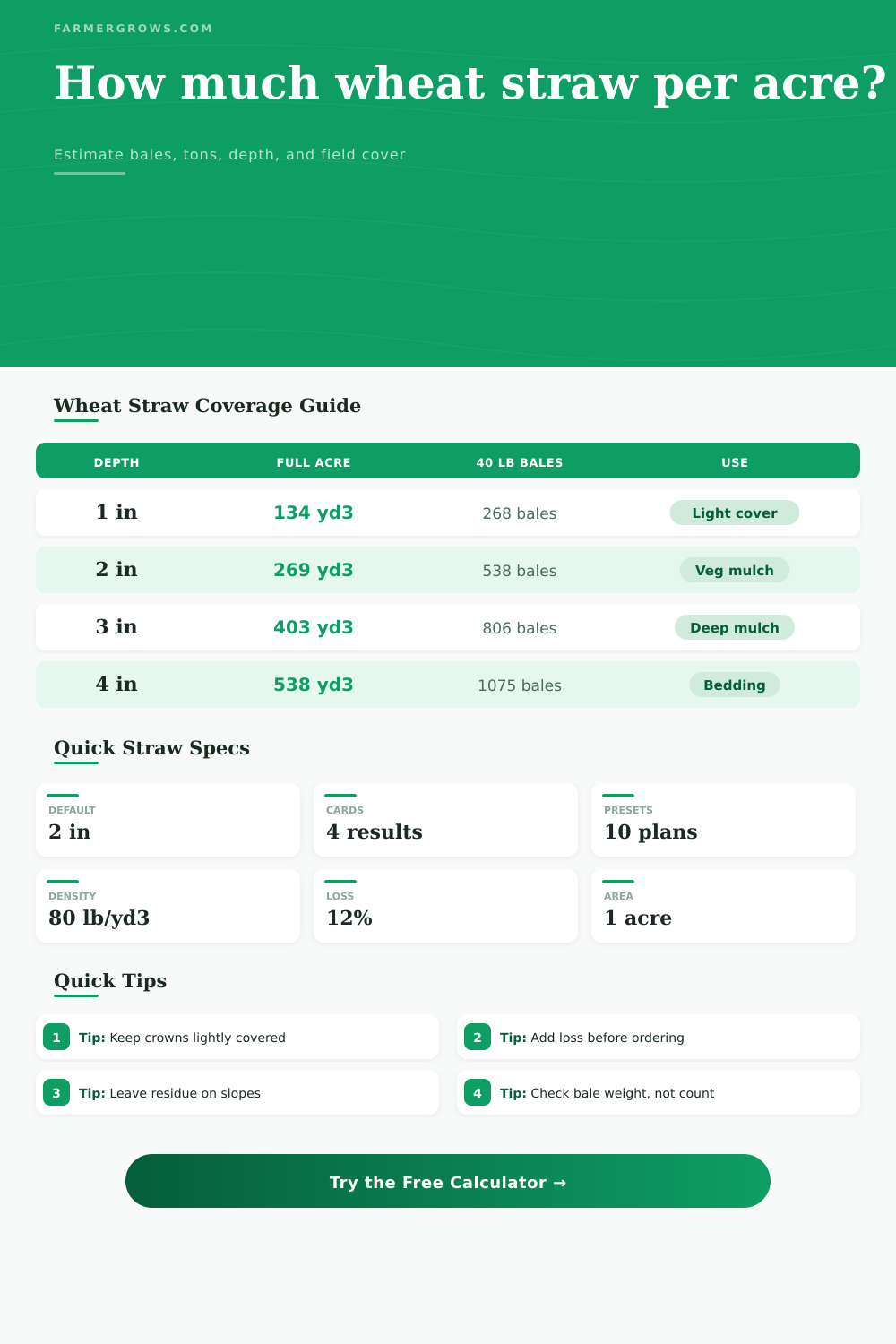
Wheat Straw Per Acre Calculator
Estimate wheat straw bales per acre for garden mulch, row mulch, erosion cover, livestock bedding, or residue planning with bale weight, bale size, straw density, chaff fraction, crop row spacing, field loss, and retention goals.
Load a wheat-straw scenario, then adjust the acres, depth, bale type, chaff, row spacing, field loss, retention goal, and use case to match the field or garden.
Wheat Straw Estimate
Your bale count, tons, volume, and residue notes will appear here.
Calculation Breakdown
Bright, hollow stems spread easily for vegetable mulch, erosion cover, and dry bedding.
Usually softer for bedding, but can mat faster in wet garden alleys.
Often finer and easier to tuck around small plants, with more awn caution.
Long, tough stems are useful for erosion and paths but can be springy.
| Loose straw depth | Volume per acre | 40 lb bales at 80 lb/yd3 | Typical use | Coverage note |
|---|---|---|---|---|
| 0.5 inch | 67.2 cu yd | 135 bales | Light soil cover | Useful for low wind and low residue removal. |
| 1 inch | 134.4 cu yd | 269 bales | Erosion or seed cover | Best when crimped, pinned, or sheltered. |
| 2 inches | 268.9 cu yd | 538 bales | Vegetable mulch | Common between rows and around transplants. |
| 3 inches | 403.3 cu yd | 807 bales | Deep garden mulch | Add more only where crowns stay uncovered. |
| 4 inches | 537.8 cu yd | 1076 bales | Bedding layer | Often better in bands, pens, or high-traffic zones. |
| Bale type | Common dimensions | Typical wheat straw weight | Compressed volume | Planning note |
|---|---|---|---|---|
| Small square | 14 x 18 x 36 in | 35 to 45 lb | 5.25 cu ft | Easy to flake around garden rows. |
| Small square | 16 x 18 x 36 in | 40 to 55 lb | 6.0 cu ft | Good default for hand labor estimates. |
| Big square | 3 x 3 x 8 ft | 500 to 750 lb | 72 cu ft | Efficient for acre-scale applications. |
| Big square | 3 x 4 x 8 ft | 700 to 1000 lb | 96 cu ft | Needs equipment but reduces bale count. |
| Round bale | 5 x 6 ft | 900 to 1400 lb | 141 cu ft | Unrolls well for bedding or large mulch strips. |
| Crop row spacing | Mulched band | Acre coverage factor | Where it fits | Straw handling note |
|---|---|---|---|---|
| 12 in | 8 in | 67% | Garlic, onions, tight beds | Use lighter flakes to avoid crown burial. |
| 18 in | 12 in | 67% | Strawberry and intensive vegetables | Pull straw around plants after settling. |
| 30 in | 18 in | 60% | Tomato, pepper, brassica rows | Good balance between weed control and bale count. |
| 36 in | 20 in | 56% | Sweet corn, squash, pumpkins | Spot mulch rows and keep traffic alleys open. |
| 60 in | 24 in | 40% | Vine crops and wide paths | Use wind protection until straw locks down. |
| Goal | Planning range | Why it matters | Calculator input | Field note |
|---|---|---|---|---|
| Low erosion risk | 25 to 35% retained | Keeps some cover after harvest | Retention goal | Better on flat, protected ground. |
| Moderate cover | 40 to 55% retained | Supports soil moisture and trafficability | Retention goal | Useful after heavy residue removal. |
| High erosion risk | 60 to 80% cover | Protects slopes and bare seedbeds | Erosion cover % | Consider crimping or anchoring straw. |
| Garden mulch | 2 to 3 in layer | Weed suppression and splash control | Desired depth | Keep straw away from stems and crowns. |
| Bedding pack | 3 to 5 in layer | Absorbency and comfort | Use case | Depth depends on stocking and cleanout cycle. |
Two loads with the same number of bales can cover differently if one has lighter bales, more chaff, or weathered outside layers. Weigh a few bales and inspect flake quality before scaling to acres.
When wheat straw is removed from the same field, keep enough residue for slope, soil texture, and wind exposure. The retention check shows when the planned removal is likely too aggressive.
So there you are with the truck three miles out of reach and you look at what’s supposed to be your vegetable garden, all weeds and nothing but dry dirt.
Oh no! Do I have time for another couple bales of wheat straw? Or should of I ordered twenty? No guessing required; that’s when folks gets out the calculator instead of the pencil and paper. It’s the tool above, which turns imprecise feelings of desire (to control weeds) into precise numbers (of bales). A fuzzy hunch becomes an actual to-do list.
How to Use the Straw Calculator
It all begins with a mental picture: fat mulch. And wheat straw compact fast as soon as it touches the ground. After just rain or footsteps, what was a couple inches may be an inch deep. Tweak desired thickness setting on the calculator.
If your tomato rows is spaced 30 inches apart, for example, don’t pile over the bare earth between the rows. Just cover area where the tomatoes themselves will grow (the “bands”). Choosing this option for just the rows alter the calculation. You do not need to fill in unused space between crops. It is a minor detail but it saves you from lifting and spending.
The assumptions can be wrong, which leads to problems with Bale weight. Common small square bale are said to be 40-pounds. How much moisture? Where are they stored? A dry bale of straw weighs less than a wet one that holds roughly the same volume. To get enough straw to hold together your pile you’ll need more dry bales.
Your supplier may sell 50 pound squares. If you use the default value of forty pounds in the calculator, you’ll end up under ordering.
You can tweak chaff percentage and density. Chaff doesn’t do much good to anchor a slope since it just blows away in the wind.
Every project has a hidden tax called field loss. A few flakes blow off the wagon. Some of them kicks up as you put your boots down. Others flake apart as you pry them loose from a tight net. The calculator accounts for this loss with a default of about twelve percent. Go ahead and raise that number if you’re doing work on a windy hillside. Better to order too much then to come up short partway through the job.
Farmers growing their own wheat has to worry about residue retention: If you haul too much straw off your field, you’ve left the ground bare. The tool will check your removal rate against a retention goal and warn you if you’re taking more than the land can afford to give.
Do you want big rounds or little squares? That’s a matter of what tools you have. Little square bales is good for precise placement around delicate plants. It takes a lot of trips to the truck. Big round bales are great for wide expanses. They are difficult to squeeze into a narrow garden bed.
The grid comparing barley, oat, and wheat straw explains the pros and cons of each type. Wheat holds its shape longest; oat straw mats down fastest. You get longevity of coverage vs. It is easy to handle.
When it comes to applying the straw, there’s an aesthetic component as well as a functional one: How much should you apply, and what balance will work best? Apply enough to block out the sun, keep things cool, and stay weed-free, but do not make it so thick that you smother the crowns of your garlic or provide slug habitat.
Use the calculator to get started. Then use your hands (and eyes) to adjust from there. Get the numbers. Get the straw down. Let it settle a while. Adjust accordingly: Add where the ground is still hot and dry; pull some back where the plants crave air.
Have confidence that the math was only the starting line.