Well Water Flow Rate Calculator
Turn a timed bucket test, a pump log, or a casing recovery test into a practical flow rate so you can compare well yield with demand.
This calculator gives a field-friendly yield estimate. Use repeated readings and the same container, then compare the conservative flow against your real water demand.
Volume and time drive bucket and pump log checks. Diameter and rise drive casing recovery checks. Use the same units for each test and repeat the run if possible.
Flow Estimate
These numbers combine the active test method with a conservative design buffer so you can compare yield to real demand.
| Test type | Volume | Time | Result |
|---|---|---|---|
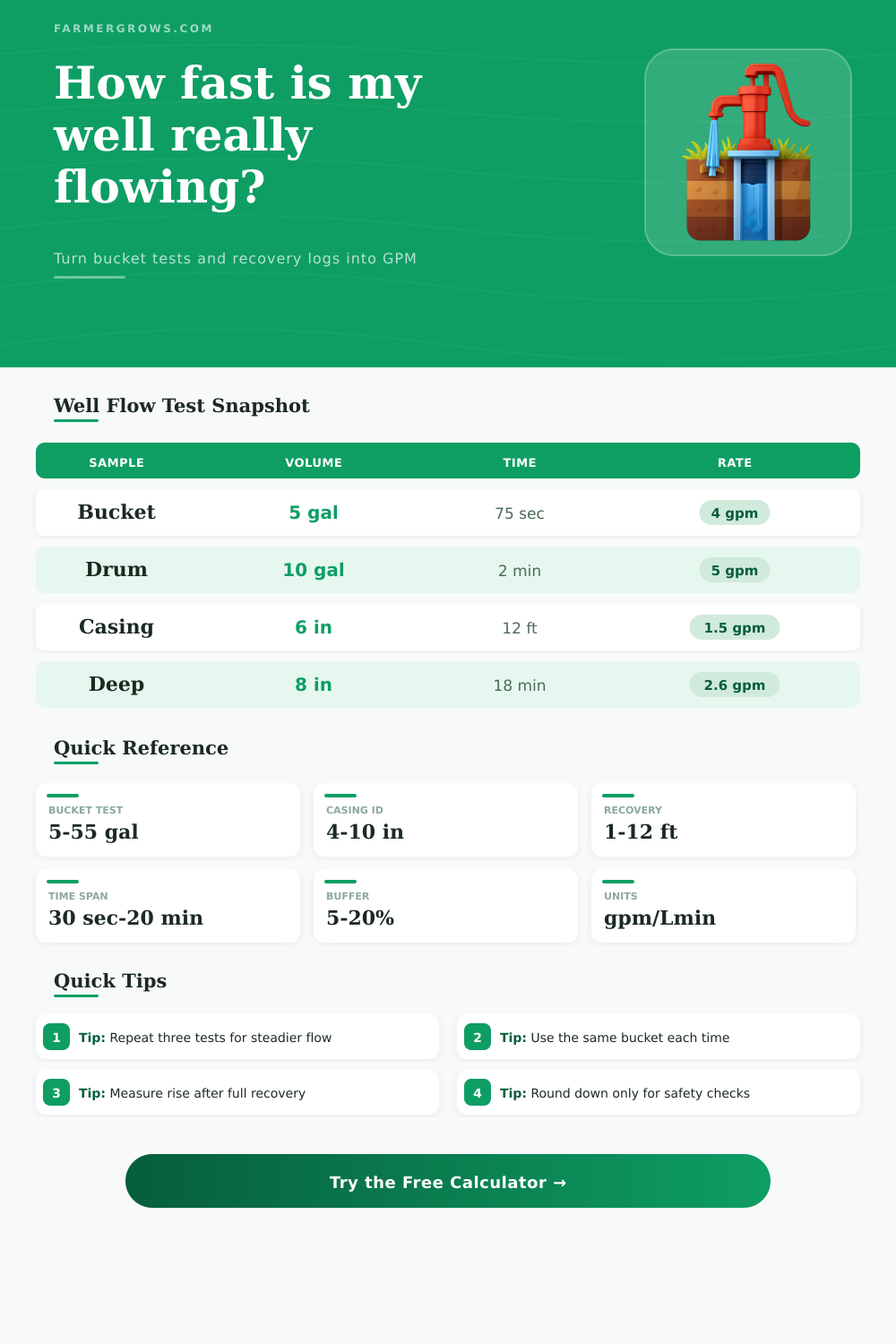
| 5 gal bucket | 5 gal | 75 sec | 4 gpm |
| 10 gal drum | 10 gal | 2 min | 5 gpm |
| 55 gal drum | 55 gal | 9 min | 6.1 gpm |
| 100 gal log | 100 gal | 8 min | 12.5 gpm |
| Casing | Gal / ft | L / m | Note |
|---|---|---|---|
| 4 in | 0.65 | 8.1 | Tight bore |
| 6 in | 1.47 | 18.3 | Common home |
| 8 in | 2.61 | 32.4 | Farm size |
| 10 in | 4.08 | 50.7 | High volume |
Check: Use the same container and stopwatch for every pass so the average stays honest.
Watch: Let the well recover fully before you time the next rise, or the rate will read low.
Use this calculator to read a well in the field, compare the measured yield with household demand, and decide whether you need storage, a slower pump, or a deeper review.
Flow rate is the measurement of how much water a well can provide in a specific length of time. Flow rate is an important measurement for determining if a well can meet the demands of a household or farm. Flow rate can be measured using several different methods, including the bucket method, the recovery test, and the pump log method.
The bucket method is one of the simplest methods of measuring flow rate. The bucket method is useful in that it is easy to perform. To use the bucket method, you must use a container of known volume to collect the water from the well.
How to Measure Well Flow Rate
A stopwatch will be required to measure how long it takes to fill that container with water from the well. The bucket method should be performed several times. By only performing the bucket method once, errors can occur due to the presence of air bubbles within the container.
After performing the bucket method several times, you can calculate the average time it takes to fill the bucket. Dividing the volume of the bucket by the average time required to fill the bucket will reveal the flow rate of the well in the unit of gallons per minute. The recovery test is a second method of measuring flow rate.
Individuals who find it difficult to catch the water that flows from the well often use recovery tests. To perform a recovery test, you must measure the amount of feet that the water level within the casing of the well rises over a specific length of time. You must know the inside diameter of the well casing to calculate the volume of the water that was extracted from the well.
Using an incorrect measurement of the inside diameter of the well casing will result in calculating the flow rate of the well incorrect. Using a calculator, the rise of the water level in the well casing in feet and the inside diameter of the casing can be made into an equivalent flow rate of the well in gallons per minute. The third method of measuring flow rate is called the pump log method.
Pump logs are useful because it measure the flow rate of the water that is being used. To use a pump log, you must record the total number of gallons that are delivered to some destination. You must also record the number of minutes that it took to deliver those gallons.
Dividing the total gallons of water that were delivered by the number of minutes that it took to deliver that water will result in the flow rate of that well. You can make the calculated flow rate of the well more accurate by applying a safety margin to the flow rate calculations. Before applying a safety margin of 15% to the flow rate calculations, the flow rate should first be calculated.
If, for instance, the flow rate of a well average 5 gallons of water per minute, applying a fifteen percent safety margin will result in a flow rate of 4.25 gallons per minute. This flow rate will account for possible dry seasons in the area and wear on the pumps. Thus, using the calculated flow rate that includes the safety margin will ensure that the well can meet the demands of the individuals in the household.
Flow rates have certain categories that classify the strength of the flow rate of a well. Flow rates that are under 3 gallons of water per minute may be sufficient for supplying water to small livestock. However, if an individual is using a flow rate of under 3 gallons of water per minute, the individual will need large storage tanks for the water.
Flow rates between 3 and 5 gallons of water per minute can supply water for a small cabin. However, you must monitor the flow rate of water per minute during peak hours. Flow rates between 5 and 10 gallons of water per minute are sufficient for a typical rural household.
Flow rates of over 10 gallons of water per minute are able to supply water for irrigation of farms, or for large families living in a household. There are several methods that can be used to measure the flow rate of a well. However, there are also mistakes that can be made during the process.
One common mistake is rushing to measure the flow rate of the well before it has had time to fully recover. If an individual measures the flow rate of the well before it has recovered, it is possible that the flow rate will be lower than the actual flow rate of the well. Another mistake is not performing the bucket method enough times.
Only performing the bucket method once will introduce errors. A third mistake is guessing the inside diameter of the casing of the well instead of taking the precise measurement. A fourth mistake that can be made is only performing the flow rate measurements once.
Instead, three measurement should be taken of flow rate from the well. In many instances, storage tanks can be used in conjunction with a well that has a low flow rate. The storage tank can collect water, ensuring that there is a large amount of water that can be used during periods of high demand for water.
Additionally, the type of pump that is used can impact the performance of the well. A large pump may not be appropriate for a well that has a low flow rate. Instead, a small pump may be better for that type of well.
Finally, another consideration for the management of a well is the availability of water. Availability of water may change throughout the year, as water levels in the aquifer may drop during the summer months when water demands are high. Another consideration for wells and flow rates is to ensure that the flow rate of the well is matched to the demands of the individuals in that household and the livestock on the farm.
For instance, a family may require between 50 and 70 gallons of water per person per day. However, the flow rate of water must be able to meet the demands of the individual during periods of heavy shower and faucet use. If there is livestock in the household, the flow rate will need to be able to supply water continuously to that livestock.
Finally, if there are plans to grow crops or raise vegetation in a garden, the flow rate will need to be high enough to water that area at a flow rate of 10 gallons of water per minute or more. Thus, ensuring that an individual understands the flow rate of their well will allow them to plan for these various demands.