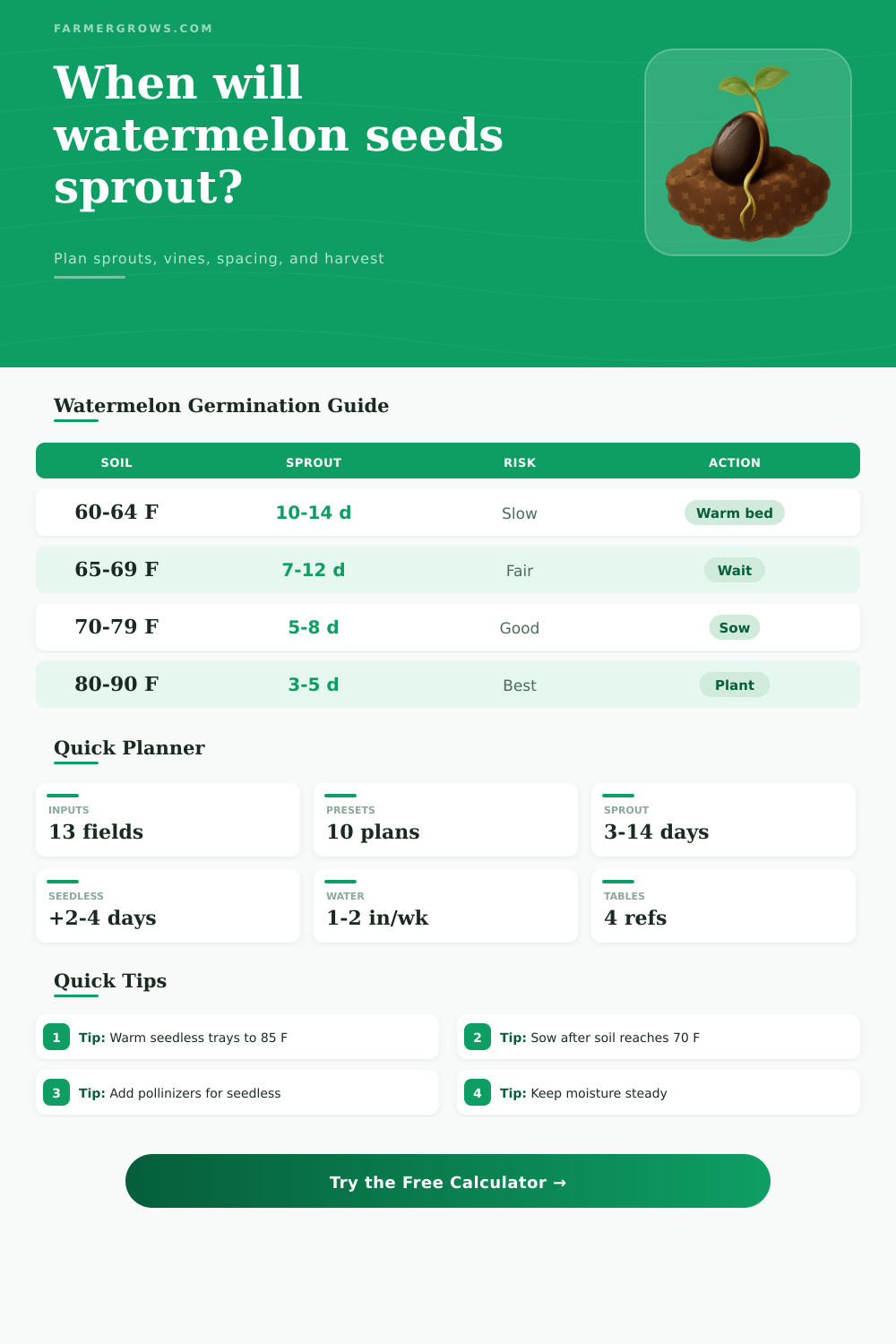
Watermelon Seed Germination Time Calculator
Estimate watermelon sprout dates, transplant timing, vine fill, harvest range, row spacing, pollinizer count, frost-free fit, and weekly irrigation from your seed plan.
Watermelon seed timing changes quickly with soil warmth. Use this planner for direct sowing, indoor starts, or transplanting so the crop has enough warm frost-free days to fill vines and mature fruit.
Watermelon Seed Schedule Estimate
Results combine soil-temperature germination, watermelon type, direct sow or transplant timing, frost dates, spacing, pollinizers, and irrigation coverage.
Sow watermelon outdoors after frost danger passes and the seed zone holds near 70°F or warmer.
Start indoors about 2 to 3 weeks before setting out, then transplant gently without disturbing roots.
Triploid seed needs extra warmth, careful moisture, and nearby seeded pollinizer plants for fruit set.
| Soil temperature | Expected sprout time | Watermelon response | Planning note |
|---|---|---|---|
| Below 60°F | Often 14+ days or failure | Too cold for reliable emergence | Wait, warm the bed, or start indoors. |
| 60–64°F | 10–14 days | Slow and uneven | Use protection and avoid seedless direct sowing. |
| 65–69°F | 7–12 days | Fair for seeded types | Borderline for triploid seedless seed. |
| 70–79°F | 5–8 days | Good emergence | Good outdoor sowing range for most gardens. |
| 80–90°F | 3–5 days | Fastest practical range | Best for seedless trays and quick stands. |
| 91–95°F | 4–7 days | Warm but usable | Watch moisture closely in trays and beds. |
| Melon type | Days to harvest | Typical spacing | Seed note |
|---|---|---|---|
| Seeded picnic | 80–90 days | 5 to 6 ft rows, 42 to 60 in plants | Reliable direct sow once soil is warm. |
| Seedless triploid | 85–95 days | 6 to 8 ft rows, 36 to 48 in plants | Start warm and include pollinizers. |
| Icebox | 70–80 days | 4 to 6 ft rows, 30 to 42 in plants | Good for shorter seasons and small beds. |
| Mini personal | 65–75 days | 3 to 5 ft rows, 24 to 36 in plants | Fastest watermelon schedule in this calculator. |
| Yellow flesh | 75–90 days | 5 to 7 ft rows, 36 to 54 in plants | Use variety maturity for final harvest checks. |
| Large or giant | 90–110 days | 8 to 10 ft rows, 60 to 96 in plants | Needs a long frost-free window and wide rows. |
| Planting route | Best timing | Germination target | Risk to watch |
|---|---|---|---|
| Direct sow outdoors | After last frost plus warm soil | 70°F+ soil for a steady stand | Cold rain can delay or rot seed. |
| Start indoors | 2 to 3 weeks before transplanting | 80–90°F tray warmth | Old transplants stall after setting out. |
| Set transplants | After frost and soil near 70°F | Already emerged seedlings | Root damage slows vine fill. |
| Seedless crop | Warm tray plus seeded pollinizer | 85–90°F is preferred | No pollinizers means poor fruit set. |
| Spacing and water item | Common range | Calculator use | Field note |
|---|---|---|---|
| Rows | 4 to 10 ft apart | Estimates planted area | Wider for large vines and equipment. |
| Plants in row | 24 to 72 in apart | Estimates plant count | Closer spacing suits mini and icebox types. |
| Seedless pollinizers | 20% to 33% | Estimates pollinizer plants | Plant pollinizers throughout the block. |
| Irrigation plus rain | 1 to 2 in per week | Converts to gallons weekly | Drip keeps foliage drier and moisture steadier. |
Warm seedless seed first: Triploid watermelon seed is less forgiving than seeded melon seed. Use warm media, steady moisture, and gentle transplanting to avoid a thin stand.
Match harvest to frost-free days: A sprout date is only useful if the vines also have enough warm days to flower, fill fruit, and ripen before fall frost.
When you get your first slice of homegrown watermelon, you want it sweet and crisp… But to get there takes more waiting then the number of days on seed-packet calendar. There’s a mathematical formula to the sprouting time that seems random until you realize that most of it has to do with concept of thermal energy: Seeds don’t count days; they count warmth. When we plan our garden layout, few of us accounts for that reality.
The one major variable in equation is soil temperature. Even with prime seeds, if the soil isn’t maintaining a minimum of about seventy degrees F around planting depth, you’re sitting there waiting to rot. Why? Because cold soil slow the metabolism that causes a seed to swell and then burst open. Below sixty-five degrees, germination becomes hit-or-miss and is not reliable.
How to Grow Sweet Watermelons at Home
Enter the calculator above, which does the math for you (turning raw temperature data into real calendar days for sprouting and harvest). No more guessing how much longer a chilly late spring will delay you.
The entire timing is altered depending on whether I want to start my seed indoors, or just direct sow. While direct sowing seem easier, it requires ideal conditions at the time of planting. A cold snap just after sowing can cause the seeds to sit and cook in the sun till they rot, or get carried off by ants. By starting them indoors, I have a jumpstart on things; but watermelons is famously tender about having their roots disturbed. They do not like being transplanted. If you wait too long to transplant them, the roots will wrap around the pot and becomes stressed as soon as they hit loose soil.
The tool takes the last frost date and how long you plan to keep your seedlings indoors into account to help me weigh those risks, and visualize the tradeoff of starting early versus stressing the plant.
Not all watermelons grows at the same pace. Some, like the giant heirloom type; can reach full size on the plant (i.e., finish swelling) in over three months, whereas some (such as the icebox types) will get there within only 70 or so. That makes a big impact when you’re gardening in short-season zone. Don’t assume that a big old picnic-type variety and a miniature personal-sized one will be interchangeable inputs! And again: Use the table on the page to compare the window of each variety and see where they differ, genetically.
Got your heart set on that perfect juicy crunch for that July barbeque? Planting too late and then choosing a slow variety is a formula for frustration. You have to match the timing of your local climate to the internal clock of the crop itself.
The other silent factor of equal importance is irrigation. Steady moisture while young vines are establishing their root systems is essential. But soggy feet are not what they love, and excessive water early on can cause fungal problems that will kill the stand long before it has any chance to get going. Once those flowers emerge, though, steady watering again takes center stage, as drought stress stop the development of fruit. Depending on row spacing and target precipitation, the calculator will help you figure out how many hose runs (or drip line installations) you’ll have to budget in each week.
It’s not all about keeping things alive, it’s also about improving the conditions, so that they don’t have to spend precious energy struggling for survival.
“Then there’s the complexity of seedless watermelons, which are triploid, meaning they can’t pollinate themselves and require nearby seeded types to do so. So not only is it a question of space, but also one of ecology. Companion planting is important. Planting pollinizers, typically a quarter of total block (is key to good fruit set). If you don’t get the companion planting right, what you’re left with is vines, and no melon. It is a tiny bit of logistic detail, but it makes or breaks the crop.
In the end: Working alongside nature (not controlling it) is what the whole point of gardening is all about. If you know the characteristics of the varieties you’re growing; if you know when frost might still occur; if you know your soil’s heat units, you’ll translate hope into a plan. And then once you get going from there, the rest of the season goes so much more smoothly. It’s not a battle with the calendar anymore; more like working with it… And that’s where we recieve that great prize of homegrown fruit on our own doorstep.