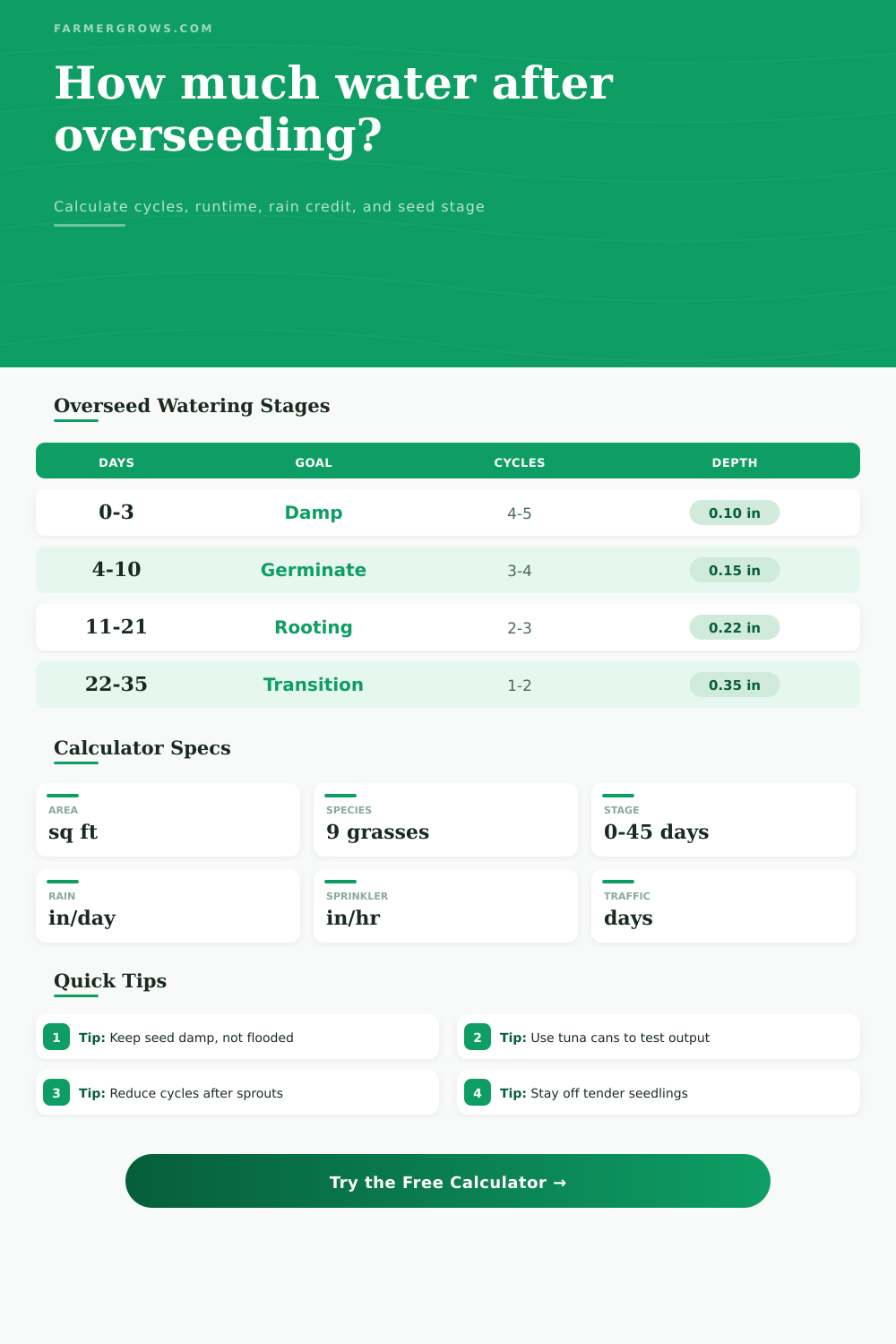
Watering After Overseeding Calculator
Estimate watering after overseeding by lawn size, grass species, seed age, soil texture, aeration, seedbed cover, rainfall, sprinkler output, daily temperatures, and traffic restriction needs.
Choose a realistic lawn situation, then adjust the sprinkler rate, rainfall, soil, cover, and temperatures for your own overseeded area.
Water just enough to keep the upper seedbed evenly damp without washing seed into low spots.
Most cool-season seed needs repeated short cycles while shallow roots are still forming near the surface.
Shift toward fewer, longer cycles as sprouts appear, especially on loam and clay that hold moisture longer.
Begin training roots downward by watering less often while still preventing wilt in hot or sandy areas.
Watering Schedule Estimate
Your overseeding watering schedule will appear here.
| Grass species | Typical germination | Early water behavior | Traffic restriction cue |
|---|---|---|---|
| Perennial ryegrass | 5 to 10 days | Fast sprouting, moderate daily demand | Restrict until first mowing, often 14 to 21 days |
| Annual ryegrass | 5 to 10 days | Fast cover, similar to perennial rye | Light traffic after seedlings anchor |
| Tall fescue | 7 to 14 days | Needs steady moisture through the second week | Restrict 21 to 28 days when possible |
| Fine fescue | 10 to 14 days | Keep moist longer in shade and cool weather | Use gentle traffic until roots knit |
| Kentucky bluegrass | 14 to 30 days | Longest cool-season moisture window | Restrict longer because seedlings arrive slowly |
| Bermuda seed | 7 to 21 days | Needs warm soil and frequent light water | Restrict through early runner development |
| Zoysia seed | 14 to 21 days | Slow start; avoid drying during hot afternoons | Restrict until coverage thickens |
| Bahia seed | 14 to 28 days | Slow and uneven; patience helps | Restrict longer on sandy, sunny sites |
| Condition | Calculator effect | Best cycle style | Watch for |
|---|---|---|---|
| Sandy soil | Adds water and cycles | Short and frequent | Edges drying before noon |
| Loam soil | Baseline schedule | Balanced cycles | Uneven sprinkler overlap |
| Clay soil | Reduces speed, splits cycles | Short cycles with soak breaks | Puddling, shine, or runoff |
| Core aerated | Slightly better infiltration | Normal cycles | Dry plugs on exposed ridges |
| Heavy thatch | Raises need for water to reach seed | Light repeat cycles | Wet thatch with dry soil below |
| Compost or peat cover | Reduces evaporation | Fewer light cycles | Cover staying soggy overnight |
| Sprinkler rate | 0.05 inch cycle | 0.10 inch cycle | Best use |
|---|---|---|---|
| 0.25 in/hr | 12 min | 24 min | Slow rotors or low pressure zones |
| 0.45 in/hr | 7 min | 13 min | Typical mixed home sprinkler layout |
| 0.75 in/hr | 4 min | 8 min | Spray heads or tight square coverage |
| 1.00 in/hr | 3 min | 6 min | Fast sprays, watch runoff carefully |
| 1.50 in/hr | 2 min | 4 min | Very fast output, split into repeats |
| Days after seed | Target depth per day | Typical cycles | Practical note |
|---|---|---|---|
| 0 to 3 | 0.08 to 0.12 in | 4 to 5 | Keep the seedbed damp and avoid heavy runoff. |
| 4 to 10 | 0.12 to 0.18 in | 3 to 4 | Most ryegrass and fescue seed is germinating now. |
| 11 to 21 | 0.18 to 0.25 in | 2 to 3 | Move from misting toward deeper root watering. |
| 22 to 35 | 0.25 to 0.40 in | 1 to 2 | Train roots downward while seedlings thicken. |
| 36 plus | 0.50 to 0.75 in | 1 as needed | Water less often and check wilt, weather, and mowing height. |
Use a catch-can test: set several straight-sided cans in the sprinkler zone, run for 15 minutes, average the depth, then multiply by 4 to estimate inches per hour.
Change the schedule when seedlings appear: once the lawn has visible sprouts, reduce tiny surface misting and begin using longer cycles that encourage roots to move down.
This calculator estimates irrigation depth for overseeding. Adjust for local watering restrictions, soil moisture by touch, runoff, disease pressure, and any seed label directions.
Scattering grass seed feels like the hard part is over, but you have actualy just started the hardest part. What happens right after is what usually makes all the difference between a lush carpet of green and a scabby mess.
Like planting any flower, most homeowners think, “I planted my seed; now I’ll just water one time per day and see how things go.” Wrong: Grass seed isn’t like other seeds. For one thing, it needs light but constant moisture to show it is awake and ready to grow. As it grows, it need deep soakings rather than light ones to encourage root growth. Either you’ll drown the seed in standing water or dry it to a crispy husk. Get the timing off by even a bit, and forget about it.
How to Water New Grass Seed
Enter the calculator above, where you input the output of your sprinklers and square footage of the area being reseeded, and let the math do its magic, and spare yourself the guesswork of conversions and coefficients.
You don’t wash out the seed coat, the first couple of days it’s all about keeping it damp without washing it away. Keep the top half inch of soil wet (not soaked), and repeat as needed. Water more often if ground is sandy, as it will drain quickly. Water less often if it’s clay; water lasts longer there, but then the mud seals the surface and drowns the emerging seeds. It isn’t the species of grass that counts at this point, but the type of soil. This is why the tool factors in soil type to adjust the number of cycles: Is yours slow-absorbing clay or quick-draining sand? That little detail makes all the difference between water soaking in or running off.
Too soon, too hard is how most people water. Seeing patches of dryness, they go full-blast on the sprinkler for 20 minutes nonstop, killing those shallow rootlets and inviting disease. The right way to do it is detailed on page’s reference table, gradually moving from spritzing to deep-soaking as seedlings settles into place.
From about day four onward, after the radicle pushes through, that baby seed is at risk of drying out, requiring only light watering several times daily. By about day ten (when it shows its first true leaves), you’ll begin reducing the frequency but lengthening each session. That tells the plant: Go deeper with your roots; find firmer footing! Keeping top constantly wet will make the roots stay near the surface, making lawn weak when the first summer heat wave arrives.
Another variable is rain credit, which changes the daily calculation. Half an inch of steady rain means no watering with the sprinkler; otherwise you’re adding artificial water on top of nature’s contribution, just wasting money and water. This gets factored out of the daily target by the calculator, so you’ll have a net requirement rather than a hard-and-fast schedule. Again, look at total moisture, not just what the timer says.
Also, what are you growing in? Cover affects the mix. Heavy thatch is a common problem that holds water above the seed bed, where it does nobody any good. Straw or compost will hold moisture longer, meaning you can go longer between waterings.
Foot traffic is the quiet assassin of newly sown seeds. That’s because feet compact soil and knock up any shallow roots that haven’t yet had time to set themselves down. Wait ’til the young lawn is strong enough to bounce back; with most species that’s a couple weeks (and sometimes three). Fast-sprouting ryegrass wants protection; slower-to-come-up bluegrass will be tough once up. The tool considers all that time, and tells you when you should of expected to resume full-on use.
Patience isn’t just a virtue; it’s also part of the plan. Haste makes waste…as in bare spots that need even more seed (and water) to mend. It’s a dance between you and the weather called overseeding. To which I say: “You got the temperature; I’ll give you the rain.”
How? Feed them regularly and consistently; they just need moist (not soaked) soil, and then they take over. Start light, go deeper, and let the roots do the work. It’s not about drowning your lawn, it’s about having one that needs no help except from you, because it’s already healthy. A green yard by summertime is in store for you if you keep the seed moist, not swimming in water.