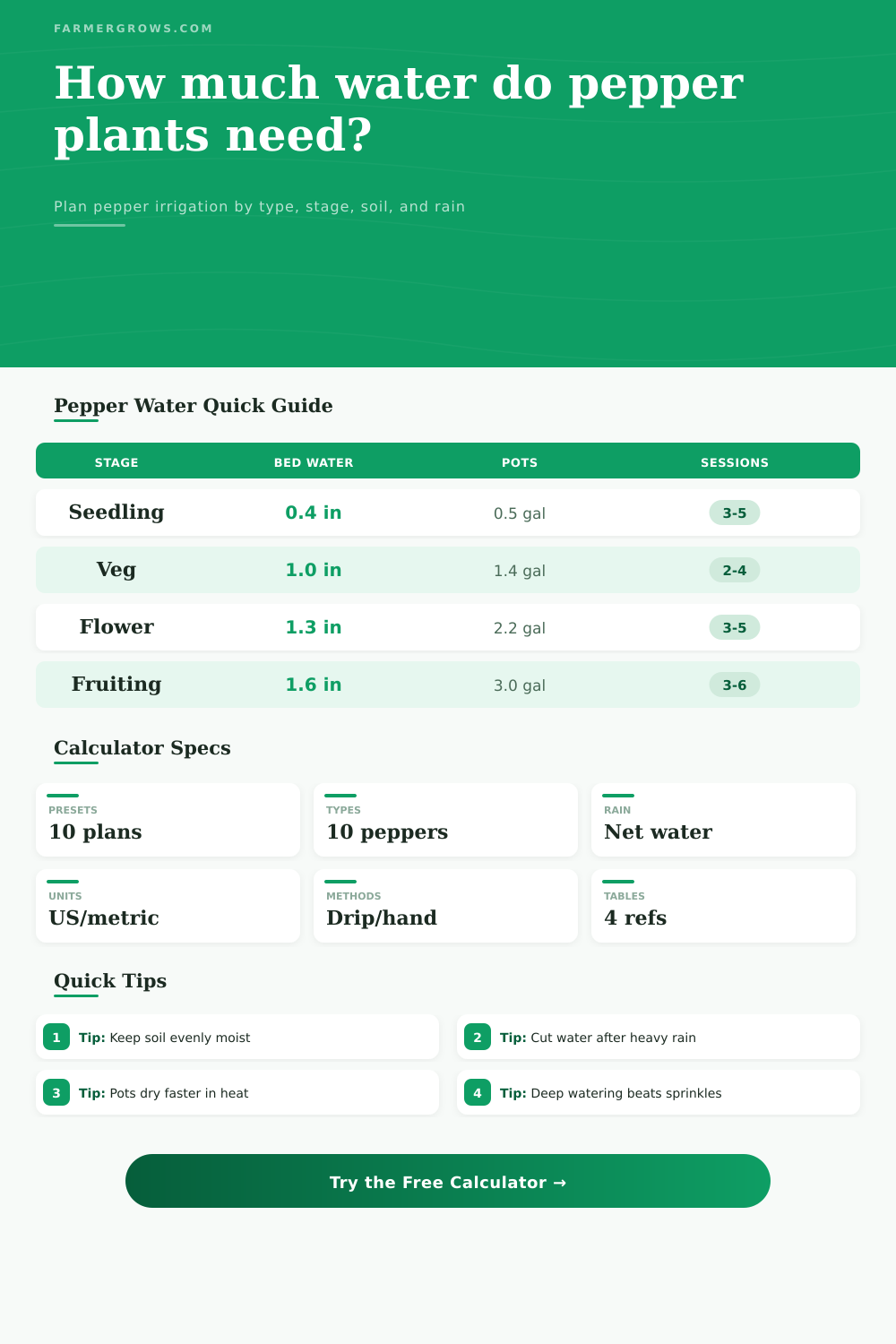
Water For Pepper Plants Calculator
Estimate pepper irrigation from plant count, spacing or container size, growth stage, soil texture, mulch, weekly rain, temperature stress, and drip or hand-watering flow.
Load a common pepper planting scenario, then adjust the rainfall, soil, mulch, and flow rate to match your garden.
Pepper Irrigation Plan
Use the cards for weekly volume, per-session volume, per-plant water, and estimated watering time.
Different pepper types shade soil differently and carry different fruit loads. These factors are used as gentle irrigation adjustments, not hard rules.
Large fruit and broad canopy usually need steady moisture during fruit fill.
Medium-fruited plants tolerate slightly drier cycles once established.
Compact hot peppers often use less water per plant than bells.
Large plants and heavy fruit need consistent irrigation near harvest.
Productive plants do well with moderate, regular watering.
Warm-season plants prefer even moisture but dislike saturated roots.
Narrow fruit and airy growth usually lower the weekly demand.
Superhots need reliable moisture in heat, especially in containers.
| Growth stage | Bed target before rain | Container baseline | Watering rhythm |
|---|---|---|---|
| Seedling or nursery start | 0.35 to 0.50 in per week | 0.05 to 0.10 gal per plant per day | Small, frequent waterings; avoid crusting the surface. |
| Recent transplant | 0.65 to 0.90 in per week | 0.10 to 0.18 gal per plant per day | Keep root ball evenly moist while roots move into soil. |
| Vegetative growth | 0.90 to 1.20 in per week | 0.16 to 0.26 gal per plant per day | Water deeply enough to wet the active root zone. |
| Flowering and fruit set | 1.20 to 1.45 in per week | 0.25 to 0.40 gal per plant per day | Prevent sharp dry-wet swings that can drop flowers. |
| Main fruiting harvest | 1.40 to 1.80 in per week | 0.32 to 0.55 gal per plant per day | Use steady moisture for fruit size and blossom-end quality. |
| Late season maintenance | 0.90 to 1.25 in per week | 0.18 to 0.35 gal per plant per day | Taper when weather cools and fruit load declines. |
| Condition | Calculator factor | What it means | Practical check |
|---|---|---|---|
| Sandy soil | 1.15x water | Fast drainage and lower storage raise irrigation need. | Water more often, especially in windy heat. |
| Loam soil | 1.00x water | Balanced holding capacity for most garden beds. | Check moisture 2 to 4 in below the surface. |
| Clay loam | 0.85x water | More water storage but slower infiltration. | Use slower applications to prevent runoff. |
| Deep organic mulch | 0.82x water | Lower evaporation and cooler root zone. | Pull mulch slightly back from pepper stems. |
| Hot stretch above 90°F | 1.35x water | High evapotranspiration increases demand. | Split irrigation into smaller sessions. |
| Extreme heat above 100°F | 1.55x water | Pots and shallow beds may need daily checks. | Prioritize morning watering and shade if needed. |
| Watering setup | Typical flow | Runtime example | Best use |
|---|---|---|---|
| Two 0.5 gal/hr emitters per plant | 1.0 gal/hr per plant | 30 min gives 0.5 gal per plant | Raised beds and individual pepper plants. |
| One 1.0 gal/hr emitter per plant | 1.0 gal/hr per plant | 45 min gives 0.75 gal per plant | Containers with one main root zone target. |
| Inline dripline near each row | 0.4 to 0.9 gal/hr per plant area | Run longer for wider spacing or dry soil. | Rows, tunnels, and mulched pepper beds. |
| Soaker hose | Variable by pressure | Use a catch cup or meter for calibration. | Short garden rows where pressure is stable. |
| Watering can | 1 to 2 gal per fill | Pour measured volume at the base of plants. | Patio peppers, grow bags, and spot watering. |
| Hose wand | 1.5 to 4 gal/min | Measure fill time before relying on minutes. | Quick hand watering with a gentle breaker head. |
| Planting example | Plants and spacing | Estimated area | 1 inch rain credit |
|---|---|---|---|
| Compact 4x8 pepper bed | 12 plants at 18 x 24 in | 36 sq ft by spacing | About 22 gal before losses |
| Double row raised bed | 16 plants at 18 x 18 in | 36 sq ft by spacing | About 22 gal before losses |
| Market row segment | 40 plants at 18 x 30 in | 125 sq ft by spacing | About 78 gal before losses |
| Patio container group | 8 plants in 5 gal pots | Pot top area varies | Rain helps less than in beds |
| Greenhouse peppers | 30 plants in protected beds | Use known bed area | Set rain to 0 for covered crops |
Root-zone check: Pepper roots do best with consistent moisture, but the surface can look dry while the root zone is still moist. Check 2 to 4 inches deep before adding extra water.
Container check: Pots and grow bags heat up quickly. If leaves wilt during the hottest hour but recover by evening, verify moisture before increasing every watering session.
Water only when the plants tells you they need it, which usually means that their leaves starts to cup up. The plant will look good first thing in the morning then flop over in the afternoon. Yes, the signs is pretty clear: Up = thirsty.
I don’t know about you, but my routine of watering every Monday and Thursday or thereabouts work fine most days…but not during this crazy year’s erratic rainfall! (It doesn’t take into account changing conditions.) That’s where the calculator comes in; enter your local growing conditions, and it do the math and tells you roughly what happened out in the real world with runoff vs. Infiltration.
How to Water Your Plants Correctly
Water requirements depends on your choice of pepper. For example, bell types tends to be heavy producers with big canopy. This means they need regular feeding but not too much or they’ll split. On the other hand, hot peppers such as serranos will be compact and somewhat drought-tolerant when grown up.
The tool knows which is which: a ghost pepper in a pot require one approach, while a bell pepper growing in earth requires another. The baseline requirement for watering take into account your chosen variety.
What is the most important variable of all? Soil texture, and how failure-prone your garden might be because off it: If the soil is mostly sand, as mine is, it will drain fast, letting the roots take up only some of it at a time. Water sandy soil frequently but lightly; if it’s clay, it’ll hold onto moisture longer, but can be soggy for to long and rot the roots. The calculator takes this drainage rate into account, so neither the plants will fry from being dried out nor drowned.
Less water is needed when plants is mulched. Mulch prevents evaporation by shading the root zone area, keeping it cooler, and provides a barrier between air and soil to prevent sun from baking the top inch of dirt. If you’re mulching heavily, the tool will adjust downward the calculated water-need estimate to match, helping you save some water, and your time.
Watering needs really jump when things gets hot. Above 90 degrees, plants takes moisture out of soil to cool themselves, which causes even more evaporation. The calculator also has an extreme-heat stress factor that will raise your volume demand. Don’t go by the cool-season regimen if it’s really hot out there; the plants need more water than that until they’re no longer in thermal stress, or else the fruit will drop off.
Because containers tend to dry out and heat up more rapidly different than the surrounding ground, there are some specific issues with them. In fact, a container like this five-gallon pot might need to be watered every day in July. You can even enter the size of your pots into the tool to determine exactly how much it will need. It also flags that no, it won’t make it through a few days without someone paying attention, if it’s growing in a tiny pot.
You will have less work now that there has been some rain lately. No sense in giving them too much when it rains so the calculator takes that into account, subtracting recent rainfall to get their actual water needs. Less is more: conserve water and save the roots from rot.
Feeding peppers isn’t about following a schedule; it’s about responding to what the plants’ roots tells you they need. Don’t wait until the leaves go floppy; do it before that happens. It’s responsive care, but with the correct inputs, the plants will stay happy and productiv throughout the season.