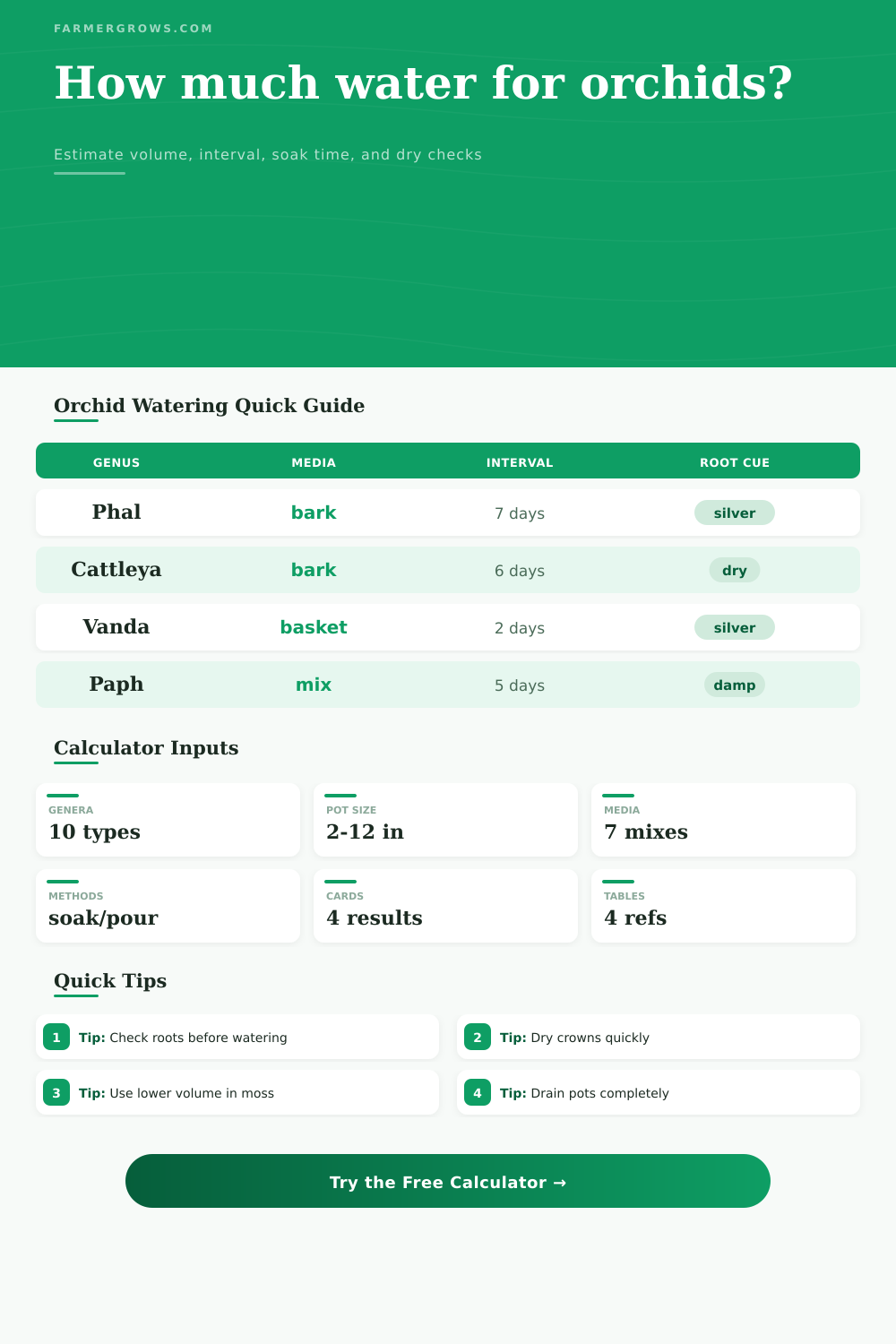
Water for Orchids Calculator
Estimate orchid watering volume, watering interval, soak duration, and the next root-check window from genus, pot diameter, media, pot material, humidity, light, temperature, season, root dryness, and watering method.
Choose a named orchid setup, then adjust the pot, media, room, and root dryness details. The calculator treats these estimates as a starting point and gives extra weight to visible root color and media dryness.
Orchid Watering Estimate
Results update from your orchid, pot, media, room, season, roots, and watering method.
Prefers roots approaching silver in airy bark, while the crown must dry fast after watering.
Likes a clear wet-dry swing; pseudobulbs store water and tolerate a slightly drier interval.
Many types drink heavily in growth and need a reduced winter rest after canes mature.
Fine roots dislike staying bone dry, so use smaller intervals with breathable media.
Exposed roots dry quickly and often need daily dunking, misting, or warm-season soaking.
Terrestrial-style roots prefer lightly damp media and should not be pushed fully dry.
Big pots and cool air slow drying, but active outdoor growth can still use plenty of water.
Thin leaves and fine roots need steadier moisture in cool, airy conditions.
Small cool growers need constant freshness, high humidity, and little stale pot moisture.
Jewel orchids grow in a more soil-like mix and prefer evenly damp, never soggy roots.
| Orchid genus | Base interval | Dryness target | Best method |
|---|---|---|---|
| Phalaenopsis | 6 to 8 days | Mostly silver roots, media barely damp | Soak or pour through, avoid crown water |
| Cattleya alliance | 5 to 8 days | Dry between watering, pseudobulbs still firm | Thorough pour or short soak |
| Dendrobium | 4 to 8 days | Faster in active growth, drier in winter | Pour through bark and drain hard |
| Oncidium alliance | 4 to 6 days | Nearly dry but not bone dry | Even pour-through or brief soak |
| Vanda | 1 to 3 days | Exposed roots turn silver quickly | Dunk, mist, or long warm soak |
| Paphiopedilum | 4 to 6 days | Lightly damp, not fully dry | Slow pour at media surface |
| Cymbidium | 5 to 8 days | Even moisture in growth, less in cool rest | Deep pour through large pot |
| Miltoniopsis | 3 to 5 days | Consistently moist but airy | Small soak or gentle pour |
| Masdevallia | 2 to 4 days | Cool, fresh, never stale-dry | Light frequent watering |
| Ludisia | 5 to 7 days | Top mix lightly dry, root zone damp | Pour like a houseplant, then drain |
| Material | Water holding | Drying effect | Calculator behavior |
|---|---|---|---|
| Coarse bark | Low to moderate | Fast air exchange | Adds volume, shortens interval |
| Medium bark | Moderate | Balanced orchid baseline | Standard volume and interval |
| Fine bark | Moderate to high | Slower core drying | Slightly lowers volume, lengthens interval |
| Sphagnum moss | High | Holds water around roots | Lower volume, longer interval, shorter soak |
| Bark and moss blend | High middle | Moist pockets in bark | Moderate volume reduction |
| LECA or clay pebbles | Low surface hold | Fast unless reservoir-grown | More frequent watering |
| Mounted or basket bare-root | Very low | Very fast drying | Frequent checks and longer contact |
| Condition | Faster drying | Slower drying | Watering note |
|---|---|---|---|
| Humidity | Below 35% | Above 70% | Dry rooms may need earlier checks, not constant sipping |
| Light | Bright filtered or grow light | Low winter windowsill | Water use follows light-driven growth |
| Temperature | Above 78°F | Below 62°F | Cool wet roots stay wet much longer |
| Season | Summer growth or new roots | Winter rest after growth | Resting orchids need smaller, less frequent watering |
| Air movement | Fan or open window | Still cachepot corner | Air should dry leaves and crowns soon after watering |
| Root or media cue | Meaning | Calculator shift | Action |
|---|---|---|---|
| Green roots, heavy pot | Recently watered or still wet core | Lower volume, longer interval | Wait and recheck ventilation |
| Mixed green and silver roots | Drying but not fully ready | Small delay | Check again in 1 to 2 days |
| Mostly silver roots | Normal watering point for many epiphytes | Baseline | Water thoroughly and drain |
| Very light pot, bone dry media | Past the ideal point for moist genera | More volume, shorter next check | Soak bark fully, then drain |
| Wrinkled leaves or pseudobulbs | Possible underwatering or root loss | Moderate volume, close check | Inspect roots before increasing frequency |
| Method | Best for | Contact time | Drain rule |
|---|---|---|---|
| Soak, then drain | Bark pots that shed water quickly | 6 to 18 minutes | Lift out and drain until dripping stops |
| Pour through | Clear slotted pots and damp-loving genera | 1 to 3 passes | Runoff should leave the pot freely |
| Gentle shower rinse | Warm active growth with dusty media | 2 to 4 minutes | Dry crowns and leaf joints after watering |
| Mist or dunk mounted roots | Vanda, mounted species, baskets | 10 to 25 minutes dunk or repeat mist | Roots should dry back the same day |
Use roots before the calendar. Clear pots make watering decisions easier: green roots and heavy media usually mean wait, while silver roots and a lighter pot mean the next thorough watering is close.
Water thoroughly, then remove standing water. Most orchids prefer a complete wetting followed by fast drainage and air around roots. Keep cachepots from holding runoff against the pot bottom.
When an orchid goes yellow in the leaf, you worry: did I kill it? And you stare at the heavy pot…did I give it too much water just the other day? No. Chances are, what kills most house orchids isn’t too-much water but bad drainage followed by standing around wet.
This calculator cuts to the chase, to help eliminate worry, by providing a starting point rather than a hard-and-fast regimen. Given your growing conditions, it calculate how much to give them, when, for how long, and how frequently to check back and see if they’re realy dry. It views your home as a climate chamber; your pot as a variable container.
How to Use the Orchid Watering Calculator
Instinct isn’t as important than genus. Thick, water-storing roots? That’s a Phalaenopsis, a tropical tree-dweller. They has fine, thirsty roots that must never go dry. That’s a Paphiopedilum, a terrestrial plant. By setting a baseline interval, the tool takes such biological distinctions into account.
And biology is just half the story. The other half is what your potting medium are made of. Sphagnum moss retains water like a sponge; bark chips dry right out. Plant a bark-lover in moss, water on a bark schedule, and you’ll rot its roots. Put a moss-lover in bark, water on a moss schedule, and you’ll dry it out. The calculator factors in how much water your medium hold to adjust both the timing and recommended volume of water.
Another thing that surprises folks is that pot size matter. For instance, a six-inch pot doesn’t dry out as fast as a four-inch one. Why? It has more water because a bigger pot have more volume. It also has a lower surface-area-to-volume ratio. The inside of a large pot remains moist even when its edges are dry. That’s why the device prompts you to enter your pot diameter, so it knows not to tell you to water based off whether the top inch of medium is dry. So it forces that interval backward, allowing the interior to dry down instead.
That’s where most people go wrong; they see some dry moss around the rim and then water again, drowning the roots in the center.
Evaporation is affected by room conditions. If you live in a humid place, it will take longer for plant to dry. If you have low humidity, it evaporates faster. If there’s bright light, that encourages more transpiration (water moving up from the roots). The calculator takes into account your current light level, humidity, even the season. Water demand will be less during winter rest periods. Water demand will be higher during summer heat. It isn’t simply a matter of dumping water in. It’s about matching input to demand.
But the biggest factor is that visual check of the root color. Roots don’t lie. If yours are green, it’s because you’ve kept them watered and hydrated and they’re doing their thing, photosynthesizing. If they’re silver or gray, they’re saying, “Hey, get me some moisture.” That visual check matters more in the tool. Whatever the calendar says, if your roots are green, it will stretch out the interval. It puts how plants work ahead of strict scheduling. This is a big difference. This isn’t about the calendar; it’s about paying attention to a signal.
Look at the contact time when you get the results. Water will eventually soak into the media if you are using the soak method. You don’t want any channeling (where water pours through, wetting only the sides but not the middle). With pour-through, water can run down the side. Soak versus pour-through makes a difference. Soaking requires that you drain all the way, because orchids do not like to sit with their feet in standing water. That deprives their roots of oxygen and promotes bacterial growth. There should be no water left in the bottom of cachepot or the pot, the tool says. The tool suggests how long to drain it.
The how: Watering is as much about when (rhythm) as it is about how much (volume). Yes, you want a wet-dry cycle; the roots must breathe. Plug in your own setup into the calculator above and it’ll do the math for you. No guesswork with coefficients or conversions; just give yourself a starting place. But the last word is the plant’s. Are its roots silvery-white? Are its leaves perky-looking? Then the schedule’s working. Adjust if not.
So begin with the numbers. Notice the result. Adjust accordingly. Don’t be a slave to the tool; it’s not about that. It’s about learning the relationship of air versus moisture, media vs. Roots, and light. Learn the dynamic by noticing what happens when you change one thing, and you’ll cease guessing. You’ll garden. The leaves will firm again; the yellowing will cease. And you’ll know the panic was never realy about the water. It was about the not knowing. Now you’ve got a map.