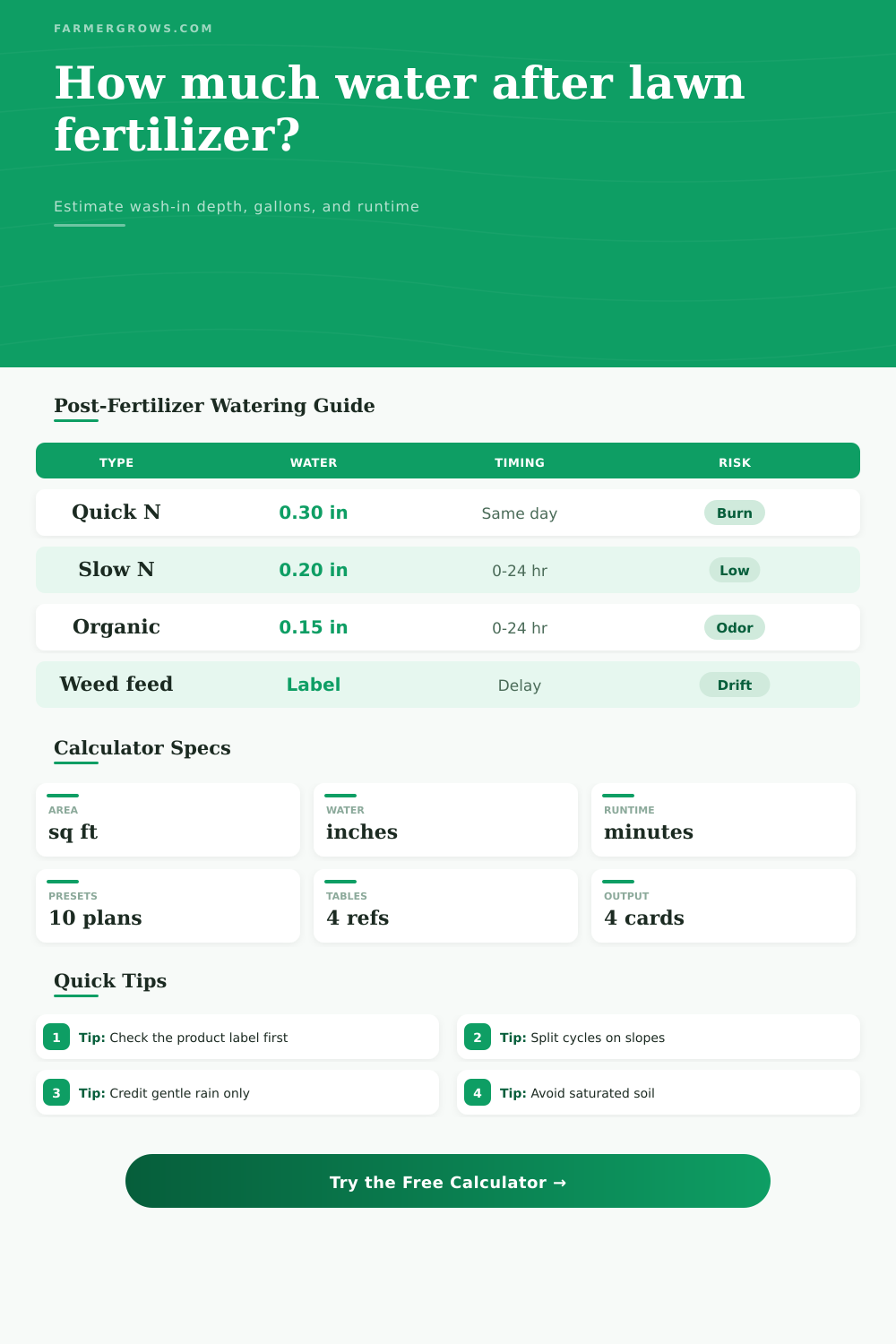
Water After Fertilizing Lawn Calculator
Estimate the wash-in depth, total gallons, sprinkler runtime, rain credit, split-cycle plan, and runoff warning for granular or liquid lawn fertilizer after spreading.
Load a common lawn fertilizer situation, then edit the area, nitrogen rate, fertilizer type, prill size, soil moisture, forecast, sprinkler output, heat, slope, and weed-and-feed setting.
Needs prompt irrigation to move salts off leaf blades and into the thatch and upper soil.
Usually needs less immediate water, but a light wash-in helps settle prills below the canopy.
Moisture starts microbial breakdown and reduces dust or odor without needing a heavy soak.
Water evenly after seeding so nutrients settle without washing seed or soil downhill.
Often needs water soon after spreading to form the barrier in the upper soil zone.
Leaf-active granules may need a dry hold after sticking to wet weeds; the label overrides the calculator.
A short rinse can protect foliage when the product is intended for soil uptake instead of foliar feeding.
Wash granules from concrete and leaf tips quickly, but avoid runoff toward pavement or drains.
Post-Fertilizer Watering Results
Your wash-in depth, water volume, sprinkler runtime, and timing plan update here.
| Fertilizer type | Typical wash-in | Water timing | Reason | Caution |
|---|---|---|---|---|
| Quick-release urea | 0.25 to 0.35 in | Same day, sooner in heat | Dissolves salts and moves N off blades | Burn risk rises above 1 lb N per 1,000 sq ft |
| Slow-release coated nitrogen | 0.15 to 0.25 in | Within 24 hours | Settles prills while keeping release gentle | Do not over-water steep slopes |
| Organic granular | 0.10 to 0.20 in | Within 24 hours | Starts breakdown and reduces odor | Heavy rain can move fine particles |
| Starter fertilizer | 0.20 to 0.30 in | Light and even after seeding | Places nutrients near seedling roots | Use soft cycles so seed does not wash |
| Pre-emergent with fertilizer | 0.25 to 0.50 in | Often soon after spreading | Activates the barrier in upper soil | Follow the label activation window |
| Broadleaf weed-and-feed | Label-specific | Often delayed 24 hours | Granules may need to stay on wet leaves | Do not irrigate early if label forbids it |
| Sprinkler rate | 0.15 inch | 0.25 inch | 0.35 inch | Best use |
|---|---|---|---|---|
| 0.30 in/hr | 30 min | 50 min | 70 min | Rotors, low runoff pressure |
| 0.50 in/hr | 18 min | 30 min | 42 min | Many mixed residential zones |
| 0.75 in/hr | 12 min | 20 min | 28 min | Moderate spray zones |
| 1.00 in/hr | 9 min | 15 min | 21 min | Pop-up sprays on absorbent turf |
| 1.50 in/hr | 6 min | 10 min | 14 min | Short cycles to prevent runoff |
| Forecast or soil condition | Calculator treatment | Watering move | Runoff concern | Note |
|---|---|---|---|---|
| No rain, normal soil | Full sprinkler depth | Water after spreading | Low to medium | Use the runtime card |
| 0.10 to 0.35 in gentle rain | Credit most rainfall | May reduce sprinkler time | Low if soil absorbs | Good wash-in weather |
| 0.75 in or more forecast | Warning added | Delay if possible | High | Heavy rain can carry fertilizer off lawn |
| Dry soil and hot air | Adds wash-in depth | Water promptly | Medium | Split cycles if water beads or runs |
| Saturated soil | Delay warning | Wait for drainage | High | Do not push fertilizer into runoff |
| Runoff risk | Cycle depth cap | Rest between cycles | Good sprinkler choice | Extra action |
|---|---|---|---|---|
| Low, flat turf | 0.40 in | Usually none | Matched precipitation zone | Watch low spots |
| Medium slope | 0.25 in | 20 to 30 min | Rotor or short spray cycles | Stop if water sheets |
| High, compacted turf | 0.15 in | 30 to 45 min | Cycle-and-soak controller | Aerate later if runoff repeats |
| Near drain or water | 0.10 in | 45 min or more | Lowest practical rate | Keep fertilizer off pavement |
Use the label as the final rule. This calculator estimates a practical wash-in plan, but weed-and-feed, pre-emergent, iron, and coated products can have label-specific watering windows.
Split water before it runs. On slopes, compacted soil, or thin turf, several short cycles with rest time move fertilizer into the lawn better than one long runoff-producing soak.
It’s a snowy patchwork of white and green across your lawn, you’ve spread the granules, and now what? Should you water right away, or wait? Mistakes on this front can transform a bright spring morning into a brown, crunchy dissapointment by Tuesday evening.
Most often, the cause isn’t so much the fertilizer as the water, what moves the product off those leaves and down in the soil for the roots to tap into. That’s why there is a calculator to help you get the math right… Irrigation is an on-off switch for most homeowners. Turn it on, run your sprinkler or sprayer, then move on. But fertilizer has chemical traits that don’t forgives.
How to Water After Fertilizing Your Lawn
Urea in particular (the quick release kind) is salt-like, and it’s deadly when it dries on the blade of grass in high sun, pulling moisture out of leaf tissue before there’s time to reach the root zone. Wash it down at once, and break up those salts so they can be washed down, too. The formula in the calculator above figures that for you, taking into account which kind of product you applied.
Because a coated slow-release granule isn’t behaving like fine organic dust, it calls for a gentler settling… and a prompt rinse. Here’s the key: Know exactly what you’re watering. It’s not thirsty soil you want to rehydrate. It’s moving some amount of chemical from the canopy down into the thatch layer.
For most granular products, a quarter-inch of water will do the job. Sounds like little, right? On a five-thousand square foot yard, that’s almost fifteen-hundred gallons. That’s a lot of water for something that looks so barely wet.
The chart on the page explains all this. It will tell you that a half inch per hour spray rate require only thirty minutes of running time. But how long did you guess at when you ran your system? Did you default to an hour out of force of habit? Runoff is waiting to happen.
The trick is that soil conditions make all the difference. Putting more water on a sodden area that’s already wet from last night’s deluge? That’s a waste of water. It is more like a runoff factory. The calculator accounts for existing soil condition and slope, alerting you if you should of held off.
Got sloping yards, heading downhill into someone else’s fence or out onto the street? A big soaking won’t keep your dollars in the lawn, it’ll be headed down the gutter. Then cycle and soak is your smartest move. Turn on the sprinklers for 15 minutes, let the soil absorb what it can, then pause, and repeat. Slower, yes. But nutrient-where-you-paid-for-it slow.
The weather prediction is important, and I don’t mean just the part about the temperature. For instance, there is a slight shower in an hour. Maybe skip it. Or maybe not. You might use the system then anyway, but less heavily, since that little bit of natural rain will do some work for you. Plus, because it falls from above, it helps settle granules unlike your sprinkler’s forceful nozzle.
But what if there’s a thunderstorm? A flood of heavy rain beats fertilizer straight into the ground water, instead of allowing absorption in the root zone. The prediction feature on the tool takes that into consideration, too, and adjusts the credit you recieve for expected rain accordingly. It differentiates between good-for-you drizzle and bad-for-everyone-downstream downpour.
And then there’s the issue with weed-and-feed products (which often contain herbicides that must stick to the leaf of the broadleaf weed to work). With these, you need the herbicide to stick to the broadleaf weed leaf to do its work. Watering it in too fast rinses the herbicide away without killing dandelion. That’s why the calculator calls this out, the label trumps the general rule.
Always read the label. It is not a blog post or a pre-set button on your device, but the label.
So how much? And when? The short answer: Watering after fertilizing is a matter of both accuracy and timing. I do not mean to say you should soak the ground until the hoses are tired. But rather, move the fert into the soil (away from the blades) using exactly as much water as needed.
Don’t use too little, because then it burns the grass. Don’t use too much, because then it goes to the sewer. That’s why it’s not a guess; it’s a plan. So you’re measuring depth instead of guessing time.