Walla Walla Onion Growth Time Calculator
Estimate sweet Walla Walla onion timing from fall overwintered starts or early spring transplants through 14-hour daylength, mild bulb sizing, neck fall, curing, and short storage.
This planner is only for Walla Walla sweet onions. It is not a Spanish storage onion, winter multiplier onion, short-day southern onion, bunching onion, green onion, or red onion calculator.
Estimated Walla Walla Growth Window
Use the window as a field check. Final harvest should follow neck fall, bulb feel, weather, and how quickly you plan to eat these mild sweet onions.
| Walla Walla crop form | Daylength fit | Best planting use | Storage expectation |
|---|---|---|---|
| Walla Walla Sweet from fall starts | Long-day, about 14+ hours to bulb | Classic overwintered crop for June to July sweet bulbs | Use soon; usually 2-6 weeks after cure |
| Walla Walla Sweet spring transplants | Long-day northern and inland Northwest gardens | Early spring planting when soil is workable and starts are young | Short holding; eat fresh or share quickly |
| Walla Walla Sweet from seed trays | Needs enough spring leaf growth before long days | Start indoors and transplant early, avoiding oversized starts | Same short storage as other sweet Walla Walla bulbs |
| Walla Walla direct seeded | Possible but slower and smaller in many gardens | Use where the season is long and beds are clean | Fresh use; less reliable for full-size slicers |
| Pathway | Typical root or settle phase | Bulb sizing phase | Harvest personality |
|---|---|---|---|
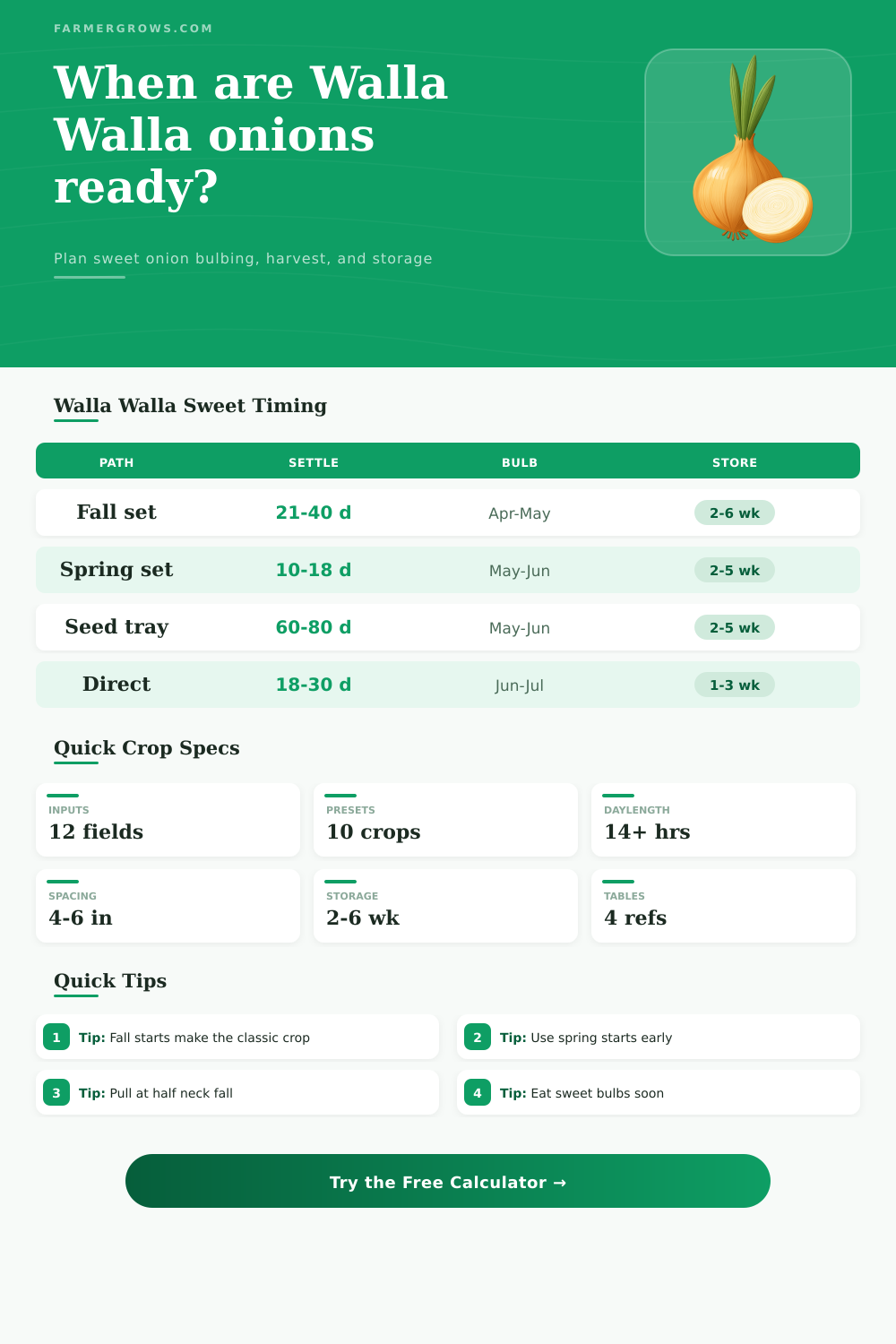
| Fall transplant, overwintered | 21-40 days before winter pause | Spring restart plus 45-75 days after 14-hour days | Earliest, largest, classic mild Walla Walla bulbs |
| Early spring transplant | 10-18 days if planted before heat | 60-90 days after daylength and leaf mass align | Good home crop, often later and slightly smaller |
| Indoor seed to transplant | 60-80 days in trays, then 10-18 days in bed | Similar to spring transplants if set out early | Flexible but needs careful transplant age |
| Direct seed | 18-30 days to stand and thin | Longer leaf-building window before reliable bulbs | Usually fresh small bulbs unless the season is long |
| In-row spacing | Likely bulb use | Timing effect | Walla Walla note |
|---|---|---|---|
| 2-3 inches | Fresh pulls and small bulbs | Earlier neck softening | Useful when you want mild onions before full slicer size |
| 4 inches | Medium sweet bulbs | Balanced timing | Good for raised beds with steady moisture |
| 5-6 inches | Large Walla Walla slicers | Adds a few finishing days | Best fit for broad mild bulbs and thick rings |
| 7-8 inches | Jumbo attempts | Latest finish and more weather exposure | Only worth it with strong tops before daylength trigger |
| Field signal | What it means | Timing adjustment | Action |
|---|---|---|---|
| Seed stalk forming | Bolting from cold, age, or stress | Harvest those bulbs early | Use fresh; they will not store well |
| Half the necks fall | Sweet bulbs are reaching eating maturity | Core harvest window begins | Lift on a dry day and cure lightly |
| Thick green necks linger | Late nitrogen or immature tops | Add 7-14 days if weather allows | Stop irrigation and avoid more nitrogen |
| Outer scales dry, neck tight | Short cure is complete | Storage clock starts | Eat within weeks, not months |
Tip: For the classic mild sweet crop, set young Walla Walla transplants in fall, mulch lightly, and uncover early enough for spring leaf growth before bulbing.
Tip: Treat storage as a short fresh-eating window. Walla Walla bulbs are juicy and mild, so thick-necked or bolted bulbs should go to the kitchen first.
Walla Walla Sweet onions have their reputation. Mild-flavored, with thick layers they define Pacific Northwestern summer.
Growing these bulbs is all about timing. It is not so much a checklist as it is a feel for the rhythm of things. It is not just about sowing seed, but also about making adjustments based off the winter ahead, the soil temperature, and the day length. Once you plug in your location data into the calculator (above), that math are done for you. No guesswork for coefficients and such. But knowing what makes each number tick set you up for a good crop instead of a decent one.
How to Grow Walla Walla Onions
This onion has one primary factor: daylength. Walla Walla is a long-day variety. It won’t do anything unless the days is at least fourteen hours long. Once it hits that light level, out comes the plant and it begin bulking up. Planting too soon in spring doesn’t give the plant time to grow enough leaves. If they reach required light while they are still small, the onions will be tiny and difficult to dig. Wait too long, and the plants may bolt. Instead of making the bulbs swell, the plant produce a flower stalk.
People tend to obsess over frost dates and overlook daylength. The tool will help you get your transplant timing lined up with right window. You want the plant to reach full leaf production before the days become longer than enough to signal it to start swelling.
Fall transplanting (commonly used by most northern growers) set young plants in October/November. The plant roots but stops growing once the ground freeze. When spring warms up, they have a head start on leaf production because their roots is already established. And because there aren’t many daylight hour in winter, why spend energy making leaves? You can model this tactic with the calculator: Just plug in how deep you think mulch will be, and what your lowest predicted winter temps may be. As long as those don’t reach 20F, the tool takes into account that plants are stressed, but protected by heavy mulch. Note that leaving straw on too long, say until June, can mean the onions will “wake up” later than optimum. By the time the daylength cue shifts and tells them to go, they’re not ready.
If you’re unable to overwinter your plants, then start some transplants in springtime. Get aggressive with dates. Young starts is what you want, no big guys. The calculator keeps track of how old they’ll be at time of transplant. Cold weather causes older plants to bolt more easier. If your soil warms early, you can go a little bigger on your starts. Keep ’em small and strong if it’s a cool spring.
Also consider spacing. Each onion bulb wants its own space to grow, so don’t crowd them too closely together (like two or three inches apart). They will produce smaller bulbs sooner. Perfect for fresh snacking, but not large slicing onions.
Be careful about when you harvest. No, you don’t wait till the tops turn brown and go dead, at least not with Walla Wallas (high-water-content, low-pungency onions). They are delicious but won’t keep for long. Harvest them when half of the necks flop over, according to the calculator that finds your best harvesting time. Harvest on a dry day, then cure lightly in the shade. Enjoy shortly thereafter (weeks), as trying to store these bulbs for months is a recipe for dissapears. These are meant to be eaten fresh. Freeze sliced rings, use in stews, share. The reference table explain how other approaches impact storage life.
The story with growing Walla Wallas is that it’s an exercise in setting expectations. If the ground isn’t warm, don’t expect a bulb; if days remain short, don’t expect a bulb. Create the environment, then let nature take its course. Use the calculator. Use the plan. Let Mother Nature do her thing. Observe the neck fall. Savor the process. Celebrate when the crop is ready, even if it’s not right on schedule.
That is the gift, the first bite of fresh-cropped sweet onion in early summer. It is not a precise date. It is the taste. And that’s why all the planning happens.