🌱 VPD Calculator
Calculate vapor pressure deficit from air temperature, relative humidity, and leaf temperature offset. Compare the current canopy condition with crop-stage targets, greenhouse type, CO2 mode, and airflow class.
Choose a named environment to load realistic temperature, leaf offset, RH, crop stage, structure, target range, CO2 mode, and airflow class.
VPD snapshot
Enter crop climate conditions to compare current VPD with the selected target range.
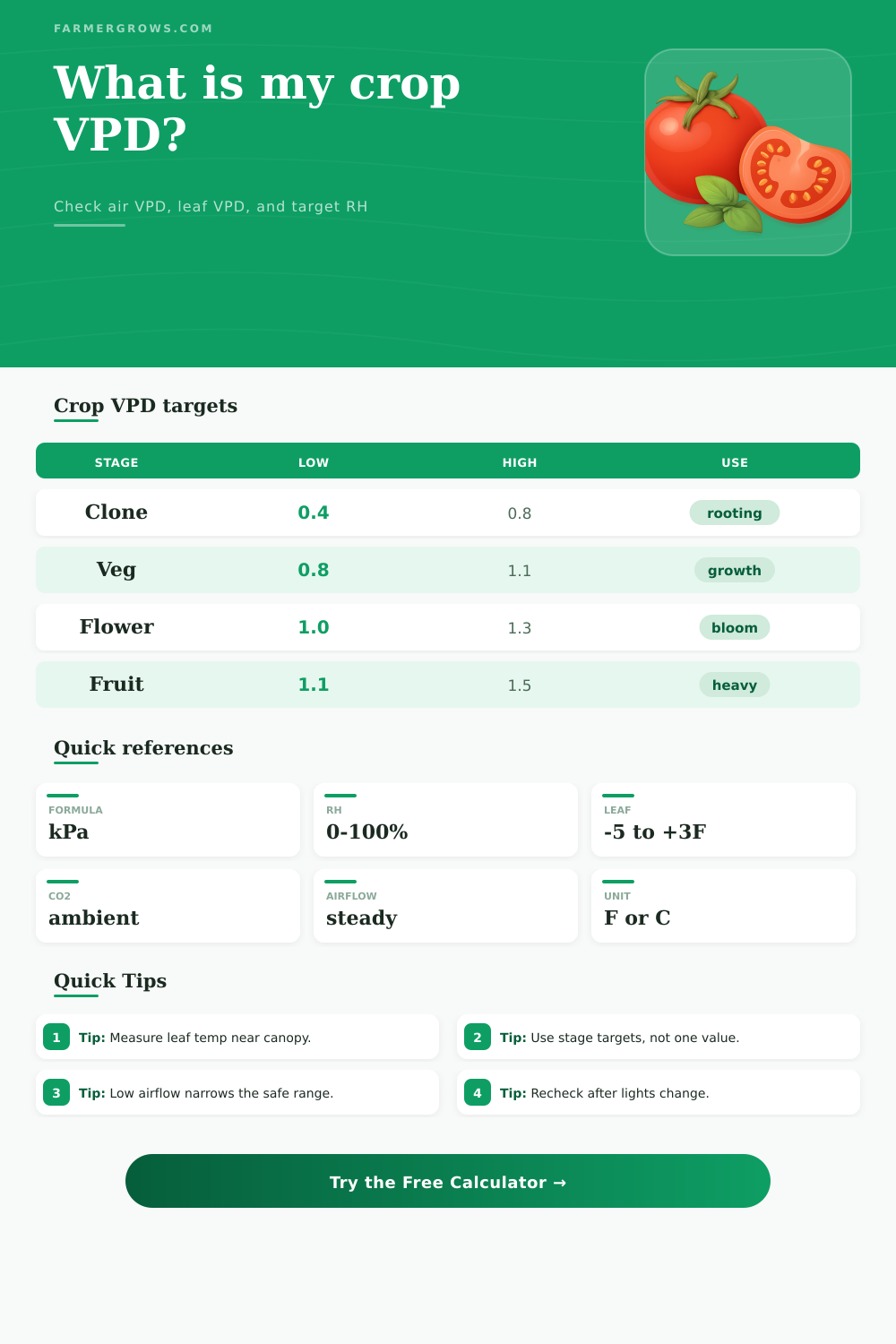
| Crop stage | Typical VPD | Target feel | Common use |
|---|---|---|---|
| Clone / rooting | 0.4-0.8 kPa | Soft | Propagation domes and benches |
| Seedling | 0.6-0.9 kPa | Gentle | Young transplants and plugs |
| Vegetative growth | 0.8-1.1 kPa | Balanced | Leaf growth under strong light |
| Flowering / bloom | 1.0-1.3 kPa | Moderately dry | Dense bloom rooms and late veg |
| Fruiting vegetables | 1.1-1.5 kPa | Stronger pull | Tomato, pepper, cucumber crops |
| Leafy greens | 0.6-1.0 kPa | Cool and steady | Lettuce, basil, tender greens |
| Air temperature | RH | Air VPD | Interpretation |
|---|---|---|---|
| 68°F / 20°C | 70% | 0.70 kPa | Seedling to leafy range |
| 75°F / 24°C | 65% | 1.04 kPa | Vegetative to flowering |
| 80°F / 27°C | 60% | 1.42 kPa | Dry fruiting pull |
| 85°F / 29°C | 70% | 1.21 kPa | Warm but balanced |
| 90°F / 32°C | 55% | 2.14 kPa | Too dry for many crops |
| Factor | Selection | Calculator adjustment | Practical meaning |
|---|---|---|---|
| CO2 | Ambient | 0.00 kPa | Base stage target |
| CO2 | Enriched | +0.05 kPa | Allows slightly stronger pull |
| CO2 | High | +0.10 kPa | Only with strong light and nutrition |
| Airflow | Low | -0.10 kPa high limit | Protects still, wet leaf zones |
| Airflow | High | +0.05 kPa high limit | Can dry leaves faster |
| Airflow | Uneven | -0.05 kPa band | Hot spots need a safer range |
| Type | Climate behavior | Likely correction | Watch closely |
|---|---|---|---|
| Indoor grow tent | Fast swings | Adjust exhaust and humidifier | Sensor placement |
| Sealed grow room | Stable but loaded | Use dehumidifier and AC | Night RH spike |
| Hoop tunnel | Sun and vent driven | Vent early, shade if hot | Midday VPD jump |
| Poly greenhouse | Moderate buffering | Blend vents, fog, heat | Condensation zones |
| Glass greenhouse | High light, quick heat | Use shade and circulation | Leaf temp offset |
| Open nursery bay | Weather exposed | Irrigate by canopy demand | Wind drying |
The calculator uses saturation vapor pressure in kPa: es = 0.6108 x exp((17.27 x T) / (T + 237.3)). Air VPD equals es(air) minus actual vapor pressure; leaf VPD uses es(leaf) minus the same actual vapor pressure.
Vapor pressure deficit is the difference between an amount of water that the air can hold at a specific temperature compared to the amount of water that the air are holding at that same temperature. The vapor pressure deficit is important in the greenhouse industry because the vapor pressure deficit will determine the rate at which the plants will lose water from their leaf. If the vapor pressure deficit is high, the plants will lose their water more fast.
However, if the vapor pressure deficit is low, the plants will lose less of their water from the leaves, but there is an increased chance of the development of disease in the plants. Thus, it is important to understand the vapor pressure deficit in relation to the watering of the plants and in how the plants will even develop their fruit or flower. Many people begin to feel the effect of the vapor pressure deficit in their greenhouse prior to being able to understand the math behind the concept.
Vapor Pressure Deficit and How It Affects Greenhouse Plants
Issues such as crisping leaves or leaves that are brown along the edges the vapor pressure deficit typically causes in relation to the amount of water that the leaves are losing. The air may feel comfortable to the individuals in the greenhouse as indicated by the thermometer and humidity gauge, yet the high vapor pressure deficit within the greenhouse indicates that the leaves are drying out. The air may also feel cool within the greenhouse, yet the vapor pressure deficit may be too low for the plants to perform at their best.
The temperature and humidity of the greenhouse are correlated to the creation of the vapor pressure deficit for the greenhouse. If the temperature is increased within the greenhouse, the saturation point of the air will increase, leading to more evaporative loss. In addition, the greenhouse walkway may be where the measurements of the humidity are taken, yet the plants may be cooler due to their canopy structure.
The temperature of the leaves is correlated to the amount of water that evaporates from the stomata of the leaves; therefore, changes in the temperature of the leaves will change the vapor pressure deficit of the greenhouse. In order to calculate the vapor pressure deficit for your greenhouse, three different value need to be entered into the calculator: the air temperature, the leaf offset, and the relative humidity of the greenhouse. Additional values may also need to be entered in relation to the type of plants that are being grown; for instance, cuttings will have different settings then tomato plants that are setting their fruit.
Additionally, sealed rooms will have different settings than open tunnels; sealed rooms will retain the humidity within the greenhouse, yet open tunnels will lose humidity with each breeze that pass through the greenhouse. Other settings that may need to be selected include the airflow class for that greenhouse, as well as the CO2 mode in relation to how the plants will transpire. Though the greenhouse calculator will eliminate the need for you to manually calculate the saturation curve of the greenhouse, you will still need to monitor the plants within your greenhouse.
Within the greenhouse calculator, there will be two different values that are provided: the air vapor pressure deficit and the leaf vapor pressure deficit. The air vapor pressure deficit will show the drying power of the air within the greenhouse in general; however, the leaf vapor pressure deficit will indicate the amount of vapor pressure deficit that the plants in the greenhouse are actualy experiencing. This value should be used to make management decision for the greenhouse.
The relative humidity band will also be provided for the greenhouse; this reading will allow you to determine whether there is a need to add or remove moisture from the greenhouse. Different stage of the plants will require different settings for the vapor pressure deficit. Young plants with small root system will not be able to handle high levels of vapor pressure deficit; too high of a vapor pressure deficit will lead to wilting of those young plants.
However, plants that are in the stage of flowering and setting their fruit will benefit from higher rate of vapor pressure deficit. Using settings created for clones for flowering plants will lead to the slow down in the flowering plants’ growth, as well as potential mold issue. Additionally, using settings created for flowering plants for clones will cause the clones to dry out before they can develop their roots.
The tables provided to the growers indicate the saturation point for humidity and temperature in the greenhouse, as well as the amount of CO2 that can be enriched into the greenhouse. Additionally, the tables also indicate the impact that horizontal airflow will have upon the amount of water lost by the plants’ leaves; too much horizontal airflow may dry the leaves of the plants, yet the humidity sensor will read a normal humidity rate in the greenhouse. The greenhouse environment is rarely as controlled as the example greenhouse environments that are illustrated in most agriculture textbook.
Hot spots may develop under the grow lamps for the plants, and the humidity may be high at the floor of the greenhouse yet low at the plants. The safety band that is included in the calculator allow for growers to account for these differences in a greenhouse. The safety band will allow for growers to not make changes to the greenhouse based on a measurement that may not be representative of the entire greenhouse.
Additionally, the safety band is crucial in that the temperature of the plants’ leaves will change throughout the day. Many growers may desire to control the vapor pressure deficit within their greenhouse to a single value. Yet, the vapor pressure deficit will never stabilize to a single value within the greenhouse; the lights will change, the plants will grow, and the outside air will move in and out of the greenhouse.
Instead of focusing on a single reading for the vapor pressure deficit, growers should focus on the trend of the vapor pressure deficit within the greenhouse. If the leaf vapor pressure deficit begins to drift upward, that indicates to the grower that either the temperature within the greenhouse is rising or that the humidity within the greenhouse is falling. By correcting these variable early, the grower will be able to keep the vapor pressure deficit within a workable range.
The grower should pay attention to the vapor pressure deficit during the nighttime hour. If the temperature within the greenhouse decreases, the relative humidity will increase. An increase to the relative humidity will lead to a decreasing vapor pressure deficit.
If the vapor pressure deficit within the greenhouse becomes too low, the leaves of the plants will remain wet until the morning hours. Such conditions can lead to issues like mildew, especially in sealed room within the greenhouse. Therefore, the grower should inspect the greenhouse conditions one hour after the lights are turned off to determine if any nighttime adjustments are needed.
Depending upon the type of greenhouse structure that is used, the growers will have different control of the vapor pressure deficit within the greenhouse. For instance, tent and small sealed rooms will have quick responses to humidifiers and dehumidifiers. Thus, these structure can be easily controlled, yet will easily overcompensate for changes in the greenhouse environment.
Larger glass houses will take more time to adjust to changes in the greenhouse environment due to their thermal mass. One of the measurement that will need to be taken is the leaf temperature of the plants. The leaf temperature can best be measured with an infrared thermometer to determine the leaf offset.
The infrared thermometer should be aimed at the upper surface of the leaves in order to best determine the leaf offset. This leaf offset can be taken at any time after the lights are on. Waiting until the hottest part of the day may lead to issues in that the leaf will be too cool in comparison to the air temperatures, leading to a low vapor pressure deficit.
Though the greenhouse calculator removes the need for growers to manually calculate the vapor pressure deficit for their greenhouse, growers will still have to make manual adjustment to the vapor pressure deficit to maintain plants that are within a workable range. Such adjustments may include the adjustment of both the temperature and humidity within the greenhouse, the adjustment of the airflow within the greenhouse, and the CO2 level that are supplied to those leaves. The workable range for the vapor pressure deficit will change as the plants grow or as the outside temperature change throughout the year in the area of the greenhouse.
Thus, the main purpose of the greenhouse calculator is to remove the need for growers to manually calculate the saturation curve; instead, growers can focus on the plants within their greenhouse and the greenhouse itself. Should growers pay attention to the trends in the greenhouse, instead of the individual measurements, they will be able to maintain their crops as steady as possible.