Grass Seed Germination Time Calculator
Estimate when grass seed should sprout, when the first mowing may be ready, how often to water, and how risky the planting window is for your lawn.
Use this calculator for lawn planning and troubleshooting. Germination varies by seed lot, seed-to-soil contact, weather swings, irrigation consistency, and local extension recommendations.
Grass Seed Germination Estimate
Results combine species timing with the current seedbed conditions you entered.
| Grass species | Typical days | Best soil temp | Best use |
|---|---|---|---|
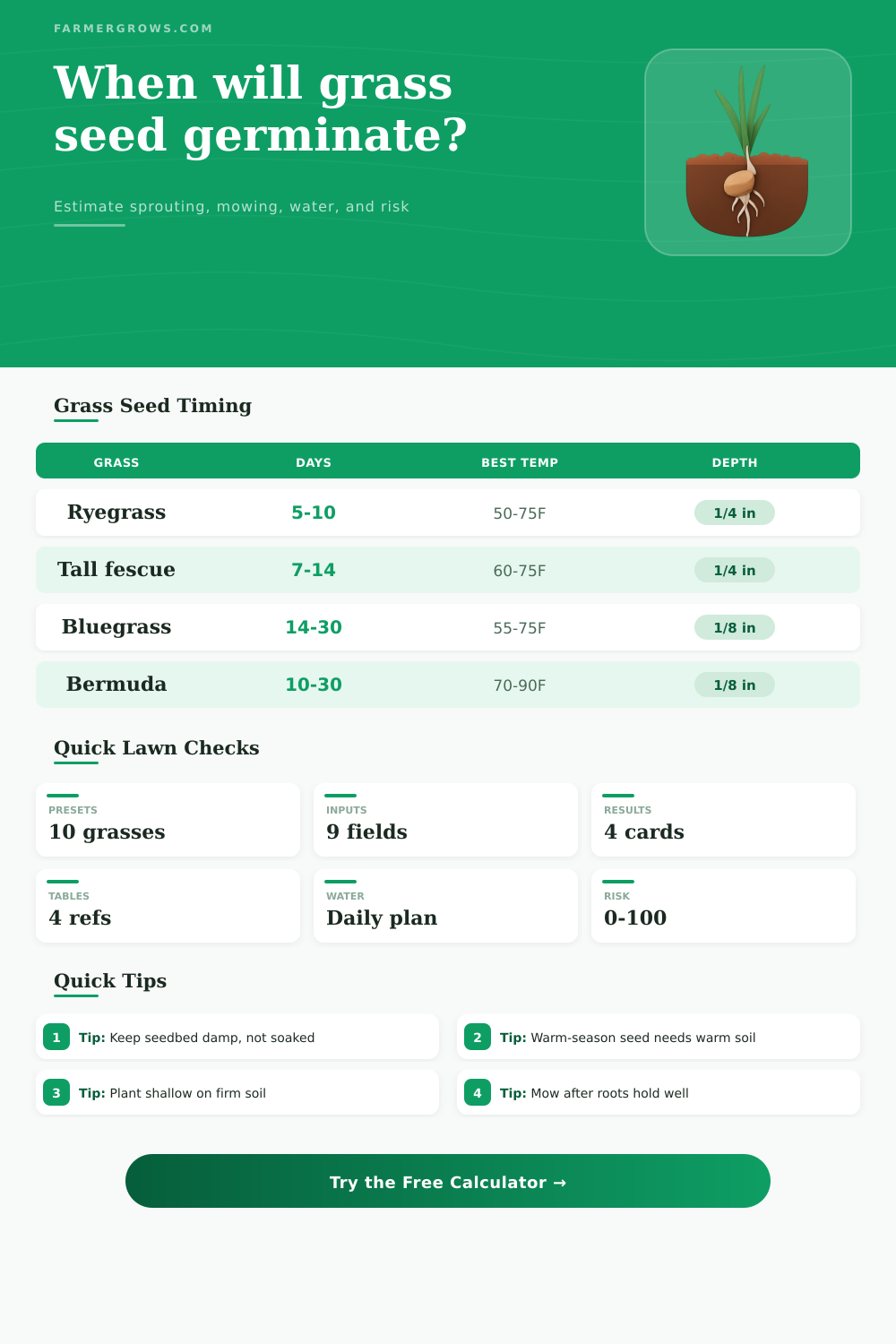
| Perennial ryegrass | 5-10 days | 50-75 F | Fast repairs, overseeding, quick cover in cool weather |
| Annual ryegrass | 4-8 days | 50-75 F | Temporary cover, nurse crop, short-term green |
| Tall fescue | 7-14 days | 60-75 F | Durable lawns, transition zone, traffic tolerance |
| Kentucky bluegrass | 14-30 days | 55-75 F | Dense cool-season lawns that can self-repair |
| Fine fescue | 10-21 days | 55-70 F | Lower-input lawns and partial shade |
| Creeping bentgrass | 10-14 days | 60-75 F | Closely mowed turf, specialized areas |
| Bermudagrass | 10-30 days | 70-90 F | Sunny warm-season lawns and athletic turf |
| Zoysiagrass | 14-28 days | 70-90 F | Warm-season lawns with slower establishment |
| Centipedegrass | 14-21 days | 70-85 F | Low-maintenance acidic sandy soils |
| Bahiagrass | 14-28 days | 70-90 F | Low-input sunny sites and sandy soils |
| Buffalograss | 14-30 days | 70-90 F | Dry sunny lawns with modest fertility |
| Soil temperature | Cool-season seed | Warm-season seed | What to expect |
|---|---|---|---|
| Below 45 F | Mostly stalled | Not suitable | Seed may sit dormant; rot risk rises in wet soil. |
| 45-54 F | Slow but possible | Too cold | Ryegrass may move; bluegrass and fescue are delayed. |
| 55-64 F | Good range | Still cool | Excellent for many cool-season lawns if moisture is steady. |
| 65-75 F | Fast but watch heat | Starting range | Strong for fescue, rye, bluegrass, and early warm-season seed. |
| 76-90 F | Heat stress risk | Best range | Warm-season grasses germinate well; cool-season seedlings need shade from stress. |
| Above 90 F | High stress | Fast drying | Water management becomes difficult and seedbeds can crust quickly. |
| Stage | Watering rhythm | Depth target | Adjustment cue |
|---|---|---|---|
| Days 0 to sprout | 2-4 light cycles per day | Top 0.25-0.50 in damp | Increase frequency if the surface turns pale or dusty. |
| Sprout to 2 inches | 1-2 light cycles per day | Top 1 inch moist | Reduce if footprints shine or puddles stay after watering. |
| 2 inches to first mow | Every 1-2 days | Moisten 2-3 inches | Shift from frequent misting toward deeper watering. |
| After second mow | 2-3 times per week | Root zone moisture | Water deeply and less often as roots strengthen. |
| Hot, windy, sandy soil | Add short midday cycle | Prevent surface drying | Use short cycles to avoid washing seed downhill. |
| Clay or shaded soil | Shorten or skip cycles | Avoid glossy wet surface | Too much water can crust soil and invite disease. |
| Grass type | Target depth | Too shallow risk | Too deep risk |
|---|---|---|---|
| Ryegrass | 1/8-1/4 inch | Dry seed and bird loss | Delayed emergence and weak sprouts |
| Tall fescue | 1/4 inch | Poor seed-to-soil contact | Slow patchy stand if buried past 1/2 inch |
| Kentucky bluegrass | Surface to 1/8 inch | Drying during long germination | Small seed may not emerge from deep cover |
| Fine fescue | 1/8-1/4 inch | Dry surface and washout | Thin emergence in heavy soil |
| Bermuda and zoysia | Surface to 1/8 inch | Heat and drying at surface | Tiny seed can be smothered easily |
| Bahia and buffalo | 1/8-1/4 inch | Slow uptake of moisture | Delayed or uneven stand |
Grass seed germinates more evenly when it touches soil. Rake lightly, roll or tamp gently, and avoid fluffy topdressing that dries faster than the soil below.
New seed needs a damp surface, but young seedlings need oxygen and rooting depth. Gradually move from frequent misting to less frequent, deeper watering.
When starting a lawn from seed, realize that the time it takes for seeds to germinate is very different depending on what kind of grass you use. It can be days (less than a week) for some kinds; weeks or more for others. Why? Because each kind of seed has its own requirements about what growing conditions should be like in soil.
Knowing how long it will take will tell you when to stop babying the area and begin thinking of it as a fully grown lawn. First comes soil temperature; cool-season species wants the ground between 50 and 75 degrees F for best growth (noting that these types are challenged by hotter weather). Soil has to be warmer than 70 degrees before warm-season type kick into gear. If you’ve measured your soil temp, the calculator will tell you whether your situation favors the grass you selected, or not.
Factors That Help Grass Grow
Another important factor that many of us overlook is moisture control. You want a good seedbed with enough water on it to stay moist (though not too wet. Rot happens when there’s no air). Clay retains moisture longer and can crust over; sandy soil dry out fast. By measuring both how you water and what type of soil you have, the tool can tell if the seedbed helps or hinders seed development.
Another factor: How deeply you plant makes a difference. Seeds that is planted just under surface will quickly dry out, while those tamped down extra-deep won’t ever see the sun (you’ll notice this more with something like bentgrass or bluegrass, which want to go bare-naked). Once it knows how far below the surface you’ve gone, the calculator tweaks its guess of when they’ll emerge, and lets you know if they’re likely to come up evenly or in patches.
It also takes into account seed age and conditions it was stored under. Older seed that was not stored in cool condition will grow less reliably and at a less predictable rate different than fresh seed. The tool can take this information (and even starter fertilizer) into account for you, so that you don’t need to remember all the reference charts.
Your plan also makes more sense when you add context of season timing. If you plant a cool-season grass in late summer, its roots will have had headstart by the time heat sets in. If it’s planted in early summer instead, those seedling face dry conditions and competition. Sowing warm-season grass types too soon means wasted time while they’re dormant, waiting for soil to warm. The season selector plugs this data into a risk score, letting you match timing to grass type.
The calculator gives four useful results. It provides an estimate of when things should start growing and the first mowing interval or range. It also shows how often they should be watered and a total risk number. This risk number is either very low, meaning everything are going well in your conditions, or high, meaning one or two thing are going wrong so you know what to fix before planting.
When we talk about when to plant: Many do. We prefer to think about when it will grow. That’s about conditions, not wishes. Germination relies more on factors like soil temperature, maintaining a moist (not sodden) surface, and matching your chosen grass to the season. The calculator explains those dynamics so that the wait time is part of a plan, not an unhappy surprise.
You should of checked the weather first.