
It may be the perfect pear tree on paper; and yet all you have come harvest time is a tree full of leaves. That’s because too much attention are paid to the fruit rather than the flowers. Unlike peaches or apples, European pears is trickier to work with.
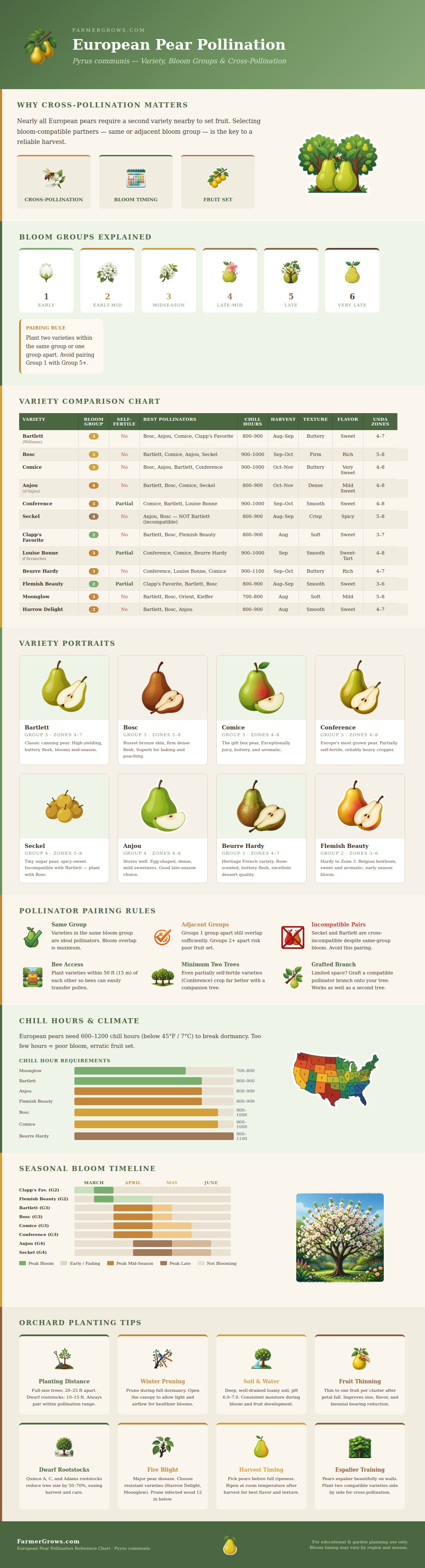
In order to bear most of them, there must be compatible neighbor nearby. A glance at the chart (above) makes that obvious, along with how important it is to get both variety and bloom timing right. Without a match in the bloom department, even the bees won’t save you.
Why Pears Need Help to Grow Fruit
Bloom groups help make what might otherwise become a season-long guessing game more simple. One variety blooms earliest in spring (Group 1), and another variety flowers latest (Group 6). Simple: You want to pair varieties that will be on schedule together, which means they need to be in the same group or one group apart. Early followed by late doesn’t work, as there’s no overlap in their schedule. That’s when the visual timeline makes it obvious where the overlap is. And therefore why Bartlett and Bosc would work nicely together.
Seckel frequently falls through the cracks. Except if it’s paired carefuly with the right companion.
Even when varieties have the same bloom time, they aren’t necessarily compatible. There are genetic oddities, some pairings that fail, no matter how much timing is right. For instance, Bartlett doesn’t pair with Seckel even though both has the same bloom time. That is a common misconception. Being close in timing isn’t the same thing as being a good partner. To find out which other variety will partner up, look at the individual plant varieties’ pollinator recommendations. However, not every pair are a sure thing.
One variety, Conference, is actualy partially self-fertile, and thus a safety net, especially if you’re planting in a small garden and don’t have room for everything else.
The climate also matters here. To break dormancy, these trees needs what is called “chill hours.” If you don’t have enough winter-time cold, their buds may not be well developed. The result is poor fruit set and erratic bloom. Moonglow is more adaptable to slightly warmer climates (it has lower chill hour requirements) different than Beurre Hardy. Avoid disappointment by knowing what’s required in your location, and cross-checking that with the variety itself. It is a little logistical check, but it will save you years of frustration.
Next up: Soil and care, followed by pruning during dormancy: Pears require fertile, loamy, well-drained soil with a neutral pH. Avoid soggy spots; too much water or too little water are both bad. Moisture should be steady around bloom time (to support fruit set), though excess rain can dilute pollen. Beware of rain during bloom, too, which promotes fungal problems, so seek out varieties with some resistance to diseases such as fire blight, like Harrow Delight does.
Resilient stock? It’s all about livig in an increasingly unpredictable climate. Open up the canopy by pruning in full dormancy. This helps promote good air circulation (prevents disease) and light penetration (improves fruit quality). Prune out any crowded/crossed-up branches or other growth that appears weak.
A subtle moment: With pears, which don’t ripen on the tree, harvest time can be tricky; they bruise easily and become mealy if left too long. The best time to pick them is when the fruit is just barely starting to give slightly to gentle pressure, yet is still firm. Let ripen at room temperature, where it will also soften. It is better than waiting for a change in color outside.
Pears are the european type of fruit that need some advance thought and also a lot of patience. They’re not like just putting in a tree, it’s more like you’re setting up a system. Make sure you choose varieties that work well together, that suit your location, and keep things on track by treating them similarily all along. But the result is worth it.
There’s nothing quite like a good homegrown Comice, or any other kind of pear, for its sweetness and juiciness. It is even better when you know where it came from. Why do gardeners come back to fruit again and again? It’s because there’s such satisfaction in seeing how careful planning pays off with something so delicious.