Pumpkin Growth Time Calculator
Estimate pumpkin harvest timing from variety, planting date, USDA zone, soil warmth, vine spacing, fruit class, watering, and first frost pressure.
Use the result as a planning estimate. Pumpkin maturity still depends on seed source, pollination timing, vine health, disease pressure, and the actual weather your patch receives.
Pumpkin Harvest Timing
The estimate combines base maturity days with soil warmth, water consistency, spacing pressure, and frost timing.
| Variety preset | Fruit class | Typical days | Suggested spacing | Best use |
|---|---|---|---|---|
| Jack Be Little | Mini | 95 days | 2 to 3 ft | Decorative, trellis, small gardens |
| Baby Boo | Mini white | 95 days | 2 to 3 ft | Decorative white pumpkins |
| Small Sugar | Small pie | 100 days | 3 to 4 ft | Baking and compact patches |
| Casperita | Small white | 90 days | 3 to 4 ft | Short season edible ornamentals |
| Howden | Medium carving | 110 days | 4 to 5 ft | Classic jack-o'-lanterns |
| Dill's Atlantic Giant | Giant | 130 days | 8 to 12 ft | Exhibition fruit and long seasons |
| Soil temperature | Expected emergence | Calendar adjustment | Patch note |
|---|---|---|---|
| Below 60°F | Slow or uneven | Add 10 days | Wait or warm the row before direct seeding |
| 60 to 64°F | 7 to 12 days | Add 6 days | Acceptable but not fast |
| 65 to 69°F | 5 to 8 days | Add 3 days | Good early-season target |
| 70 to 85°F | 4 to 6 days | No delay | Best balance for quick emergence |
| Over 90°F | Heat stress possible | Add 4 days | Shade, mulch, and water evenly |
| Fruit size class | Vine spacing | Row spacing | Fruits per plant | Timing note |
|---|---|---|---|---|
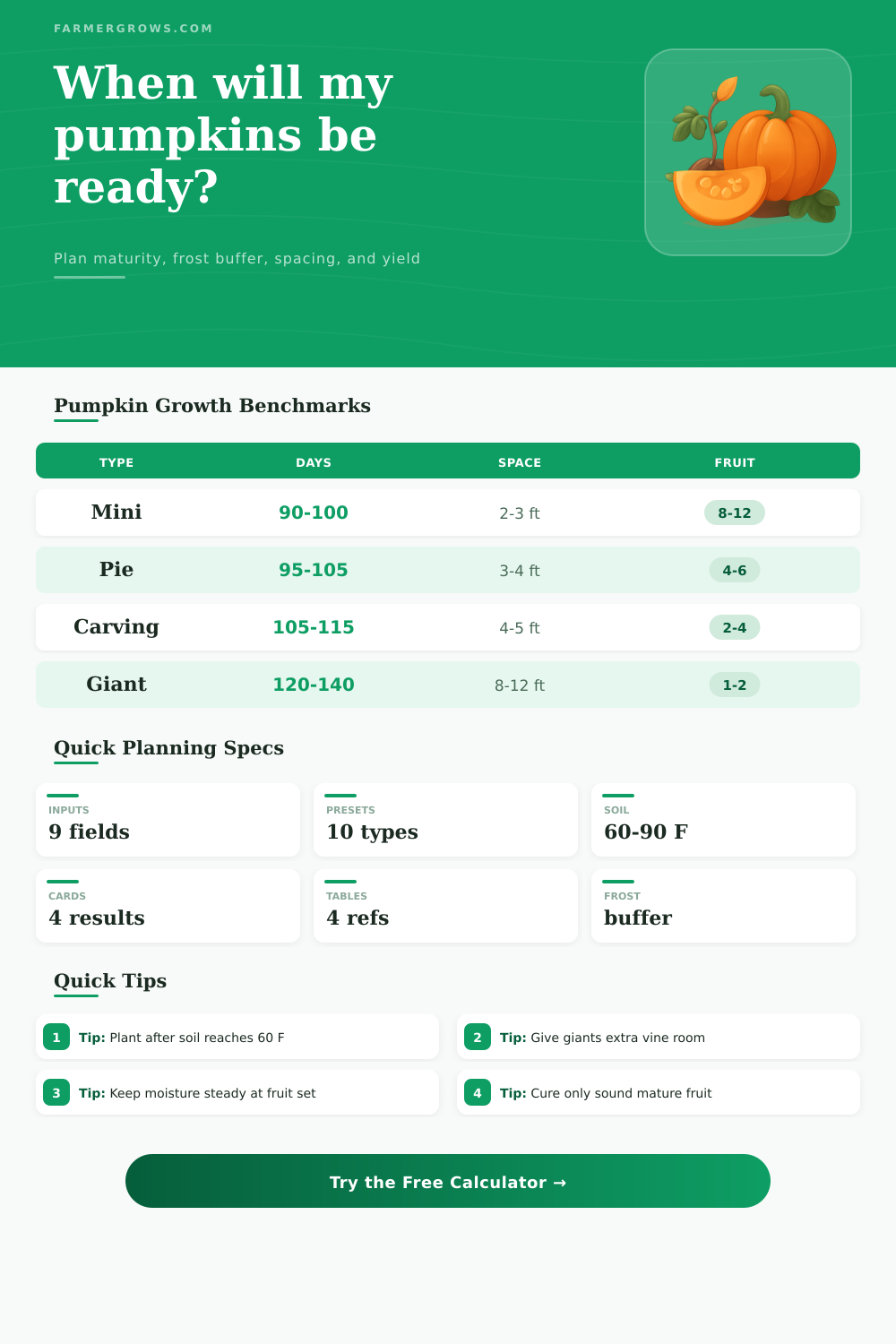
| Mini | 2 to 3 ft | 4 to 6 ft | 8 to 12 | Often earliest to finish |
| Small pie | 3 to 4 ft | 5 to 6 ft | 4 to 6 | Good for short to moderate seasons |
| Medium carving | 4 to 5 ft | 6 to 8 ft | 2 to 4 | Needs full summer growth |
| Large field | 5 to 8 ft | 8 to 10 ft | 1 to 3 | Thin fruit for uniform size |
| Giant | 8 to 12 ft | 10 to 15 ft | 1 to 2 | Best started early under cover |
| Maturity group | Days to maturity | Likely yield | Harvest sign | Storage tendency |
|---|---|---|---|---|
| Fast mini | 90 to 100 | 8 to 12 fruit | Full color, hard rind | Moderate if cured well |
| Pie pumpkin | 95 to 105 | 4 to 6 fruit | Deep color, dry stem | Good for kitchen use |
| Carving type | 105 to 115 | 2 to 4 fruit | Dull rind, corky handle | Best used within season |
| Heirloom large | 110 to 125 | 1 to 3 fruit | Color settled, rind firm | Often good when cured |
| Giant type | 120 to 140 | 1 to 2 fruit | Growth slows, stem hardens | Usually grown for size |
For short seasons: Choose mini or pie varieties, transplant after nights are settled, and keep a frost cover ready for the first two weeks outdoors.
For better harvest estimates: Recalculate after fruit set. Pumpkins that pollinate late often need more time than the seed packet maturity number suggests.
How to get the timing right on pumpkins? It is partly up to chance, like whether I got the timing right on my pumpkins. It’s also partly about knowing what happens in the real world when they grows.
The initial day count are based off the seed packet, which assumes perfect conditions, a constant supply of water, good soil, and adequate space for plant to stretch their way out into the garden. A few weeks’ delay due to late frost or other weather (dry spells, cool soil) means adding a week (or even two) to the calendar. The pumpkin growth time calculator does that math for you, if you plug in some info about where you’re growing it and when you planteded.
How to Choose When to Plant Pumpkins
The variables are all simple: Soil temperature is the one most folks miss, as pumpkins don’t want to dawdle to get going. Below the mid-sixties, they takes longer to emerge. If your reading was on the cool side, the calculator will adds on a bit of time. It’s better to wait another week then rush into chilly soil.
Spacing also matter. Tightly planted vines compete for water and light, so the calculator knows that closer spacing mean more time before harvest, while wider spacing may actualy speed things up because there is less stress and fewer delays.
Once there are flowers, it’s not so much how much water they get, but whether conditions is consistent. Fruit will swell with a steady inch (or maybe two) a week. However, if conditions swing between bone dry and sodden, that slows things down and can even cause fewer usable pumpkin per plant. Note that the calculator doesn’t think of watering as an on-off deal. Instead, it focuses on adjusting factors. You might find that a little extra from drip irrigation save a few days here and there, but that inconsistency adds time back in. When you’re already pushing up against your frost date, those little changes adds up.
These aren’t hard-and-fast rules, just some tables on the page to do a snap check of sanity. If you’re trying to choose between a small pie-type pumpkin, a bigger one meant for carving, or another variety, these tables shows roughly how much fruit to expect in each class. They also show what their space needs will be.
The frost buffer calculation is the number that always shocks growers. This will tell you how many days are between when you think your earliest ripe fruits might come, and the day (on average) the first frost hits. That is a clue for when to use row cover. It helps you decide whether to plant something else earlier or just be OK with picking green-shouldered pumpkins if the weather turns chilly early.
Seed-company testing are not always ideal. In real gardens, rain can delay pollination. Disease can slow the vines’ growth. One heat wave can stalls the fruit set for days. No calculator can account for all these microclimate events, but it do make you think about the big levers within your own control.
Run through a couple of scenarios, and you begin to see a pattern: Faster-growing mini or pie types tend to fit short-season sites; bigger fruit needs a longer season, but with some breathing room for the vines. You’re never going to get perfect predictions, but you can get a workable window…to keep the frost from sneaking in first, as we often discover too late.
You should of checked sooner.